

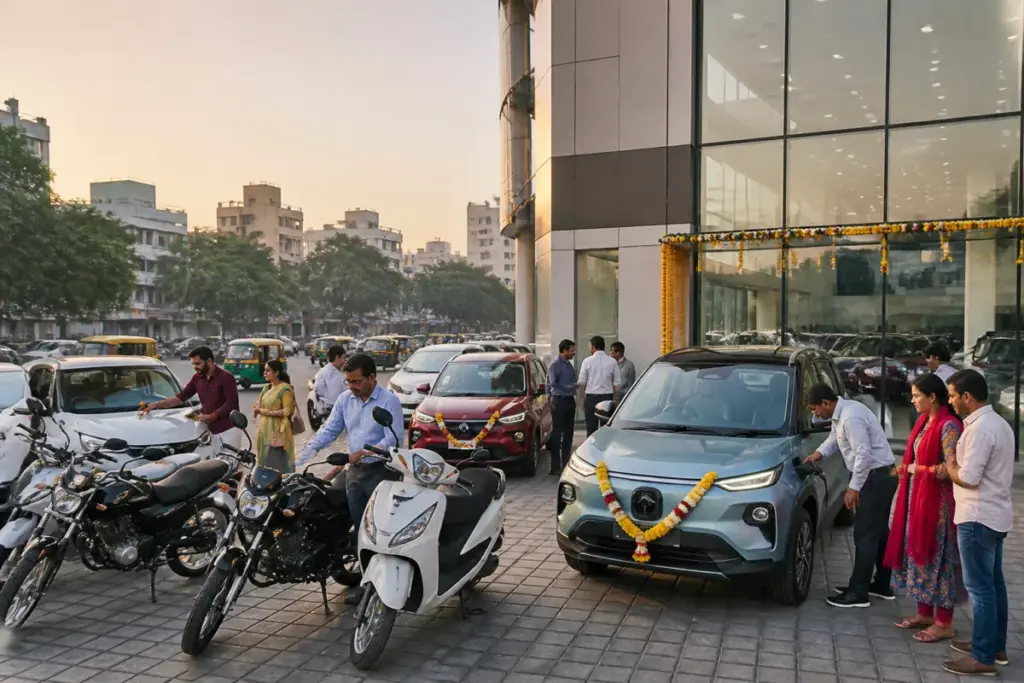
Gujarat’s festive vehicle sales point to a mobility market expanding at two speeds: mass-market two-wheelers and cars continue to dominate household purchases, while luxury vehicles and electric models are gaining visibility in the state’s major cities. Figures reported for Navratri and Dussehra show strong demand in Ahmedabad and Surat, a mixed outcome in Rajkot, and substantial premium-car deliveries in Vadodara.
The numbers matter because vehicle sales are not only a measure of consumer sentiment. They also indicate how urban residents are moving, what kinds of vehicles are entering city streets, and how quickly the cost and technology profile of private mobility is changing. The reported sales do not establish a statewide trend on their own, but they provide a detailed snapshot of how festive purchasing is shaping the urban transport landscape.
The Federation of Automobile Dealers Associations, or FADA, was cited as saying that around 11,000 cars and 50,000 two-wheelers were sold across Gujarat on Dussehra. FADA Gujarat chairman Pranav Shah told Divya Bhaskar that vehicle purchases during the festival period were showing growth of approximately 8% to 10% compared with the previous year’s Navratri and Dussehra period. He described the festival as an important buying occasion when customers often prefer to take delivery on an auspicious day.
Ahmedabad formed a significant part of this reported activity. The city recorded approximately 6,000 to 6,500 two-wheeler deliveries and between 2,500 and 3,000 car deliveries during the period cited in the report. The figures include conventional vehicles as well as electric vehicles, suggesting that the festive market is expanding without a single technology replacing the others immediately.
That distinction is important. The reported data does not show a clean shift away from petrol and diesel vehicles. Instead, it shows a layered market in which established internal-combustion models remain the largest part of demand, while EVs are becoming more visible in both mainstream and premium categories. The report states that buyers in Gujarat were purchasing electric vehicles alongside petrol and diesel models, but it does not provide a consolidated statewide EV share for the single-day sales.
The strongest evidence of premiumisation comes from the luxury segment. In Ahmedabad, an Audi dealer told the publication that an Audi sports model starting at approximately ₹2.5 crore was sold during the first day of Navratri, while two sports cars priced at around ₹2.5 crore and ₹3.5 crore were sent to Surat on Dussehra. The dealer also said that both the new and previous Audi Q3 models were among the strongest sellers and that sales were approximately double the level of the previous year.
Surat’s registration data gives a more structured view of the festive period. The city recorded 9,888 new vehicle registrations during the nine days of Navratri, according to the report. That translates to an average of more than 1,000 new vehicles entering the city’s roads each day. Two-wheelers accounted for 7,594 registrations, or more than 76% of the total. Honda led this category with 3,562 vehicles, followed by TVS with 1,190 and Hero MotoCorp with 1,179.
The Surat numbers underline the continuing centrality of two-wheelers to urban mobility. Motorcycles and scooters remain the most accessible form of private transport for many households because they require less road space and generally have a lower purchase cost than cars. The data also shows that a large number of new vehicles can be added to a city’s road network within a short period, even when public transport capacity and road space are not discussed in the sales figures.
Cars represented a smaller but economically significant part of Surat’s registrations. The city recorded 1,495 new private cars in the light motor vehicle category during Navratri. Maruti Suzuki led with 407 cars, followed by Hyundai with 233, Tata Motors with 216, Kia with 201 and Mahindra with 111. Commercial vehicles, three-wheelers and goods carriers accounted for another 799 registrations.
The EV figures from Surat provide a useful indicator of the market’s direction, although not yet of its dominance. The city registered 696 pure electric vehicles during the nine-day period, including 509 electric two-wheelers and 173 electric cars. Tata, MG, Mahindra and Tesla models were among the electric cars registered. These figures show that electric mobility is present across different price bands, from electric two-wheelers to premium vehicles, but the report does not establish whether the registrations represent a sustained shift or a seasonal concentration of purchases.
Surat’s premium registrations also reveal how luxury mobility is becoming part of the city’s festive consumption pattern. Fourteen vehicles priced between ₹50 lakh and more than ₹1.5 crore were registered during Navratri. BMW accounted for seven of them, including the X7, 320Ld, X1, electric iX1 and a Mini Countryman. Mercedes-Benz accounted for three, Tesla for three Model Y vehicles and Audi for one Q3. The mix is notable because it combines conventional luxury SUVs and sedans with premium electric vehicles.
Dussehra deliveries added to that premium activity. The report recorded more than 15 Mercedes-Benz cars sold in Surat, including a Mercedes G 63 AMG priced at approximately ₹4.5 crore. BMW sold more than 12 cars, including a BMW M440i xDrive Convertible priced at around ₹1.1 crore. These numbers come from dealership-level reporting and should be read as sales snapshots rather than a complete account of the city’s luxury-car market.
Rajkot presents a different picture. Between 11 and 19 October, 3,068 vehicles worth approximately ₹75.73 crore were sold or registered during Navratri, according to the report. The total was lower than the previous year’s 4,054 vehicles, while reported revenue declined from approximately ₹76.02 crore to ₹75.73 crore. The report attributed the weaker volume to lower rainfall and an economic slowdown, although the supplied material does not independently establish the causes.
Rajkot’s category data shows 2,484 two-wheelers, 455 four-wheelers, 127 three-wheelers, one six-wheeler and one tractor trolley. The city nonetheless recorded strong luxury-car activity, with 16 Mercedes-Benz and 14 Audi vehicles sold during the festival period. An Audi sales manager said three Audi cars were delivered on Dussehra, including two priced at approximately ₹65 lakh and one at ₹1.34 crore. A Maruti Suzuki dealer said around 100 car deliveries were expected on Dussehra, with demand reported for models such as the Ertiga, Victorious and Baleno.
Vadodara’s reported Dussehra deliveries add another layer to the picture. A BMW showroom delivered five cars with a combined estimated value of around ₹5 crore, including a 7 Series vehicle priced at approximately ₹2.16 crore. Two Mercedes-Benz cars were also reported as sold. These high-value transactions are small in volume but significant as indicators of the expanding visibility of premium consumption in Gujarat’s urban centres.
Taken together, the figures reveal three simultaneous processes. First, two-wheelers remain the foundation of urban vehicle demand, especially in cities such as Surat and Rajkot. Second, car ownership continues to expand, with mass-market manufacturers accounting for the largest volumes. Third, the premium segment is growing in visibility, and luxury EVs are appearing alongside conventional high-end vehicles.
The institutional significance lies in what happens after the sale. Vehicle dealerships, manufacturers and buyers experience the festival as a commercial opportunity, while municipal authorities and transport agencies must eventually manage the consequences of every new registration: demand for road space, parking, charging infrastructure, traffic management and enforcement. The source report does not provide data on these systems, so it cannot establish whether local infrastructure is keeping pace with registrations. It does, however, show the scale at which new vehicles can enter urban markets within days.
The EV data also highlights the difference between adoption and transition. Surat’s 696 electric registrations during Navratri, including 173 electric cars, demonstrate a visible market for battery-powered vehicles. Yet the overall registration profile remains dominated by two-wheelers and conventional cars. The reported presence of Tesla, BMW iX1 and other premium electric models suggests that EV adoption is not restricted to cost-conscious buyers, but the supplied evidence does not indicate how many charging points are available or how frequently these vehicles are used.
Gujarat’s festive vehicle market therefore cannot be read simply as a sales success story. It is a record of changing urban aspirations and a test of city capacity. More vehicles can reflect rising purchasing power, improved access to credit or cultural preferences around auspicious deliveries, but they also increase the need for coordinated decisions on parking, road design, public transport integration and charging networks.
The evidence confirms that private vehicle demand was strong in several Gujarat cities during the reported festival period, while Rajkot recorded lower overall volumes than the previous year. It also confirms that luxury and electric vehicles are gaining a larger place in the public profile of urban mobility. What remains uncertain is whether the reported festive surge will continue beyond the buying season and how city authorities will absorb the additional vehicles. Future registration data, EV usage figures and infrastructure capacity will determine whether this was a temporary sales spike or part of a deeper change in Gujarat’s urban transport system.


