

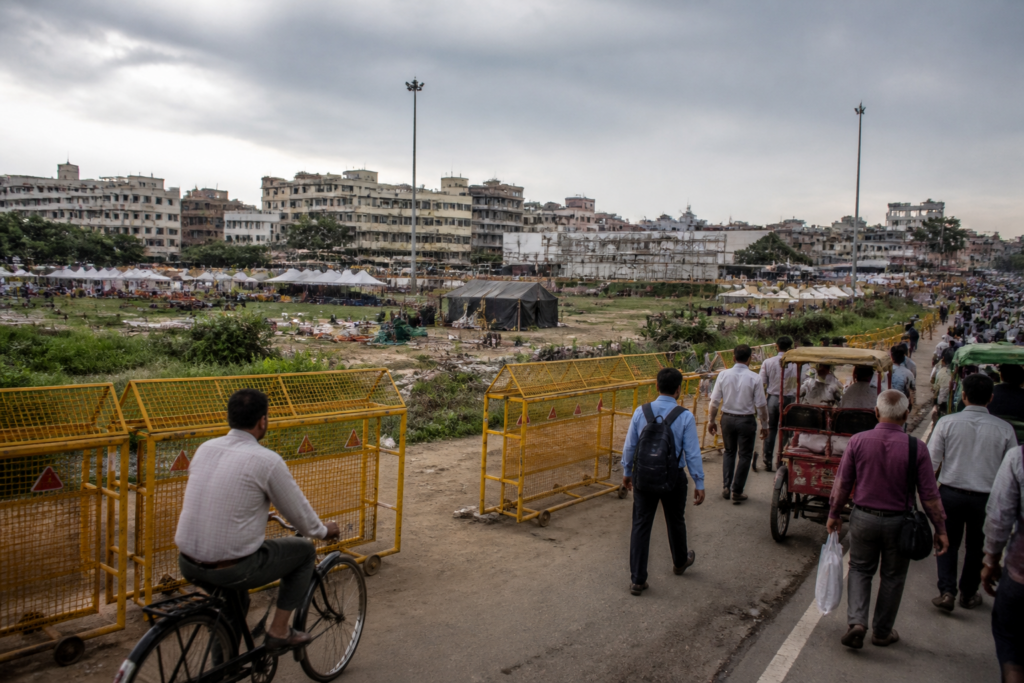
Delhi’s three alternative protest sites reveal a problem larger than the closure of Jantar Mantar: designating land for demonstrations does not, by itself, create a functioning public forum. The sites at CBD Ground in Shahdara, Ramlila Maidan and Burari raise immediate questions about maintenance, bookings, road access, distance from the city centre and the livelihoods that depend on everyday movement around them.
The Delhi Police allotted the three grounds after Jantar Mantar was denotified as a designated protest site. The shift moved the city’s protest infrastructure away from a familiar central location and towards spaces with very different physical and administrative conditions. The Indian Express’s on-ground reporting found that each alternative site faces a distinct constraint: CBD Ground appeared poorly maintained and was already booked for Ramlila events; Ramlila Maidan is accessible but sits within a dense traffic and livelihood network; and Burari Ground is large but distant and difficult to locate.
That contrast matters because a protest site is not simply an empty plot. It is part of an urban system involving public transport, pedestrian access, police deployment, traffic diversions, commercial activity, nearby housing and the ability of citizens to attend or observe a demonstration. A ground that is legally available but inaccessible, poorly maintained or already occupied may satisfy an administrative designation while failing as a practical civic space.
CBD Ground in Shahdara illustrates the gap between handover and operational readiness. Tall grass, bushes and waste were reported along large stretches of the ground. An official of Shanghai Tunnelling Project Engineering Co, a third-party company that worked for the National Capital Region Transport Corporation, said the site was clean and well maintained when it was handed over to the Delhi Development Authority. The official attributed its current condition to a lack of maintenance by the DDA.
The report does not establish the precise maintenance responsibility or the terms under which the site was handed over. The DDA declined to comment on the booking process for CBD Ground. That silence leaves an important administrative question unresolved: which agency is responsible for ensuring that a designated protest site remains usable between events, and what standards determine whether it is ready for large gatherings?
The site’s physical condition is only one difficulty. Preparations for Ramlila events were underway at CBD Ground, and an organiser said three events were drawing nearly 5,000 people a day. The venue was booked until the following month, making it unlikely that protests could be held there during that period. Nearby malls, wedding halls and a village could add to congestion if large numbers of protesters arrived, the organiser said.
This points to a recurring urban governance problem: land may be assigned to multiple public purposes without a clear hierarchy or transparent scheduling system. A ground used for religious or cultural events, policing operations, recreation and political assembly requires a booking framework that can manage competing claims. If the space is formally designated for protests but practically unavailable during periods of high demand, the designation becomes conditional rather than dependable.
Ramlila Maidan presents the opposite challenge. It is around four kilometres from Jantar Mantar, making it the closest of the three alternative sites, and it has a long history of hosting major agitations. A contractor who has worked in the area for 20 years recalled protests including the 1975 rally against Indira Gandhi, Anna Hazare’s anti-corruption movement, the anti-CAA protests and the farmers’ protest. His account suggests that the area’s residents and shopkeepers are familiar with the disruptions and routines associated with large demonstrations.
Familiarity, however, does not eliminate the cost of disruption. A rickshaw driver who has worked in the area for 15 years said road closures could reduce rides and affect his ability to earn a living. Local residents also raised concerns that diversions and blocked roads could affect people whose income depends on daily traffic. For these workers, a protest is not an abstract exercise of democratic rights or a temporary police-management problem. It can directly change the number of passengers, customers and vehicles moving through the area.
The administrative process for booking Ramlila Maidan, which is under the Municipal Corporation of Delhi, requires an application to the zonal office, details of the reason for the protest, a police no-objection certificate and a security amount of Rs 5,000. MCD officials said the ground was next available for booking between December 29 and 31 of that year. The process indicates that access is mediated through municipal and police permissions, but the supplied report does not clarify how applications are prioritised when a site is already booked or when a protest could affect surrounding businesses and transport.
Burari Ground exposes a different weakness: distance and visibility. Located around 14 kilometres from Jantar Mantar, it is the farthest of the three alternatives. The entry point was difficult to find, much of the area was fenced, and the visible blue gate was surrounded by construction debris and mounds of sand. Inside, the athletic track appeared worn out, with stagnant water in several places, while discarded Ganesh idols lay at one end.
The ground is used by local residents for jogging, cricket and learning to ride scooters and motorcycles. Residents said its size could allow protests to take place alongside everyday activities. Yet they also questioned whether people from elsewhere in Delhi would travel that far to hold or attend a demonstration. That question goes to the civic function of protest spaces: a venue must not only contain a crowd but also connect organisers, participants, journalists, observers and affected citizens.
Distance changes who can participate. A central site near established transport routes can be reached by a wider range of people and is more visible to the public. A peripheral ground may reduce disruption in central commercial areas, but it can also reduce public access and visibility. The report does not provide transport data or attendance comparisons, so it cannot establish how Burari would affect participation. It does, however, document a practical barrier that is often missed when authorities assess land primarily by area and capacity.
The three locations therefore represent three different models of urban compromise. CBD Ground has questions of maintenance, scheduling and surrounding congestion. Ramlila Maidan offers proximity and historical familiarity but creates direct concerns for traffic and street-based livelihoods. Burari has space and the possibility of accommodating large gatherings, but its distance, unclear entry conditions and existing local uses may make it less accessible to citywide movements.
These differences also reveal the fragmented institutional structure behind public-space management. The sites involve the Delhi Police, the Delhi Development Authority and the Municipal Corporation of Delhi, while previous use and handover arrangements involve other public agencies and contractors. The report records a DDA refusal to comment on the booking process for CBD Ground and no clear explanation of how the three sites will be maintained, allocated or coordinated. The result is a system in which responsibility appears distributed, while accountability for usability remains difficult to identify.
A protest site must be evaluated through more than its legal designation. The evidence in the report suggests that at least four operational questions are central: whether the site is maintained; whether it is available when a protest is proposed; whether people can reach it without unreasonable difficulty; and whether police and civic arrangements can manage the impact on surrounding communities. A fifth question concerns livelihoods: how will traffic diversions affect rickshaw drivers, shopkeepers, contractors and other workers whose earnings depend on movement around the site?
The issue is not to eliminate disruption. Public demonstrations necessarily occupy space and can interrupt ordinary urban routines. The institutional task is to make that disruption predictable, proportionate and fairly distributed, while ensuring that the right to assemble is not reduced to access to an unusable or remote ground. The reporting from Ramlila Maidan shows why nearby residents may accept protests as part of the area’s history while still worrying about income. The accounts from Burari show why a large ground may remain functionally distant from the city’s public life.
The immediate evidence does not establish whether the three sites have been formally assessed against common standards, whether a public booking calendar exists, or how authorities will resolve conflicts between protests and other events. It also does not establish whether the reported maintenance conditions are temporary or persistent. Those are significant gaps because the success of the new arrangement will depend less on the announcement of alternative sites than on their regular administration.
Delhi’s replacement protest sites thus raise a larger urban question: can civic rights be supported through spaces that are treated as leftover land, event venues or traffic buffers? The answer will depend on whether authorities treat them as public infrastructure requiring maintenance, access planning and transparent governance. Until those conditions are visible on the ground, the city’s designated protest network will remain a list of locations rather than a reliable civic system.


