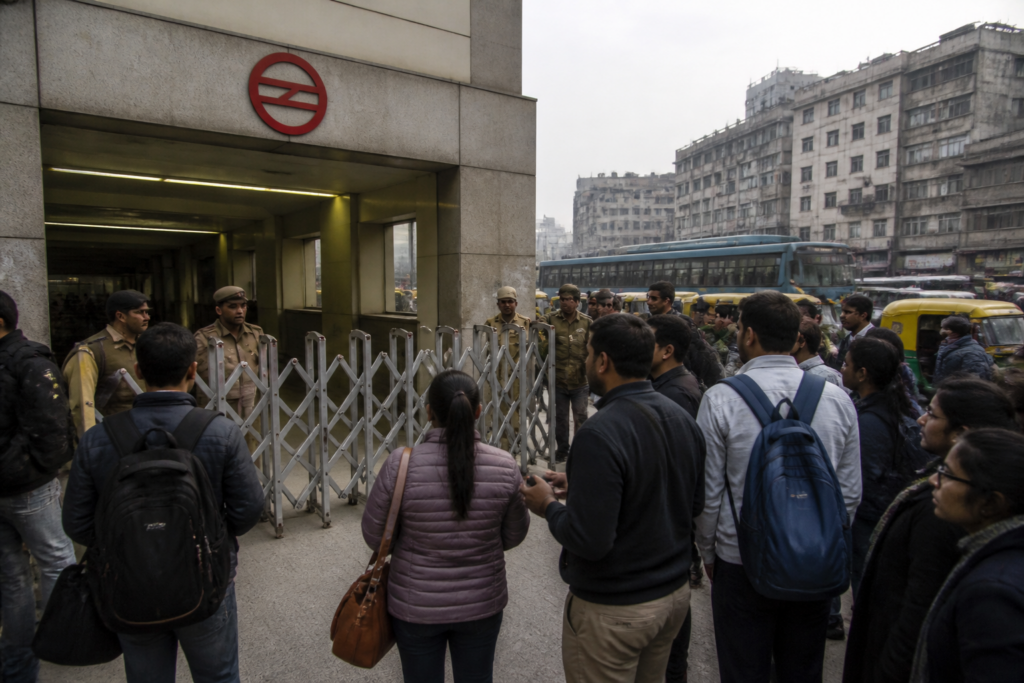
The Delhi Metro remained operational during protests by the Cockroach Janta Party on October 10, but restrictions at dozens of stations sharply reduced access for commuters. The Delhi Metro Rail Corporation’s affidavit to the Supreme Court says 271 trains completed all 4,157 scheduled trips that day, while entry and exit controls affected 45 of the network’s 303 stations. The dispute now before the court is not simply whether trains ran, but whether a Metro system can be treated as fully available when passengers cannot enter or leave key stations.
The affidavit, submitted by DMRC Chairperson D Thara, came in response to a contempt notice issued after the Supreme Court directed the Centre on October 9 to ensure there was no “complete prohibition” on the movement of Metro and other trains entering Delhi on October 10. The court’s direction followed petitions challenging the closure of entry and exit gates at 57 Metro stations. On October 11, the court said the petitioners had made out a prima facie case of contempt and sought a response from DMRC.
DMRC has denied that there was a blanket shutdown. It said restrictions were imposed at the instructions of the Delhi Police, based on the assessment of law-enforcement agencies. It also tendered an “unconditional apology” in its affidavit while maintaining that it had complied with the Supreme Court’s October 9 order “in letter and spirit”.
The distinction made by DMRC is central to the case. The corporation says there was no curtailment or cancellation of train services, no reduction in the total number of train trips and continued operation across more than 85% of the network. However, the petitioners’ challenge focuses on passenger access: whether closing station gates can effectively prevent movement even when trains continue to run through the system.
The figures in the affidavit show both sides of that distinction. DMRC said approximately 32 lakh commuters travelled on the network during operational hours on October 10. That was lower than the approximately 58 lakh passengers recorded on a normal second Saturday, a difference of about 26 lakh journeys. The corporation attributed the reduction to the protests, saying a large number of commuters appeared to have refrained from travelling and, consequently, from carrying out their usual daily activities or attending work and business.
This ridership decline matters because a transport network’s public function is measured not only by the number of trains operated. A train may complete its scheduled trip, but the service is less useful if passengers cannot reach the platform, exit at their destination or change lines at an affected station. In that sense, the affidavit presents an operational definition of continuity, while the contempt proceedings test a passenger-centred definition of access.
DMRC said only 45 stations, or around 15% of the network, were affected after the Supreme Court’s October 9 order. It said the number had been reduced from 57 stations and that all the affected stations were opened by 10 pm on October 10 following directions from the Delhi Police. The corporation also said 258 stations remained fully operational, accessible and functional, while 14 key interchange stations, including Rajiv Chowk, Kashmere Gate, Central Secretariat, Mandi House and Hauz Khas, continued to provide uninterrupted interchange facilities.
The network-wide figures, however, do not fully capture the importance of individual stations. A station can represent a small share of the total network while serving as a local access point, an interchange or a connection to an institutional, commercial or residential area. DMRC’s own affidavit acknowledges that passenger movement at sensitive stations such as GTB Nagar and Vishwavidyalaya was regulated rather than completely stopped. At Vishwavidyalaya, exit gates remained operational, while Gate 3 at GTB Nagar was kept open to facilitate passenger exits.
That arrangement reveals the administrative character of the restrictions. The decision was not presented as a service suspension ordered by DMRC. Instead, the corporation said it acted on police instructions, while attempting to preserve train operations and regulate movement at selected stations. The result was a divided responsibility structure: the police assessed the law-and-order risk, and DMRC implemented restrictions within the transport system.
The affidavit also records a later restriction. DMRC said it received another communication from the Delhi Police on October 12 directing the closure of entry and exit at six stations between 6 am and 4 pm. The restrictions were subsequently extended until 5 pm. The supplied material does not establish the reasons for that later direction, but it shows that station access continued to be managed through police communications after the October 10 episode.
For commuters, this system creates a practical problem of predictability. DMRC said it issued regular updates through its official X, Facebook, Instagram and LinkedIn accounts. Announcements were also made from the Operations Control Centre and by train operators, while advisory signboards were placed at station gates. These measures indicate an effort to communicate restrictions, but they do not remove the disruption caused when access conditions change at specific stations or during defined time windows.
The Supreme Court’s intervention places those operational decisions within a larger governance framework. Metro services are critical urban infrastructure, but their functioning depends on several institutions. The transport operator controls trains, stations and passenger communications. Police authorities assess security conditions and direct access measures. The court, in this case, is examining whether those decisions complied with an order intended to prevent a complete prohibition on Metro movement.
The case therefore raises a question about the meaning of compliance in urban infrastructure. DMRC’s position is that compliance should be assessed through train movement, scheduled trips and the proportion of the network that remained open. The petitioners’ position, as reflected in the contempt proceedings, is that station closures can amount to a much wider restriction even when trains continue operating. The difference is between infrastructure availability in theory and usable access in practice.
The numbers supplied by DMRC do not resolve that difference on their own. The completion of all 4,157 scheduled trips establishes that train operations were maintained. The 32 lakh ridership figure establishes that passenger use was substantially lower than the cited normal Saturday level. The closure or restriction of access at 45 stations establishes that a defined portion of the network was not available in its ordinary form. Each figure describes a different layer of the Metro system, and the legal question is how those layers should be treated together.
The episode also shows why the location of restrictions matters as much as their count. DMRC identified 14 interchange stations that continued to function without interruption, but it separately referred to sensitive stations where passenger movement was regulated. A network can preserve its main interchange structure while still producing significant local disruption for passengers whose origin or destination is an affected station. The supplied material does not provide station-wise ridership or journey data, so the precise distribution of that impact cannot be established from the affidavit alone.
There is also a question of institutional accountability. DMRC says restrictions were imposed on police instructions, while the Supreme Court’s notice was directed at the corporation’s response to the order. This places the operator in the position of implementing directions from another authority while defending its own compliance before the court. The affidavit’s unconditional apology acknowledges the seriousness of the proceedings, even as its operational data contests the allegation of a blanket shutdown.
The case’s wider urban significance lies in how cities manage essential networks during public demonstrations. A Metro system is not only a collection of moving trains. It is a chain of stations, gates, interchanges, announcements and passenger decisions. Restricting one part of that chain can change how the whole service is experienced, even when the timetable remains intact. The Delhi proceedings make that distinction visible through a concrete conflict between police instructions, transport operations, commuter access and judicial oversight.
What the court ultimately decides will determine how the October 10 restrictions are characterised in relation to its October 9 direction. The available evidence confirms that trains operated, scheduled trips were completed, many stations remained accessible and some stations had entry and exit restrictions. It also confirms a substantial fall in ridership and continuing police-directed restrictions at six stations on October 12. The unresolved issue is whether operational continuity can satisfy a judicial direction against a complete prohibition when passenger access is selectively curtailed. That question remains central to the contempt proceedings.