

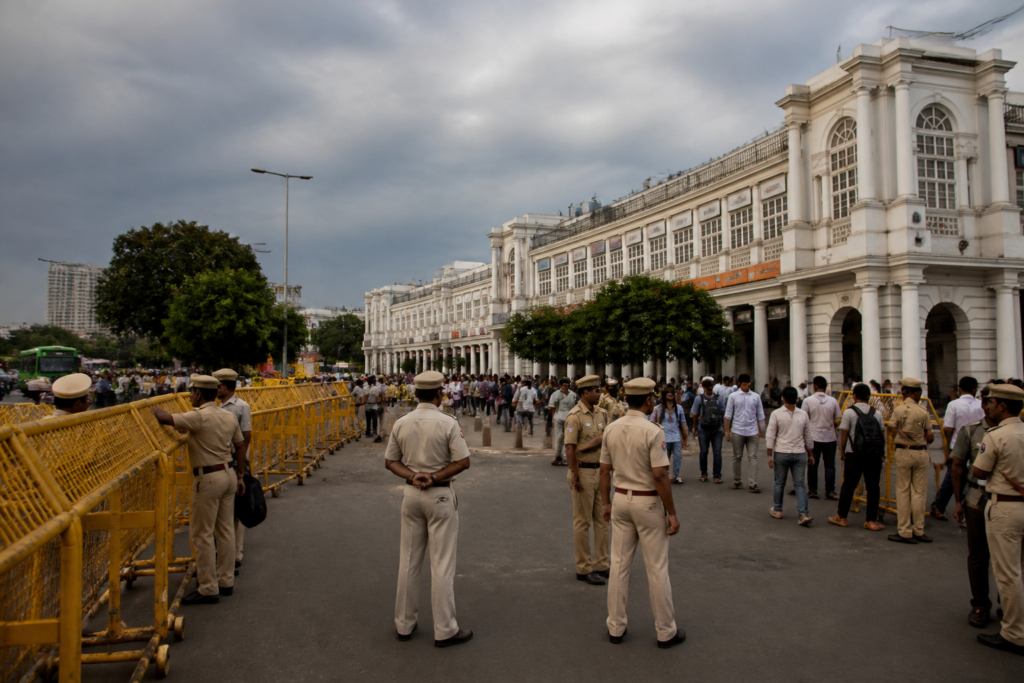
The Delhi Tiranga march called by the Cockroach Janta Party (CJP) and the All India Students’ Association (AISA) faced heightened security in the capital on Friday, with police serving CJP founder Abhijeet Dipke a notice against holding the protest and installing multiple barricades around Connaught Place.
The march was scheduled to begin at 5 pm at Central Park in Connaught Place. Police were also monitoring the movements of CJP and AISA members who called the event. The security measures were intended to prevent protesters from entering the premises, according to the report.
Hours before the march, a Delhi Police team reached the Karol Bagh house where Dipke was staying to serve him the notice. The house is owned by Anish Gawande, a spokesperson for the Nationalist Congress Party (Sharadchandra Pawar). Dipke had earlier alleged that police personnel had been deployed around the property on Rani Jhansi Road.
Gawande said the police presence around his residence had increased over the previous few days, particularly before the march. “It is frankly quite amusing to see the extent of police deployment outside and around my house over the last few days, especially in the hours before the Tiranga March,” he told The Indian Express. He questioned whether such a force could have been better used to protect women and reduce crime in Delhi.
A senior Delhi Police officer, however, said the force was keeping watch on the situation but denied that any specific arrangement had been made outside the house of a resident. The officer did not indicate the number of personnel deployed or provide details of the notice served to Dipke.
At a media briefing on Thursday evening, Dipke and CJP legal head Ratna Singh alleged that police and intelligence officials had been deployed around their residence and were following their movements. Dipke said the organisations had called for a protest and planned to unfurl the Tricolour peacefully at Connaught Place, describing it as a fundamental right.
Dipke also referred to an earlier protest call on October 10 and alleged that authorities had brought Delhi to a standstill and called in forces from Jammu and Kashmir. These allegations were not independently confirmed in the report. The police officer’s statement only confirmed that authorities were monitoring the situation and had made security arrangements around Connaught Place.
The organisers said the march was linked to their demand to wave and unfurl the national flag at Connaught Place. Dipke and Singh invoked the political and constitutional traditions associated with Mahatma Gandhi and B R Ambedkar while stating that the event would be peaceful.
For the city, the immediate operational issue was the deployment of barricades and monitoring around one of central Delhi’s busiest commercial and public spaces. The police arrangements could affect access to Central Park and movement through the inner circle during the scheduled protest. The report did not provide details of traffic diversions, road closures or the duration of the restrictions.
The march and the police response were taking place amid a dispute over whether the organisers could hold the event at Connaught Place. Police had served the notice before the scheduled start and said they were watching the situation, while organisers maintained that they intended to proceed peacefully. Further action was expected around the 5 pm march at Central Park.


