

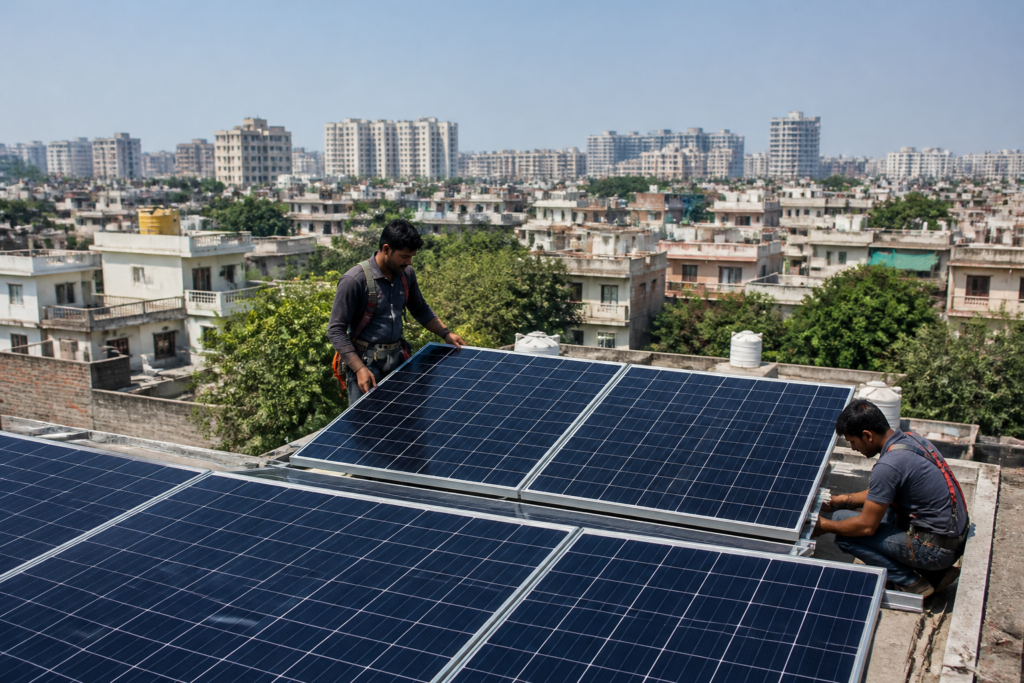
Delhi’s rooftop solar scheme has received 77,614 household registrations in just over three weeks, taking the city past one-third of its target to install 2.3 lakh solar power units by March 31 next year, officials said on Wednesday.
The registrations have come through the scheme’s portal since September 21. The response is a sharp increase over Delhi’s earlier pace of rooftop solar adoption. Before the scheme was launched, BSES and Tata Power had together installed 29,718 solar connections with a combined capacity of 472 MWp.
BSES Yamuna Power Limited, which serves East and Central Delhi, recorded the highest number of applications at 27,197. Tata Power Delhi Distribution Limited, serving North and Northwest Delhi, received 26,788 applications, while BSES Rajdhani Power Limited, which covers South and West Delhi, recorded 23,925 registrations.
Delhi Power Minister Ashish Sood said the response from rural areas and unauthorised colonies indicated growing interest in rooftop solar installations. He described the response as evidence of citizen trust and enthusiasm for the programme.
The scheme is designed to reduce the upfront cost that has historically limited household adoption. Under the Pradhan Mantri Surya Ghar: Muft Bijli Yojana, the Centre provides a subsidy of up to Rs 78,000 for rooftop solar systems of up to 3 kW. The Delhi government has announced an additional subsidy of up to Rs 78,000 for eligible consumers, taking the combined subsidy to Rs 1.56 lakh and making installation almost free of cost for qualifying households.
The policy also provides support for group housing societies. The Delhi government has increased its subsidy for rooftop solar systems serving common facilities from Rs 2,000 to Rs 11,000 per kW, with support available up to a capacity of 500 kW. Eligible installations can also receive central assistance of Rs 18,000 per kW.
Officials have identified several reasons for the slow adoption of rooftop solar in Delhi before the new scheme. Households consuming up to 200 units a month receive free electricity, which can reduce the immediate financial incentive to make a solar investment. The high initial installation cost and the difficulty of securing agreement among residents in group housing societies have also affected uptake.
Consumers who install eligible systems can reduce their electricity bills and sell surplus power to distribution companies, subject to applicable rules. The scheme therefore links household-level generation with the existing electricity distribution system, although the source report does not provide a breakdown of how many registrations have progressed to approved installations or commissioned units.
Delhi had around 73 lakh electricity consumers in 2024-25, including approximately 61 lakh domestic consumers. Nearly 48 lakh households received electricity subsidies, either through free power for consumption of up to 200 units a month or a 50 per cent subsidy for consumption between 201 and 400 units.
The next measure of the scheme’s performance will be the conversion of registrations into installed and operational rooftop systems. The government’s stated target is to install 2.3 lakh solar power units in the city by March 31 next year.


