

Delhi’s new protest sites are exposing a problem that goes beyond where demonstrations are permitted. The three grounds designated after Jantar Mantar was denotified are not operating as a coordinated public system: one is covered by overgrowth and waste, another is occupied by a booked Ramlila event, and the third is difficult to access and poorly maintained. The result is a clash between the administrative need to regulate protests and the everyday needs of residents, commuters, workers and other users of public land.
The locations are CBD Ground in Shahdara, Ramlila Maidan and Burari Ground. Delhi Police allotted them as alternative protest venues, but the Indian Express report found that their readiness, accessibility and relationship with surrounding neighbourhoods vary sharply. That variation matters because a protest site is not simply an empty parcel where people can assemble. It requires maintenance, crowd management, transport access, traffic planning, clear booking rules and a predictable relationship with nearby businesses and residents.
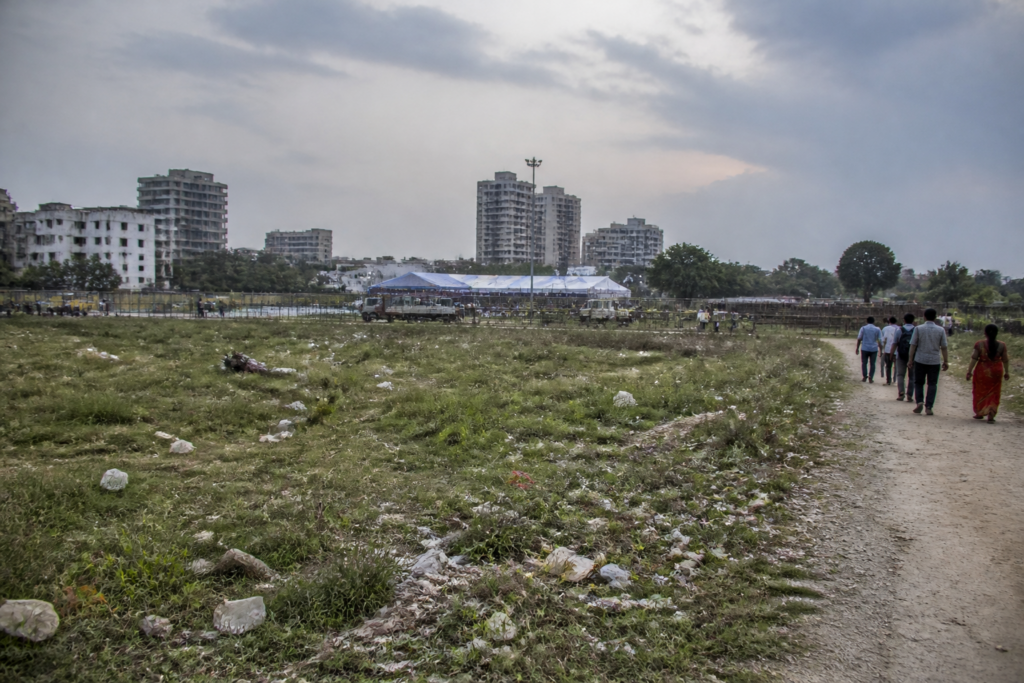
The condition of CBD Ground illustrates the first weakness: the gap between handing over land and keeping it usable. Large stretches of the ground were covered by tall grass and bushes, while waste had accumulated along the edges. Preparations for Ramlila events were also under way. An official of Shanghai Tunnelling Project Engineering Co, a third-party company that worked for the National Capital Region Transport Corporation, said the ground was clean and well maintained when it was handed over to the Delhi Development Authority. The official attributed its present condition to a lack of maintenance by the DDA.
The account points to an institutional question that is often missed in debates over protest regulation: who is responsible for maintaining a designated public facility between major events? The report does not establish the full terms of the handover or the maintenance arrangement, and the DDA declined to comment on the booking process for CBD Ground. But the visible condition of the site suggests that designation alone has not created an operational facility. A ground can be legally available on paper while remaining practically unusable because of waste, vegetation, construction material or competing bookings.
CBD Ground also shows how the choice of a protest venue can create new traffic pressures. The site is around 12 km from Jantar Mantar and lies in a commercial area near malls, wedding halls and a village. An official warned that protests and police barricades could disrupt traffic and inconvenience residents and commuters. An organiser said three Ramlila events were under way and attracting nearly 5,000 people each day, with the venue booked until the following month. If those bookings continue, the ground’s designation as an alternative protest venue does not by itself guarantee that protesters can use it when required.
This is a land-use conflict rather than a simple scheduling inconvenience. The same site is expected to support religious and cultural events, crowd-intensive public gatherings and the administrative requirements of protest policing. Each use has different needs. Ramlila events bring stages, stalls, a ferris wheel and large daily footfall. Protests may require assembly space, police barricades, access routes and traffic diversions. Without a publicly clear calendar and operating protocol, the conflict is likely to be resolved informally, leaving organisers and local users uncertain about access.
Ramlila Maidan presents a different balance of advantages and risks. At around 4 km from Jantar Mantar, it is the closest of the three alternative sites and has a long history of hosting major agitations. A local contractor, Om Bhansal, said the ground had hosted the 1975 rally against Indira Gandhi, Anna Hazare’s anti-corruption movement, the anti-CAA protests and the farmers’ protest. His account suggests that the surrounding area has an established relationship with large public gatherings.
That history, however, does not mean that disruption is evenly distributed. Gyan Singh, a rickshaw driver who has worked in the area for 15 years, said road closures could reduce rides and affect his ability to earn a living. Local residents also raised concerns about diversions and the effect of protests on people whose income depends on daily traffic. The ground’s proximity makes it more reachable for protesters and visitors, but that same proximity can intensify pressure on roads, informal transport and nearby commerce.
The booking system at Ramlila Maidan shows how access is mediated through municipal procedure. The ground is under the Municipal Corporation of Delhi. Applicants must approach the zonal office, state the reason for the protest, obtain a police no-objection certificate and pay Rs 5,000 as a security amount. MCD officials said the ground was next available for booking between December 29 and 31 of that year. The process establishes a formal route, but the report also raises a broader issue: whether a booking procedure designed for ordinary events can respond to protests whose timing may be linked to sudden political, legal or administrative developments.
Burari Ground exposes the opposite problem. The site is large but distant, located around 14 km from Jantar Mantar, and its entry point was difficult to find. Much of it was fenced, the visible blue gate was surrounded by construction debris and mounds of sand, and the athletic track appeared worn, with stagnant water in several places. Discarded Ganesh idols were also seen at one end. Everyday activity was concentrated in a small section, where people practised riding scooters and motorcycles and children played cricket.
The site’s distance and condition raise a question about whether a venue can be considered accessible merely because it has enough physical space. Residents who use the ground for jogging, recreation and driving practice said it could accommodate a protest while retaining space for ordinary activities. But one resident also asked who would travel that far from the city to hold or attend a protest. That question goes to the civic function of protest spaces. A site that is difficult to reach may reduce inconvenience in central areas, but it can also reduce public visibility and participation.
The three sites therefore represent three different forms of urban trade-off. CBD Ground appears to face maintenance failure and competing bookings. Ramlila Maidan offers centrality and historical familiarity but carries a clear risk of road closures and lost earnings for workers dependent on traffic. Burari Ground provides space but raises concerns about distance, entry, maintenance and public reach. None of these problems can be solved by relocation alone because each reflects a different part of the city’s infrastructure and governance system.
The report also reveals a fragmented chain of responsibility. Delhi Police allotted the alternative sites, the DDA maintains or controls at least some of the grounds, MCD administers Ramlila Maidan, and event organisers and local users occupy or depend on the same public spaces. The NCRTC-linked contractor’s account adds another layer by describing the condition of CBD Ground at the point of handover. Yet the available information does not show a single authority publicly explaining how the three venues will be maintained, scheduled, inspected and prepared for protests.
That institutional gap is important because public assembly requires more than permission. It requires a functioning site, a traffic plan, sanitation, safe access, crowd management and clarity about competing users. When any of those elements is absent, the costs move elsewhere: to commuters facing diversions, residents negotiating blocked streets, informal workers losing rides and organisers travelling to locations that may not be practical.
The evidence also complicates the assumption that centralisation is the only problem. Jantar Mantar was a recognisable and accessible protest location. The replacement model distributes demonstrations across sites with different levels of connectivity and readiness. This may reduce pressure at one central location, but it can also make the right to assemble dependent on distance, booking availability and the condition of land administered by different agencies.
What remains unclear from the available material is how often the sites have been inspected, who pays for their upkeep, how conflicts between Ramlila bookings and protests are resolved, and whether traffic and livelihood impacts are assessed before a venue is assigned. The DDA declined to comment on the booking process for Burari Ground, while the report also records no detailed response from the DDA on the condition of CBD Ground. Those unanswered administrative questions are central to whether the alternative-site policy works in practice.
Delhi’s three protest sites thus reveal a broader urban governance challenge: public land is expected to serve multiple civic purposes, but the systems governing maintenance, scheduling and access do not always operate as one system. The immediate issue is where the next protest can be held. The larger question is whether the city has created venues that are genuinely usable, publicly accessible and administratively prepared—or merely renamed grounds as alternatives.


