

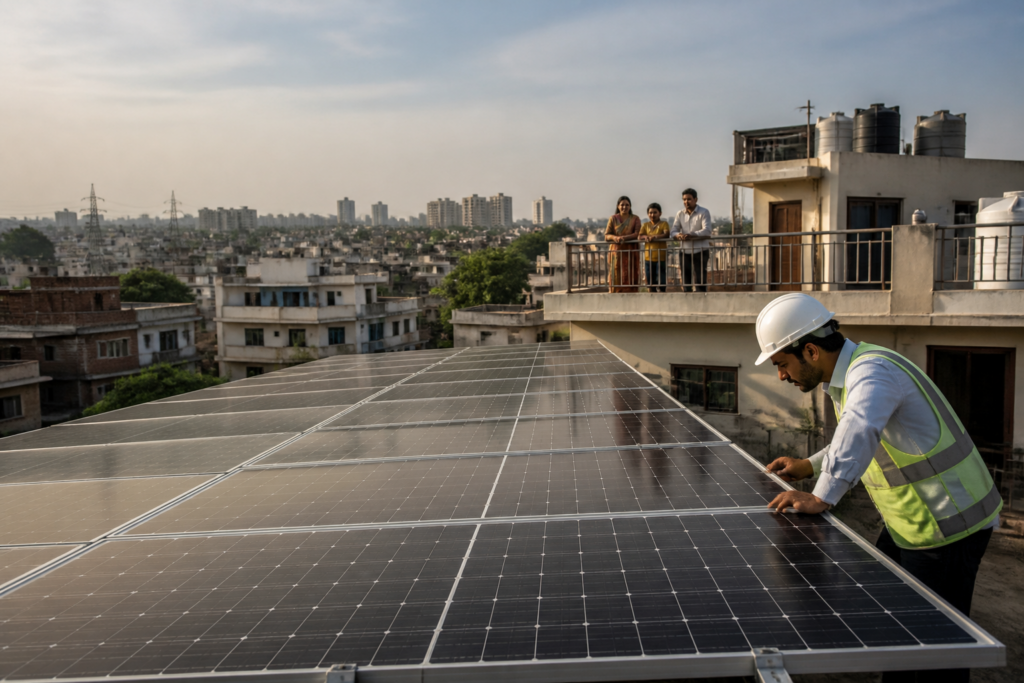
Delhi’s rooftop solar programme has attracted 77,614 registrations since its portal opened on September 21, but the more consequential measure of success will be whether those applications become installed, commissioned and operational systems before the government’s March 31, 2027 target. The early distribution of registrations across the city’s three major electricity distribution companies suggests that interest is not confined to one part of the Capital. It also places the administrative capacity of the government and discoms at the centre of the next phase.
BSES Yamuna Power Limited recorded 27,197 registrations by October 9, followed by Tata Power Delhi Distribution Limited with 26,788 and BSES Rajdhani Power Limited with 23,925. The gap between BYPL and TPDDL was only 409 applications. That spread matters because it indicates that the programme is receiving attention across multiple discom territories rather than depending on a single localised pocket of demand.
The figures do not, however, show how many households have been approved, surveyed, technically assessed or connected. They record registrations, which are an early expression of interest rather than proof that a rooftop system has been installed. The distinction is important for a programme whose stated objective is not simply to create an application pipeline but to expand functioning rooftop solar capacity across Delhi.
The government has set a target of 2.30 lakh rooftop solar installations by March 31, 2027. Against that target, the 77,614 registrations reported by October 9 represent a substantial initial pipeline, but the supplied figures do not establish how many registrations will translate into completed systems. The next indicators will therefore be installation approvals, commissioning, capacity added and the time taken to complete net-metering arrangements.
The programme’s urban significance lies in its attempt to shift part of electricity generation from centralised infrastructure to individual buildings and shared residential facilities. Delhi’s electricity system serves a large and diverse consumer base: the Capital had around 61 lakh domestic electricity consumers in 2024-25. That provides a sizeable potential pool for rooftop solar, although the number of consumers alone cannot determine how many homes are eligible. Roof ownership, structural conditions, available space, electricity consumption, building form and technical feasibility will all affect adoption under the scheme’s conditions.
The revised Delhi Solar Energy Policy is designed to lower the upfront barrier for a specific group of domestic consumers. Eligible households with average monthly consumption of up to 400 units can receive rooftop solar systems of up to 3 kW without paying the installation cost upfront, subject to the policy’s conditions. The Centre provides a subsidy of up to Rs 78,000, while the Delhi government has announced an additional subsidy of up to Rs 78,000. Together, the support can reach Rs 1.56 lakh for eligible systems.
This structure makes subsidy administration as important as the headline allocation. A household may register because the potential financial benefit is attractive, but the programme’s public value will depend on whether eligibility is communicated clearly, applications are processed consistently and installations are delivered without creating new delays or unexpected costs. The supplied report does not provide a breakdown of registrations by income group, housing type or eligibility status, so it is not yet possible to assess whether the scheme is reaching the households most constrained by electricity expenses.
The government’s emphasis on rural areas and unauthorised colonies adds another layer to the rollout. Power Minister Ashish Sood said the response from these areas had been particularly encouraging and described the registrations as evidence of citizen trust and enthusiasm. The statement identifies locations where demand is emerging, but it does not establish whether the technical and administrative conditions for installation are equally available there. Converting registrations into systems will test how the scheme works in neighbourhoods with different building patterns, tenure arrangements and infrastructure conditions.
Group housing societies are another important part of the policy landscape. The revised policy increases the subsidy for rooftop systems serving common facilities from Rs 2,000 to Rs 11,000 per kW, up to 500 kW. Eligible projects may also receive central assistance. This recognises that a significant share of Delhi’s housing stock is organised through shared buildings, where rooftop space and electricity demand may be managed collectively rather than by individual households.
The group-housing provision also changes the administrative problem. In an individual home, the applicant and the electricity connection may be relatively easy to identify. In a housing society, decisions can involve common areas, resident associations, multiple meters and shared facilities. The policy’s ability to expand rooftop solar in these buildings will depend on how these responsibilities are handled, although the supplied material does not provide details on the approval process for societies.
The policy also promises benefits beyond direct bill reduction. Consumers may sell surplus power to distribution companies under applicable arrangements, while the revised framework provides five years of free maintenance. The Delhi government has said the time required for residential net metering will be reduced from around 75 days to 25 days. That proposed reduction addresses one of the practical bottlenecks in rooftop solar adoption: a system can be physically installed but remain less useful to the consumer if the connection and accounting arrangements take too long.
For the discoms, the registration figures point to a distributed implementation task rather than a single infrastructure project. BYPL, TPDDL and BRPL will be involved in processing applications within their respective service areas and in enabling the arrangements needed for consumers to use or export generated power. The near-even registration pattern means that progress will need to be tracked across all three companies. A strong aggregate number could conceal uneven performance if installations, approvals or net-metering timelines diverge between discom territories.
The available data also reveals what remains unknown. There is no registration breakdown by installed capacity, no reported number of completed systems and no figure for the total rooftop solar capacity already operating under the programme. There is also no evidence in the supplied material on rejection rates, average processing time or the proportion of applications from eligible consumers. Without these measures, registrations can show demand but cannot yet demonstrate delivery.
That distinction is central to understanding Delhi’s rooftop solar challenge. A rooftop programme must coordinate policy design, public subsidies, household decisions, building-level feasibility, vendors, discom processes and grid connections. Each stage can affect the final outcome. The March 31, 2027 deadline gives the programme a clear administrative milestone, but it also makes implementation speed and transparency measurable.
Delhi’s early response suggests that rooftop solar has found interest across discom areas and among communities that the government says include rural localities and unauthorised colonies. The evidence currently confirms a sizeable registration pipeline and a substantial subsidy framework. It does not yet confirm the scale of operational capacity created. The next phase of scrutiny should therefore follow the applications beyond registration: how many systems are sanctioned, installed, commissioned and connected, how quickly net metering is completed, and whether the policy reaches the varied housing types that make up the Capital.


