

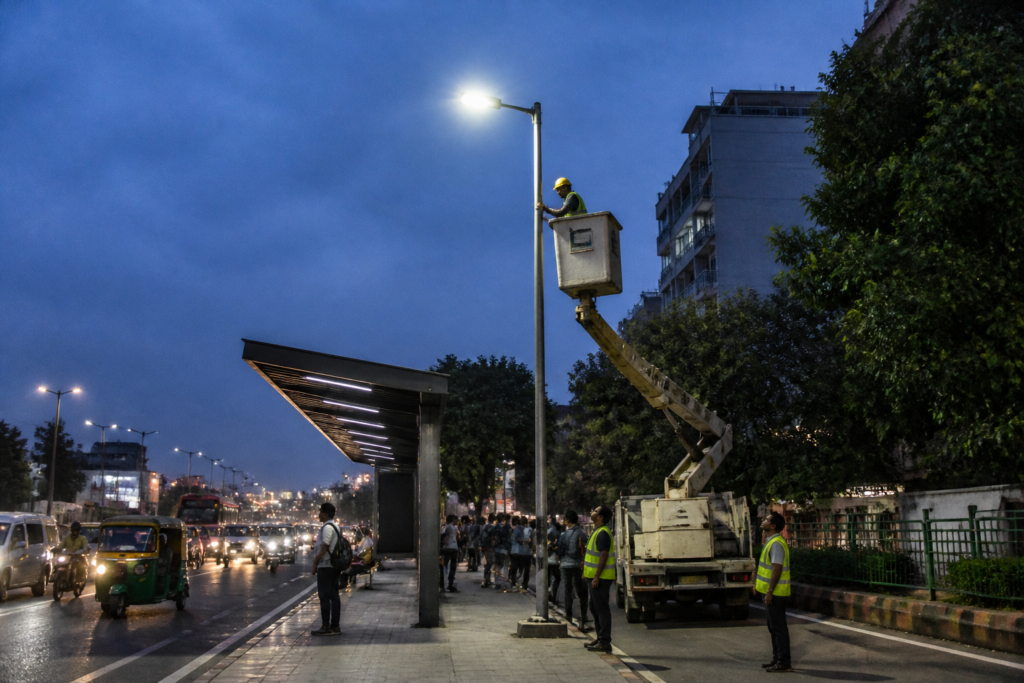
Delhi Chief Minister Rekha Gupta has launched a project to install one lakh smart LED street lights across the Capital, with the first installation beginning at the Andrews Ganj bus stop. The initiative is intended to address dark spots, improve women’s safety and make public spaces more convenient for residents.
The project follows concerns raised by female students during Gupta’s recent interaction at Delhi University. The government has positioned the lighting programme as a response to gaps in street-level visibility, particularly in areas where inadequate lighting can affect how residents use roads, bus stops and other public spaces after dark.
The new lights will be monitored in real time through a central command centre. Each light will carry a QR code that citizens can use to access information and register complaints. This creates a formal channel for reporting faulty or non-functioning lights instead of relying only on routine inspections or complaints routed through general civic systems.
The project has set a target of 99 per cent functionality. Under the stated service requirement, faulty lights must be repaired within 48 hours of a complaint. Agencies that miss the deadline will face a penalty of Rs 2,000 per light per day.
The combination of central monitoring, citizen reporting and time-bound repairs makes the project more than a conventional street-light replacement exercise. Its performance will depend not only on the number of lights installed, but also on whether complaints are recorded, assigned and resolved within the promised period. The penalty provision is intended to attach a measurable cost to service delays.
Street lighting is a basic urban service, but failures can have wider consequences for mobility and public confidence. Poorly lit bus stops, roads and pedestrian routes may discourage residents from using public transport or walking after dark. For women, visibility and the ability to report a faulty light can be particularly important when travelling through or waiting in public spaces.
The launch at Andrews Ganj provides the starting point for the wider programme. The supplied announcement does not specify the installation schedule for the remaining lights, the agencies responsible for different areas, the total project cost or the command centre’s operating arrangements. Those details will determine how the city measures coverage, response times and compliance with the 99 per cent functionality target.
The immediate implementation benchmark is therefore the conversion of the announced commitments into functioning lights and documented repairs. The project’s next steps are the installation of the remaining smart LED lights, operation of the central monitoring system and enforcement of the 48-hour repair requirement, including penalties for agencies that fail to meet it.


