

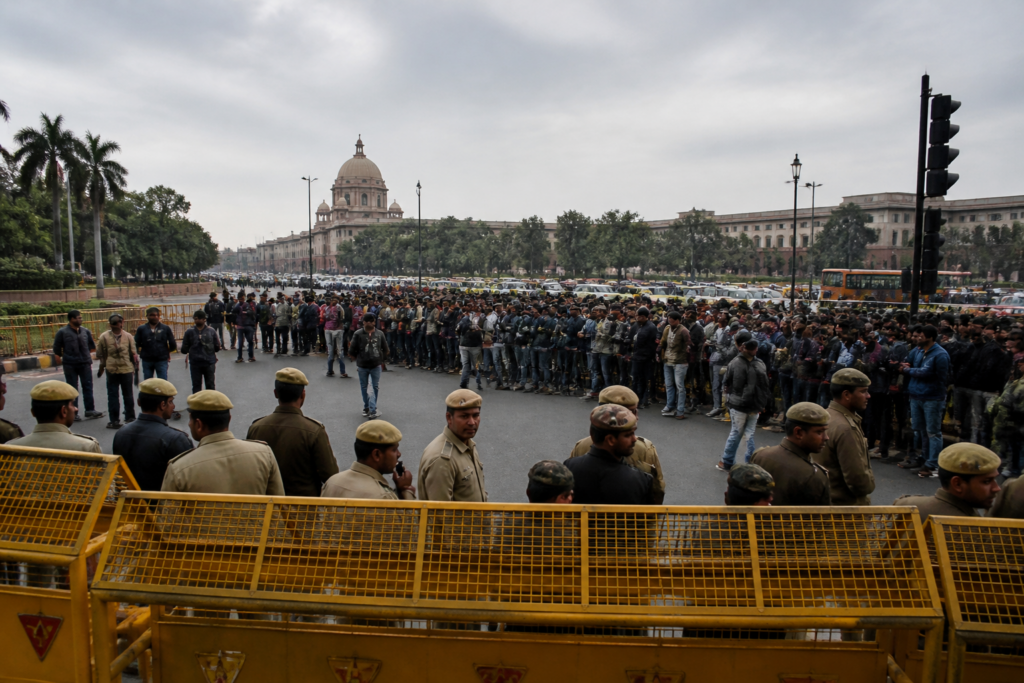
The FIR filed after a Delhi protest brings two competing allegations into the same institutional frame: an assistant commissioner of police says he was subjected to caste-based abuse and obstruction while on duty, while journalist Rozy and other women had earlier accused police personnel of sexual harassment and pushing during the same demonstration. The immediate legal development is significant, but the larger urban governance question is how accountability works when protest policing, occupational identity and competing complaints collide in a crowded public space.
According to a report by Jagran – New Delhi, Delhi Police registered an FIR on the complaint of ACP Vivek Bhagat, who is posted in the Connaught Place sub-division of New Delhi district. The case relates to a protest held on October 3 at Buta Singh Roundabout against the Election Commission. The report says the FIR names journalist Rozy, Gajendra Singh and an unidentified person.
The complaint alleges caste-based remarks, public insult, threats and obstruction of government work. It invokes provisions of the Scheduled Castes and Scheduled Tribes (Prevention of Atrocities) Act, including Sections 3(1)(p), 3(1)(q), 3(1)(r) and 3(1)(s), as well as provisions of the Bharatiya Nyaya Sanhita. The report does not reproduce the complete list of BNS sections, so the precise range of ordinary criminal charges cannot be established from the supplied material.
The allegations are disputed by their very nature and have not been tested in court. Jagran reported that ACP Bhagat told investigators he belongs to a Scheduled Caste and that a journalist referred publicly to his caste identity, nameplate and appointment as an ACP in a derogatory manner. He said he was accompanied by constable Ravi Dahiya and that the remarks publicly humiliated him and affected his official duty.
The account places the alleged exchange within a wider crowd-control operation. Police personnel had been deployed to maintain law and order as protesters attempted to move towards Jantar Mantar at about 2.30 pm. The complaint refers to restrictions imposed under Section 163 of the Bharatiya Nagarik Suraksha Sanhita and says protesters were asked to disperse. When they did not do so, police began taking people into custody.
The complaint further alleges that at about 3 pm, while Bhagat was helping move a bus carrying detained protesters, Rozy accused him of sexual harassment. It also refers to a subsequent argument involving Bhagat and other people present at the site. Later, at about 6.15 pm, Rozy, Gajendra and others allegedly gathered outside Parliament Street police station and raised slogans against him, the report said.
The police complaint also alleges that posts and reels circulated on X and Instagram portrayed Bhagat as a sexual offender. That allegation is part of the complainant’s account and is not, on the evidence supplied, an independently established finding. The report does not provide the content of the posts, the identities of their authors, or details of any digital investigation.
The same episode already had another complaint trail. Jagran reported that Rozy and other women journalists had accused ACP Bhagat of sexual harassment and pushing during the protest. It said police had acted on those complaints and that the matter had been sent to the Crime Branch for investigation. The supplied report does not state whether that investigation has concluded, whether any FIR was registered in that matter, or whether an independent body has examined the allegations.
This overlap is what makes the case relevant to urban governance rather than only to criminal-law reporting. Demonstrations in central Delhi are managed through a dense administrative system involving police deployment, movement restrictions, detention, transport of detainees and the operation of public roads and roundabouts. When an encounter during crowd control generates allegations from both police personnel and protesters, the credibility of the process depends on more than the registration of separate cases. It depends on whether each complaint is examined independently and whether the record clearly distinguishes allegation, evidence and finding.
The setting also matters. Buta Singh Roundabout, the route towards Jantar Mantar and Parliament Street police station are part of a central Delhi environment where public protest, traffic management, policing and access to government institutions intersect. Restrictions imposed during demonstrations can affect movement through the city, while police action can determine whether a protest remains a public assembly or becomes a matter involving detention and criminal investigation. That operational context creates a high burden for clear documentation.
The FIR under the SC/ST Act also raises a specific institutional issue. The law provides a framework for addressing offences involving caste-based humiliation and discrimination, including conduct alleged to have occurred in public. In this case, the complainant’s caste identity and the alleged public nature of the remarks are central to the police account. Whether the statutory provisions are ultimately sustained will depend on the evidence collected and the legal assessment of the alleged words, intent, circumstances and witnesses. Registration of an FIR is not a conviction.
The same principle applies to the allegations of sexual harassment. The report identifies Rozy’s accusation as an allegation made during the protest and says that police complaints by her and other women were sent to the Crime Branch. It does not establish whether the accusation is true or false. A credible accountability process must therefore avoid treating either the police complaint or the journalists’ complaint as a final determination before investigation and due process are complete.
The case also illustrates how public-order disputes can expand across institutions. An incident that begins at a protest site can move into a police station, a criminal investigation, social media platforms and potentially the courts. Each stage creates a different record: deployment orders and video footage at the site, witness statements and seizure records in the investigation, digital material online, and legal submissions in court. The reliability of the final account will depend on how these records are preserved and reconciled.
The supplied report does not say whether body-camera footage, CCTV recordings, mobile-phone videos, protest permissions, detention records or police wireless logs have been secured. It also does not identify independent witnesses or state whether the people named in the FIR have responded to the caste-abuse allegations. These are material gaps in understanding the episode, not grounds for assuming that either side’s account is correct.
For city residents, the issue is practical as well as legal. Public demonstrations are a routine feature of the capital’s civic and political life. Police officers must be able to enforce lawful crowd-management instructions without facing abuse or obstruction. Protesters and journalists, in turn, must be able to raise complaints about police conduct without those complaints being weakened by institutional conflict or handled without transparency. Both requirements depend on procedures that can withstand scrutiny.
The immediate administrative questions are therefore clear: how the Crime Branch investigation into the earlier allegations is progressing; how the Parliament Street police investigation will examine the ACP’s complaint; whether digital and video evidence is being preserved; and whether the two complaint trails are being assessed separately. The report does not provide answers to these questions.
What the FIR confirms is that a protest-related confrontation in central Delhi has developed into a wider accountability dispute involving caste, alleged sexual misconduct, police powers and public-order management. What remains unresolved is the factual sequence of events and the evidentiary strength of the competing allegations. Those determinations will depend on the investigations and any subsequent judicial proceedings, rather than on the registration of either complaint.


