

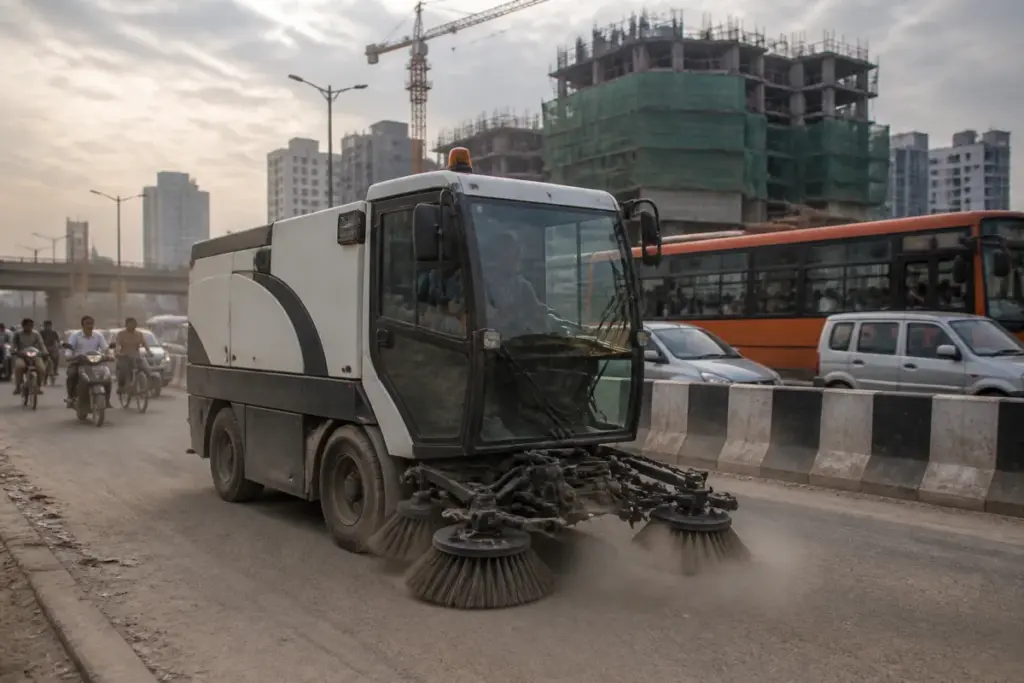
Delhi’s spending under the National Clean Air Programme (NCAP) points to a problem larger than the size of its pollution-control budget: money has been concentrated in a narrow set of activities, while a substantial share of approved funds remains unused. The pattern raises questions about whether clean-air finance is being managed as a coordinated pollution-reduction programme or as a series of individual works, dominated by road-dust control.
An analysis by the Foundation for Responsive Governance, cited by Jagran, found that Delhi was sanctioned Rs 113 crore under NCAP between 2020-21 and 2025-26. Of this, Rs 81 crore was released, but only around Rs 14 crore had been spent. The same study said that expenditure was concentrated largely on road dust and construction and demolition waste management.
A separate assessment by the Centre for Research on Energy and Clean Air (CREA) in January 2026 indicated an uneven distribution of expenditure under NCAP and air-quality grants from the 15th Finance Commission. According to the figures reported, road-dust management accounted for 68 per cent of spending, followed by transport at 14 per cent and waste management and biomass burning at 12 per cent. Capacity building and monitoring together accounted for about 3 per cent, while industry, domestic fuel and public awareness each received less than 1 per cent.
The numbers do not establish that road-dust control is unnecessary. Delhi’s extensive road network, construction activity and recurring construction-and-demolition waste create visible and measurable sources of particulate pollution. Dust suppression, mechanical sweeping and related municipal operations can therefore form an important part of a clean-air plan. The concern is that a high concentration of expenditure in one category may leave other sources with insufficient institutional and financial attention.
That distinction matters because the NCAP was designed as a multi-source programme. Launched in January 2019, it provides cities with financial and technical support for local action plans intended to reduce air pollution. Its listed areas of intervention include road dust, construction activity, vehicles, industries and waste burning. The programme’s target for 2025-26 was to reduce PM10 levels by up to 40 per cent from 2017 levels or achieve the prescribed national standards.
A programme with that scope cannot be assessed only by the amount spent, the number of machines purchased or the kilometres of road treated. Its performance also depends on whether spending is connected to measurable reductions in pollution and whether different sources are being addressed in proportion to their contribution and controllability. The Delhi figures reported in the study make both questions difficult to avoid.
## The utilisation problem behind the allocation problem
The gap between Rs 113 crore sanctioned, Rs 81 crore released and approximately Rs 14 crore spent is the clearest institutional signal in the available evidence. It suggests that the challenge is not limited to securing funds. It also lies in releasing money on time, preparing projects, assigning responsibilities, completing procurement and recording expenditure against outcomes.
Each stage involves different public agencies and administrative decisions. A city may receive an allocation but lack ready projects, technical capacity or procurement arrangements to use it. Funds may be released but remain tied up because departments cannot coordinate implementation or because activities are delayed. Conversely, expenditure may occur without a sufficiently strong system for tracking whether it changed local air quality.
The reported spending pattern therefore has two dimensions. The first is under-utilisation: most of the sanctioned amount had not been spent, according to the Foundation for Responsive Governance study. The second is concentration: the expenditure that did take place was directed largely towards road dust and construction-related debris. Together, these patterns raise a question about the quality of the city’s clean-air planning pipeline, not merely its budget size.
For residents, the administrative distinction has practical consequences. A grant that remains unspent cannot support enforcement, monitoring or public communication. A grant spent predominantly on one source may produce visible activity without delivering a comprehensive response to the range of emissions affecting the city and the wider National Capital Region.
## Why awareness and monitoring are not peripheral items
Public awareness received less than 1 per cent of expenditure in the distribution reported by CREA. That figure can appear small because awareness campaigns are less tangible than sweeping equipment, dust suppressants or transport projects. Yet the source material links public participation to activities such as waste burning and other pollution-generating practices.
Awareness spending, by itself, cannot substitute for enforcement or infrastructure. Residents cannot be expected to prevent waste burning if collection systems are inadequate, nor can communication campaigns control emissions from construction sites without inspections and penalties. But the near absence of spending in this category suggests that behavioural and community-facing measures may not be integrated into the main pollution-control strategy.
Capacity building and monitoring together accounted for approximately 3 per cent of expenditure in the CREA assessment. Monitoring is essential to determine whether an intervention is working, where pollution is being generated and which agencies need to respond. Capacity building is similarly important when municipal bodies must manage specialised equipment, inspect construction sites, enforce waste rules or interpret air-quality data.
The reported distribution raises a basic sequencing issue. Cities need to spend on physical controls, but they also need the administrative capacity to operate them, verify their performance and correct course. Without that supporting system, spending can become activity-led rather than outcome-led. The evidence supplied does not show that every road-dust intervention failed; it shows that the overall spending pattern provides limited assurance that all major sources and implementation functions received adequate attention.
## Delhi’s clean-air challenge is broader than visible dust
Road dust is highly visible. It can be seen along unpaved edges, construction sites and heavily trafficked corridors. This visibility can influence both public demand and administrative response. Machines, water sprinklers and sweeping operations are also easier to identify as budget items than longer-term work on emissions inventories, enforcement systems, fuel use or regional coordination.
The CREA figures indicate that transport received 14 per cent of the reported expenditure, while waste management and biomass burning received 12 per cent. Industry, domestic fuel and public awareness each accounted for less than 1 per cent. The source material specifically notes that industrial emissions, domestic fuel and awareness received limited attention, while also calling for more effective use of funds for emissions reduction, monitoring quality, research on volatile organic compounds and ozone precursors, and regional air-shed management.
These categories point to the institutional complexity of Delhi’s air. Pollution does not remain within a single municipal boundary, and different sources are governed by different agencies. Road maintenance may involve civic bodies and public works agencies. Transport emissions involve vehicle regulation, public transport and traffic management. Industrial emissions depend on regulatory enforcement. Waste burning is connected to collection, disposal and local compliance. Research and monitoring require technical institutions and sustained data systems.
The NCAP framework recognises several of these sources, but the expenditure figures suggest that implementation may not be equally distributed across them. The result is a mismatch between a broad policy design and a narrower pattern of actual spending. That mismatch is the central issue revealed by the reported data.
## What the funding pattern says about urban governance
Delhi’s NCAP experience illustrates how urban environmental programmes can be weakened even when they have a defined mandate and dedicated funding. The first weakness is the gap between sanction and expenditure. The second is the absence of a clear connection, in the reported figures, between spending and pollution outcomes. The third is the concentration of resources in activities that may be easier to procure or demonstrate than to evaluate.
This is not solely a Delhi problem. The report cites expert observations that around Rs 13,000 crore has been spent nationwide on dust control, while public awareness received only about 1 per cent of the total budget. That comparison, as presented in the report, suggests a wider tendency to favour physical and immediately visible interventions over communication, monitoring and institutional strengthening.
A more complete assessment would require consistent city-level data on allocations, releases, expenditure, project completion and changes in pollution levels. The supplied material does not provide that full dataset, nor does it establish how much of Delhi’s pollution reduction can be attributed to any individual NCAP activity. It does, however, show that financial utilisation and expenditure composition are measurable governance questions and should be treated as such.
The programme’s stated target of reducing PM10 levels by up to 40 per cent from 2017 levels, or achieving national standards by 2025-26, also makes outcome measurement important. Spending more does not automatically mean cleaner air, just as low spending does not identify which intervention should be expanded. What matters is whether funds are used across relevant sources, whether implementation is monitored and whether the results are visible in reliable air-quality data.
The central lesson from Delhi’s NCAP spending is therefore not that dust control should be abandoned. It is that dust control cannot become a substitute for clean-air governance. The figures reported by the two studies show a programme with substantial unspent funding, a strong concentration in road-dust management and limited expenditure on awareness, monitoring and several other pollution sources. The next stage of scrutiny should focus on how the remaining funds are used, which agencies are responsible for delivery, and whether expenditure can be linked to demonstrable improvements in air quality.


