

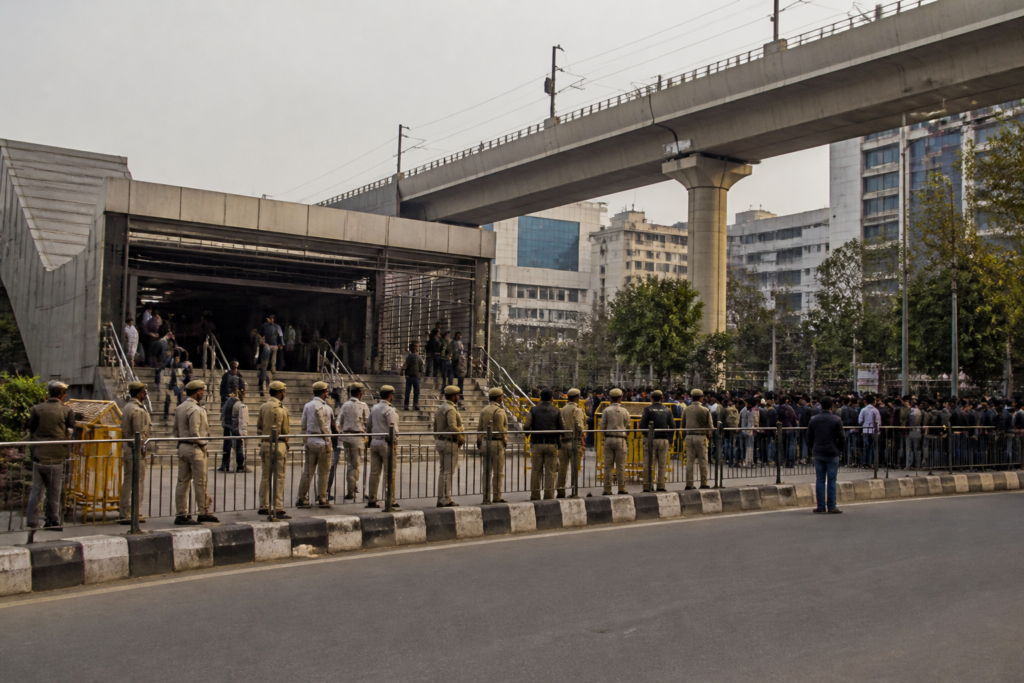
The Delhi Metro protest row has moved beyond a dispute over one day’s service regulation. It now places public-order policing, court-directed access to transport and the operational autonomy of Delhi’s mass-transit system in the same legal frame. In an affidavit to the Supreme Court, Delhi Police Commissioner Anurag Kumar said timely, proportionate and lawful measures had helped avert a major public-order situation during protests in the national capital on October 10. The affidavit was filed in a contempt case concerning alleged violation of the court’s direction that there should be no “complete prohibition” on Metro and train services during the protest.
The case is significant because the Metro is not merely a transport service that can be adjusted independently of the city around it. It is a critical urban network through which workers, students, patients and visitors move across Delhi and the National Capital Region. Any restriction, regulation or suspension therefore has consequences beyond the immediate protest site. It affects access, crowd movement and the ability of residents to make essential journeys. The court proceedings bring that operational reality into a legal test of proportionality.
According to the affidavit reported by Millennium Post, the police commissioner tendered an unconditional and unqualified apology to the Supreme Court. He also said the measures taken during the protest were based on intelligence inputs and assessments of the evolving ground situation. The police position was that the steps were intended to maintain peace and tranquillity, and that Delhi’s status as the national capital required particular sensitivity to public order.
The affidavit also cited what it described as a history of mob violence, property damage and injuries linked to the organisation behind the protest. It argued that an incorrect narrative was being propagated about the police response. These claims are part of the police’s submission to the court and do not, by themselves, establish how the restrictions were experienced by passengers or whether each operational measure complied with the Supreme Court’s direction.
That distinction is central to the case. A public transport system can be regulated for safety, but the legal question reported here is not simply whether the authorities faced a security concern. It is whether the response crossed the boundary identified by the Supreme Court, which had directed that there should be no “complete prohibition” on Metro and train services during the protest. The difference between a limited, targeted regulation and a broad shutdown is therefore not semantic. It determines whether transport access remains available while authorities manage a public-order risk.
The court had found a prima facie case on October 11 and issued notices to Delhi Police Commissioner Anurag Kumar, Union Home Secretary Govind Mohan and Delhi Metro Rail Corporation Chairperson D Thara. The notices bring three distinct institutional positions into the same proceeding. The police are responsible for public-order measures. The Union Home Secretary represents the central administrative structure named in the case. The DMRC is responsible for the operation of the Metro system. The proceedings therefore examine not only what happened on the ground, but also how decisions affecting a citywide transport network were made and implemented.
This institutional overlap is a recurring feature of urban emergencies. A Metro operator does not control the entire security environment around its stations, while police authorities cannot treat the transport system as a purely administrative instrument without considering its role in everyday mobility. The incident described in the affidavit shows how quickly the two responsibilities can collide. A decision taken in response to intelligence inputs may be intended to prevent disorder, but it can also alter the movement choices available to millions of people who are not participants in the protest.
The supplied report does not establish the number of stations affected, the duration of any service regulation, the routes involved, the passenger volume disrupted or the precise instructions communicated to the DMRC. Those details matter because the practical effect of a transport restriction depends on its geographic reach and duration. Regulating a station near a protest location is materially different from restricting services across a large section of the network. Without those operational details, the public record described in the report is sufficient to establish the legal dispute but not to measure its full transport impact.
The same limitation applies to the police reference to intelligence inputs and the evolving ground situation. The affidavit states that these assessments formed the basis for preventive measures, but the report does not reproduce the underlying intelligence or explain the specific threat assessment. That information may not be publicly available because of security considerations. Even so, the court’s intervention indicates that preventive action remains subject to legal boundaries when it affects a service as essential as urban rail transport.
The October 10 protest was called by the Cockroach Janta Party, seeking the resignation of Chief Election Commissioner Gyanesh Kumar over alleged electoral irregularities. The source report does not provide details of the protest’s size, route, attendance or incidents of violence on that day. It records the police affidavit’s reference to the organisation’s alleged history of mob violence, property damage and injuries. The word “alleged” is important: the police submission presents this history as part of its justification, while the court proceedings will determine how that material bears on the contempt case.
The case also illustrates the administrative importance of clear operational instructions. When a court directs that there should be no complete prohibition on services, the implementation question becomes precise: which services may continue, under what conditions, and who decides when safety concerns justify a change? A police order, a transport operator’s operating decision and a court’s direction may each use different language. The risk of dispute grows when those instructions are not publicly explained in a way passengers can understand.
For commuters, the distinction between a security-based regulation and an effective shutdown is experienced through uncertainty. Passengers need to know whether stations are open, whether trains are running through a particular section, whether interchanges are available and what alternative routes exist. The source material does not record passenger accounts or DMRC advisories, so it cannot establish the extent of confusion or inconvenience. It does, however, show that the question of service continuity was important enough to become part of contempt proceedings before the Supreme Court.
The DMRC’s presence in the proceedings is especially relevant to the governance of urban infrastructure. Metro systems are often described in terms of trains, stations and corridors, but their functioning depends on a chain of decisions involving security agencies, operators, courts and government departments. When one institution seeks to manage a public-order situation through transport regulation, the consequences are carried by the network and its users. The court’s notice to the DMRC Chairperson indicates that the operator’s role in the disputed measures is part of the legal examination.
The matter also raises a broader question about the meaning of proportionality in a densely connected capital. Delhi’s Metro network links residential areas, workplaces, government districts and major interchanges. The source report does not provide ridership or network data, and no broader transport comparison can be made from the supplied evidence. But the institutional facts are clear: a decision taken during a protest can have consequences across a system that is larger than the immediate site of public assembly. The legal standard applied to that decision therefore has urban implications even though the case arises from one event.
The affidavit’s apology and its defence of the police response are not mutually exclusive. An unconditional apology addresses the court, while the explanation of preventive measures sets out the authority’s account of why those measures were taken. The Supreme Court will have to consider the relationship between the apology, the alleged breach of its direction and the operational facts surrounding the Metro and train services. The supplied report does not state the court’s final determination.
What the episode confirms is that public-order management in a city cannot be assessed only through the lens of protest control. It must also be assessed through the continuity of essential urban systems. The police affidavit frames the October 10 measures as necessary, lawful and proportionate. The contempt case exists because the Supreme Court had already set a limit against complete prohibition of Metro and train services. Between those two positions lies the central administrative question: how can authorities respond to a perceived threat without making a city’s transport network an unnecessarily broad instrument of restriction?
The next stage will depend on the responses to the Supreme Court’s notices and the court’s assessment of the alleged violation. The key facts still requiring clarification include the exact service changes, the agencies that authorised them, the duration and geographical scope of the measures, and how those decisions were reconciled with the direction against complete prohibition. Until those details are placed before the court, the case remains both a contempt proceeding and a test of how Delhi’s public transport infrastructure is governed during periods of heightened security.


