

Crude oil prices crossing $110 a barrel has turned an energy-market shock into a wider risk for India’s urban economy. The immediate concern is not only whether petrol and diesel become more expensive, but how a prolonged rise could move through public and private transport, goods distribution, construction inputs, manufacturing costs and household budgets.
Brent crude reached $110 a barrel on October 16, the first time since May, before closing at $109.86. US West Texas Intermediate rose 3.5% to $101.41 a barrel. Over the week, WTI gained more than 10%, while Brent increased by about 5%, according to the report by Aaj Tak Business. The movement followed heightened geopolitical tensions in the Middle East and eastern Europe, including reported threats to important oil shipping routes and concerns around regional production and export infrastructure.
The numbers matter because crude oil is not an isolated commodity in a city. It is an input into the movement of people, food, construction material, manufactured goods and services. When the price of imported energy rises, the pressure can reach urban residents through several routes, although the timing and scale of the impact depend on domestic pricing decisions, currency movements, inventories and the duration of the shock. The supplied report does not provide those additional indicators, so the immediate price rise should be treated as a risk signal rather than proof of a uniform increase in all consumer costs.
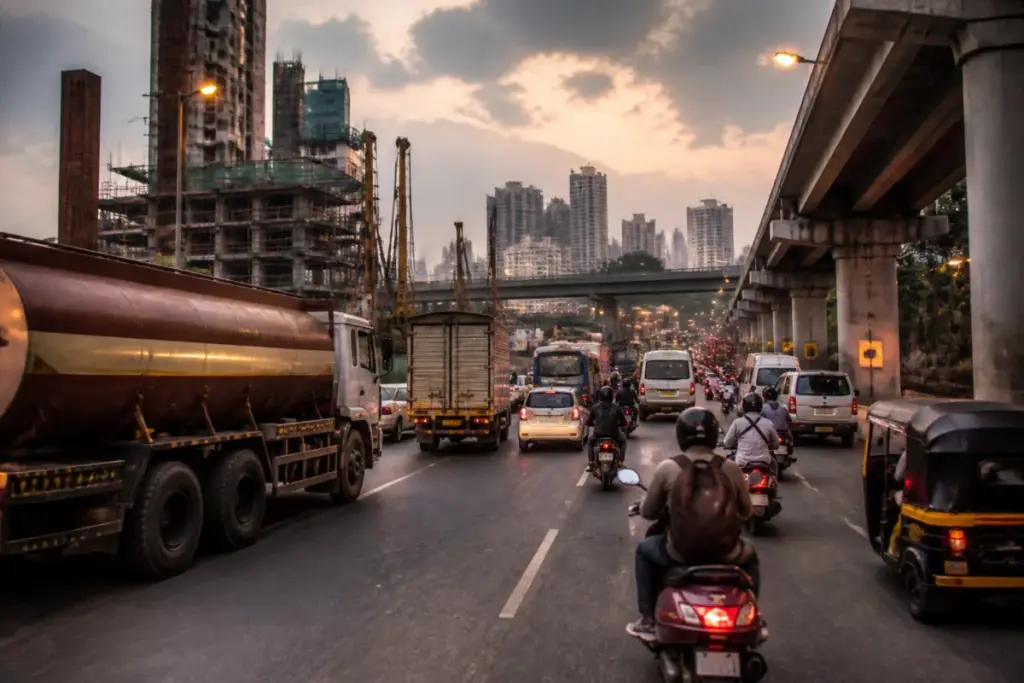
The first transmission channel is transport. Petrol and diesel prices influence the operating costs of buses, taxis, delivery fleets, trucks, construction vehicles and private cars. Public transport systems that rely on diesel may face higher operating expenses, while app-based mobility and logistics operators may see fuel become a larger component of their costs. Freight vehicles connect ports, industrial areas, wholesale markets and residential neighbourhoods, making fuel prices relevant even to households that do not own a vehicle.
Urban supply chains are particularly exposed because cities depend on continuous movement from outside their boundaries. Food, cement, steel, aggregates, packaged goods and other essentials often travel through several stages before reaching a household or construction site. A sustained increase in diesel costs can therefore affect both the cost of delivery and the price of goods. The report specifically identifies higher transport expenses and rising manufacturing costs as possible consequences of elevated crude prices.
That does not mean every price will rise immediately or by the same amount. Businesses may absorb part of the increase, adjust logistics, renegotiate contracts or pass on costs gradually. Government decisions can also affect the final price paid by consumers. The report states that petrol and diesel prices could increase if crude remains at high levels, but it does not establish that such increases have already occurred or quantify their likely size.
### Why the urban economy is vulnerable
India’s cities operate through energy-intensive systems. Buses, trucks, construction equipment, generators, commercial vehicles and industrial supply chains all depend directly or indirectly on fuel. Even where urban rail and electric mobility reduce exposure for some trips, the wider city continues to rely on road-based movement for freight, last-mile delivery, maintenance and construction.
This creates an important distinction between transport demand and transport cost. A household may not change its daily travel immediately when fuel prices rise, especially if work, education or healthcare requires a particular journey. A small manufacturer may also continue operating while accepting a smaller margin or raising prices. The pressure can therefore accumulate before it becomes visible as a major change in travel behaviour or business activity.
The report connects the crude oil rise to a broader inflation risk involving retail fuel, manufacturing and transport. For cities, that risk is significant because urban households typically purchase a large range of goods and services whose prices include some logistics cost. Rent and property prices are not determined by crude alone, but construction and maintenance activity can be affected through machinery use, transportation and the movement of materials.
The construction sector illustrates the complexity. Fuel is used to move sand, aggregates, concrete, steel and equipment, while energy costs also affect factories producing or processing construction materials. However, the supplied report does not provide data on the share of fuel in construction costs or evidence of current price changes in specific building materials. It is therefore not possible from the available evidence to calculate the effect on housing or infrastructure project budgets.
### The geopolitical trigger and the limits of the evidence
Aaj Tak Business attributes the sudden increase to simultaneous risks around energy corridors, including the Strait of Hormuz and Bab al-Mandeb, along with tensions involving Iran, Saudi Arabia and the conflict in eastern Europe. The report says these developments raised concerns about commercial shipping, petroleum transport, production infrastructure and exports.
These claims explain why the market response was rapid: oil prices react not only to actual supply losses but also to fears that future supply or shipping could be disrupted. Yet the report does not state that a specific quantity of oil was removed from the market, nor does it provide official shipping, production or inventory data. The evidence supports a clear account of heightened risk and market volatility, but not a definitive assessment of how long the disruption will last.
That distinction is central for India. A brief price spike can be managed differently from a prolonged period of high crude prices. Companies may have more scope to absorb a short-term increase, while an extended rise can become embedded in freight rates, procurement contracts and consumer prices. The report warns that markets may remain volatile, but it does not offer a duration estimate or a forecast for Brent or WTI.
### India’s exposure is also an urban governance issue
The report notes that India imports most of the crude oil it needs from other countries. This external dependence means that domestic cities are exposed to events beyond the control of municipal bodies. Municipal governments do not set international crude prices, but their decisions influence how resilient urban systems are when operating costs rise.
The strength of public transport, the efficiency of freight networks, the distance between housing and employment, and the availability of alternatives to private vehicles all shape how fuel shocks are experienced. A city where essential travel depends heavily on private vehicles may transmit a fuel increase directly to households. A city with reliable mass transit may reduce the impact on some passenger journeys, even though freight and municipal operations remain exposed.
This is why an oil-price story belongs within urban reporting rather than only in the business pages. Fuel is part of the operating infrastructure of a city. It affects the cost of collecting waste, maintaining roads, supplying markets, moving construction material and delivering goods to homes. The available report does not provide city-level data on these services, but it identifies the broad economic channels through which pressure could spread.
The policy response is not established in the supplied material. There is no information about changes in fuel taxes, subsidies, public transport fares, freight policy, strategic reserves or municipal budgets. Those omissions are important because the effect of a crude shock is mediated by public policy and commercial decisions rather than determined by the international benchmark alone.
### What the price movement confirms—and what remains uncertain
The evidence confirms a sharp and recent rise in crude oil benchmarks. Brent’s move to $110 a barrel and WTI’s rise above $100 provide a measurable indication of market stress. The weekly gains reported for both benchmarks show that the increase was not limited to a single trading session.
The evidence also establishes a credible risk pathway for India: imported crude becomes more expensive, which can place pressure on fuel, transport and manufacturing costs. For urban residents, that pathway can affect mobility and the price of goods. But the supplied material does not establish the eventual effect on retail fuel prices, inflation, public transport fares, construction costs or household budgets.
The developments that require monitoring are therefore concrete. These include whether Brent remains above $100, whether the reported geopolitical risks disrupt actual oil shipments or production, whether domestic petrol and diesel prices change, and whether freight and manufacturing companies begin passing on higher costs. Until those indicators become available, the crude oil rise is best understood as a significant warning about the vulnerability of India’s urban economy to external energy shocks—not as proof that every urban cost has already increased.


