In Balrampur-Ramanujganj, rehabilitation for families affected by Maoist violence is being measured through more than compensation or a single government benefit. The district administration has linked women from 25 surrendered and Maoist-affected families to self-help groups under the Bihan programme, while combining housing, small loans, literacy support and government jobs into a broader effort covering 94 families. The approach offers a useful view of rehabilitation as an administrative process that must reconnect households to income, shelter and public services at the same time.
The district has divided the 94 families into four categories: surrendered Maoists, civilians injured in violence, dependants of people killed in violence, and families whose property was damaged. This classification is significant because the consequences of conflict are not identical. A family that has lost an income earner may need employment or social protection; one whose property was damaged may need housing support; and a household with no established livelihood may require credit and training. The administration’s response, according to the report, has been to map these different needs rather than treat rehabilitation as a uniform payment.
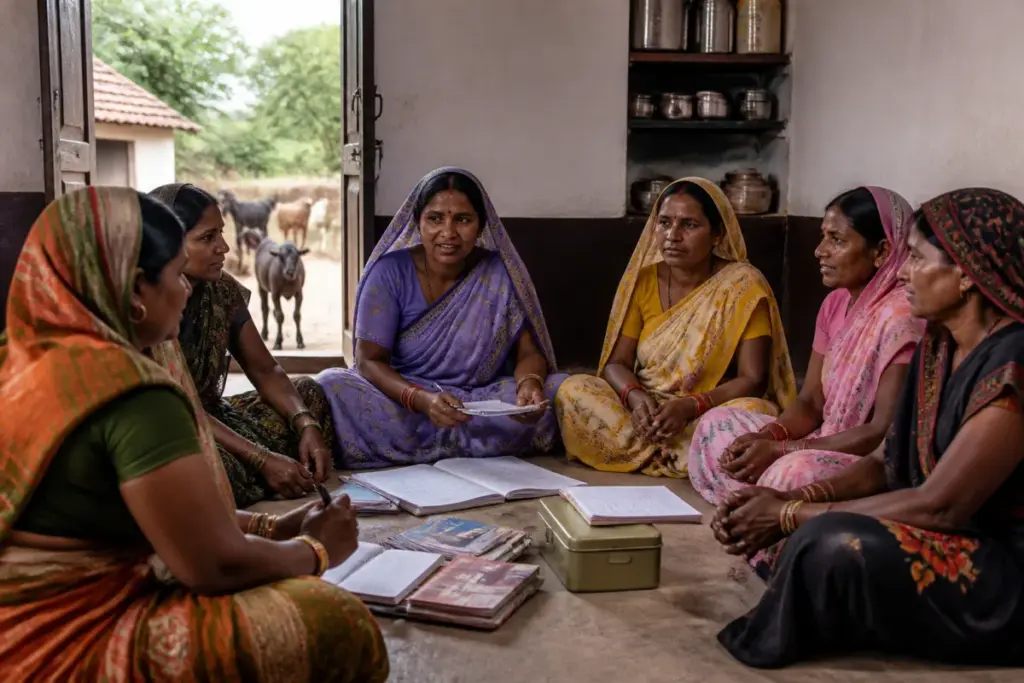
The numbers show both the reach and the unfinished nature of the programme. Of the 34 families identified as eligible for self-help group linkage, 25 have joined so far. The participants include nine families of surrendered Maoists, all three eligible families of injured civilians and 13 other Maoist-affected families. The remaining gap between eligible families and those linked to groups matters because self-help groups are not simply savings collectives in this model. They are the institutional channel through which women can access small loans, training and a route towards a more stable household income.
Savita Singh’s experience illustrates how that channel works at household level. Singh, from Barwahi village in Ramchandrapur block, lost her father-in-law to Maoist violence. After her family received a permanent house under the Pradhan Mantri Awas Yojana, she joined the Nisha women’s self-help group and started goat rearing with a loan of Rs 2,000. A second loan of Rs 10,000 enabled her to expand the activity. The district administration says goat rearing now generates between Rs 1 lakh and Rs 1.5 lakh a year, with poultry and dairy adding to the family’s income.
The sequence is important. A permanent house provides a more secure physical base, while access to credit supports an income-generating activity. Neither intervention, considered alone, necessarily resolves a household’s vulnerability. Together, they create the possibility of a more durable livelihood. The account does not establish that every participating family has achieved a similar outcome, but it demonstrates why rehabilitation cannot be assessed only by counting sanctioned benefits. The more consequential question is whether those benefits connect with one another in the daily life of a family.
More than a dozen women from the affected families are also being trained with the aim of qualifying as “Lakhpati Didis”, according to the administration. The stated goal places the women’s self-help groups within a wider income-building framework. It also shifts the emphasis from immediate relief to the capacity of households to generate continuing earnings. However, the supplied information does not specify the training curriculum, the income measurement method or how many women have already reached the target. Those details will be important for evaluating the programme beyond its initial enrolment figures.
Housing is another visible part of the rehabilitation architecture. Twenty-seven houses have been sanctioned under a special PMAY project for surrendered and Maoist-affected families. Eighteen are complete and nine remain under construction. The completion rate shows substantial progress, but the nine unfinished houses also underline that sanction and delivery are different administrative stages. For families rebuilding after violence, the practical value of a housing programme is realised only when construction is completed and the home becomes usable.
The housing component also reveals how welfare administration can influence livelihood recovery. Secure shelter reduces one immediate household vulnerability and may make it easier for families to invest time and limited capital in activities such as goat rearing, poultry or dairy. The report does not provide details on construction quality, infrastructure connections or occupancy, so no conclusion can be drawn on the full performance of the housing programme. But the linkage between housing and livelihoods is clear in the way the district has presented the rehabilitation effort.
The programme extends beyond physical assets and income. Five members of affected families in Nawadih, or Kothli, village who were previously unable to read or write became literate under the literacy mission in 2025. Literacy can affect the ability to sign documents, maintain savings records, understand loan terms and access welfare schemes. In this case, it is also a measure of whether rehabilitation is reaching the administrative capabilities of households, not only their material needs.
Employment support forms another layer. Dependants from 29 families of people killed in Maoist violence have been given government jobs, while relief assistance has been extended in most eligible cases involving death, injury and property loss, according to the district administration. These interventions address different kinds of household damage. A government job can replace some lost income security for a dependant, while relief assistance responds to a specific event. Self-help group credit, by contrast, supports an income activity that requires continuing participation and management.
This range of interventions creates a more complex administrative task than distributing a single benefit. The district must identify families, establish eligibility, match them to schemes, track construction, coordinate training and ensure that loans or employment support reach the intended beneficiaries. Collector Chandan Sanjay Tripathi said the focus was on connecting each family with the support it needed, including housing, livelihood, education, nutrition or welfare schemes, rather than treating rehabilitation as a one-time benefit.
That statement describes a shift from event-based relief to household-level case management. The distinction is important in areas affected by prolonged violence. A one-time payment may address an immediate loss, but it does not automatically restore a home, rebuild an income or help a household navigate government systems. The Balrampur model, as described in the report, attempts to assemble several programmes around individual family circumstances. Its effectiveness will depend on whether the coordination continues after the initial benefit is delivered.
The district administration says Balrampur-Ramanujganj was removed from the list of Left-Wing Extremism-affected districts on April 4, 2025. That administrative change provides a wider backdrop to the rehabilitation exercise, but it does not by itself indicate that the social and economic effects of violence have ended. The district’s own figures show that houses are still under construction, eligible families are still being linked to self-help groups and women are still undergoing training.
The available data also suggests that progress should be read at several levels. At the programme level, 25 of 34 eligible families have been linked to self-help groups, 18 of 27 sanctioned houses are complete and dependants from 29 families have received government jobs. At the household level, one reported case moved from a Rs 2,000 loan to a stated annual income of Rs 1 lakh to Rs 1.5 lakh from goat rearing, alongside poultry and dairy. These figures show activity and outcomes, but they do not yet provide a complete evaluation of coverage, durability or differences between categories of affected families.
That missing information is central to understanding whether the model can be sustained. The supplied report does not state how many of the 94 families have received every benefit for which they are eligible, whether incomes have remained stable, or how many sanctioned houses are expected to be completed by when. It also does not describe the repayment performance of the loans or the number of families still awaiting relief. These are not minor administrative details: they determine whether rehabilitation is functioning as an integrated system or as a collection of partially connected schemes.
The broader urban and built-environment lesson is that recovery is not confined to cities. Rural and small-town districts also depend on the interaction between housing, roads and services, livelihoods, literacy and public administration. A house is part of a settlement; a self-help group depends on access to markets and institutions; and a government job or welfare benefit requires documents and administrative reach. The physical rebuilding of homes therefore sits within a wider system of social and economic infrastructure.
Balrampur’s experience also shows why the success of rehabilitation cannot be judged only by the disappearance of a district from an official list. The end of a conflict classification is an important administrative milestone, but families experience recovery through more ordinary indicators: whether a house is complete, whether a woman can operate a livelihood activity, whether a dependant has stable work, and whether household members can read and manage official records. These indicators are slower and less visible, but they more directly describe how households regain autonomy.
The evidence currently confirms a coordinated rehabilitation effort covering 94 families, with measurable progress in self-help group enrolment, housing construction, literacy and employment support. It also shows that implementation remains incomplete: nine houses are still under construction and nine of the 34 eligible families have not yet been linked to self-help groups. The next stage of scrutiny will be whether the district can close those gaps and document sustained household outcomes. For now, Balrampur provides a case study in how housing and livelihood policy can be combined to move rehabilitation beyond relief and towards everyday stability.