

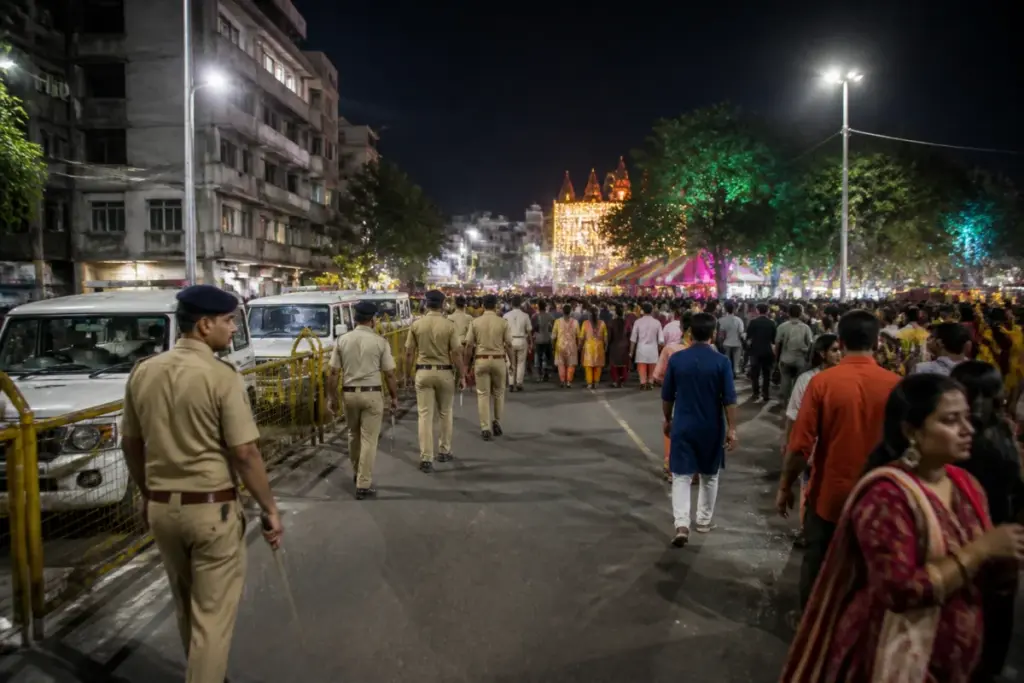
Ahmedabad Navratri murders reported across five areas during the festival have placed the city’s public-safety arrangements and response to everyday disputes under scrutiny. The five cases occurred over the nine days of Navratri in Amraiwadi, Danilimda, Shahibaug, Ramol and Khokhra, with the reported triggers ranging from verbal confrontations and old enmity to a tea-stall financial dispute, vehicle parking and a property disagreement.
The incidents do not establish that the festival itself caused the violence. They do, however, reveal how ordinary urban conflicts can become lethal when they escalate in crowded neighbourhoods and during a period when large numbers of people are moving through the city late at night. The report says police registered murder cases in all five incidents and initiated action against the accused.
The immediate question is not only how many police personnel were deployed around garba venues. It is also whether a festival security plan can detect and manage violence that begins away from the main event spaces: in residential lanes, near roadside businesses, around parking areas and at points where residents, visitors and commercial activity intersect.
The incidents were reported in five different parts of Ahmedabad rather than at a single venue. That geographical spread matters because it suggests that the public-safety challenge cannot be understood only through entry checks, venue barricades or crowd management at organised garba grounds. A festival security system also operates across the wider urban network that connects event locations with homes, transport routes, food stalls, parking spaces and local markets.
The reported disputes were similarly varied. In Amraiwadi, Danilimda, Shahibaug, Ramol and Khokhra, the cases were associated with ordinary points of friction, including a verbal dispute, previous hostility, a disagreement over tea-stall money, parking and property. The available report does not provide the full case records, the exact times of the incidents, the number of arrests, the identity of the accused or the status of the investigations. It therefore cannot support a conclusion about a single common motive or a city-wide rise in crime beyond the five cases described.
That limitation is important. The report characterises Ahmedabad’s crime graph as rising, but it does not provide a comparison with the same Navratri period in earlier years, a monthly baseline, or official crime statistics. Nor does it establish whether the five cases represent an increase in murder, a change in reporting patterns or an unusual concentration during this year’s festival. Those questions require police data and case-level information that are not included in the supplied material.
What the reported cases do establish is a pattern of severe escalation. Conflicts over parking, money or property are common features of dense urban life. They become a public-safety concern when there are weapons, longstanding hostility, alcohol or other aggravating factors, or when people lack effective ways to withdraw from a confrontation. The available account does not identify which of these factors was present in each case, and it would be unsafe to assign a common explanation to all five deaths.
A senior psychologist, Dr Prashant Bhimani, told the source that sleep deprivation, sustained excitement and stress during prolonged festivals can affect behaviour and impulse control. He also cautioned that no single factor can be treated as the direct cause of a murder. That distinction keeps the focus on evidence. Festival fatigue or heightened excitement may be relevant to behaviour, but they cannot replace investigation into the specific circumstances, alleged actions and legal evidence in each case.
The policing question is therefore operational as well as investigative. Before Navratri, Ahmedabad city police had reportedly spoken of strict security arrangements and a “zero tolerance” policy to protect citizens and garba participants. The five murders have led to questions about the effectiveness of those arrangements and night patrols. The report does not establish whether police were present at the locations when the incidents occurred, whether earlier complaints had been made, or whether any accused had been previously identified as a risk.
Those details would determine whether the issue was a failure of deployment, a gap in intelligence, delayed intervention, inadequate lighting or surveillance, or a conflict that emerged too quickly for prevention. Without them, criticism of the security plan remains a question raised by the sequence of events rather than a proven finding. A credible assessment would need incident timelines, police response times, patrol routes, CCTV availability, emergency-call records and information on whether local beat officers had received warnings about disputes.
The urban geography of the reported cases also points to the limits of venue-based security. Large festivals are often planned around visible public spaces, commercial areas and temporary traffic arrangements. Yet residents experience the security environment across the entire journey: while walking to an event, searching for parking, returning home, buying food or using a neighbourhood business. Violence in these transition spaces can remain outside the main security perimeter even when a venue itself is closely monitored.
This creates an administrative coordination problem. Festival safety involves the police, traffic authorities, municipal agencies, event organisers, private security personnel, local businesses and residents. Each institution controls only part of the public realm. Police handle law and order and criminal investigation; traffic teams manage movement and parking; organisers control access within event premises; municipal agencies influence lighting, roads and public-space conditions. The supplied report does not say how these responsibilities were divided or whether a joint review was conducted after the incidents.
The distinction between preventing crowd disorder and preventing targeted or interpersonal violence is equally significant. Metal detectors, frisking and venue surveillance may reduce the risk of weapons entering an event, but they cannot by themselves resolve a property dispute or a confrontation at a tea stall. Night patrols may deter some offences, but deterrence depends on coverage, visibility and the ability to respond before a disagreement becomes an assault. The five cases show why festival security cannot be measured only by crowd size, traffic flow or the absence of stampedes.
The evidence available here is too limited to calculate a trend. There are no figures for total murders in Ahmedabad during comparable periods, no breakdown of offences by neighbourhood, and no information on the number of festival venues or nightly attendance. It is also not clear whether the five reported cases occurred within or outside organised garba locations. These are not minor omissions: without them, the city cannot distinguish between a festival-specific risk, a broader law-and-order problem, or a cluster of unrelated criminal incidents occurring during the same period.
At the same time, the cases raise a broader question about how urban institutions handle low-level conflict. Parking disagreements, unpaid bills, property disputes and old personal enmity are not exceptional in a large city. The public-interest concern begins when these disputes repeatedly move from argument to weapon use. Addressing that transition requires more than a festival-season announcement. It requires timely police intervention, accessible complaint channels, visible local policing and reliable investigation after violence occurs. The supplied material does not show whether these systems were available or effective in the five cases.
For residents, the practical issue is the reliability of public space during major festivals. A city can host a large cultural event while also ensuring that neighbourhood streets, transport routes and commercial edges remain safe. That requires security planning beyond the main stage or garba ground. It also requires transparent reporting after serious incidents so residents can understand what happened, what action was taken and which gaps, if any, were identified.
The five Ahmedabad murders confirm that serious violence occurred across several neighbourhoods during Navratri and that police registered cases. They do not, on the available evidence, prove a single festival-related cause or a generalised city-wide crime surge. The next meaningful assessment will depend on official case details, comparative crime data and a clear account of deployment and response. Until those are available, the strongest conclusion is narrower but important: festival safety must be assessed across the urban areas that support an event, not only inside its formal venues.


