

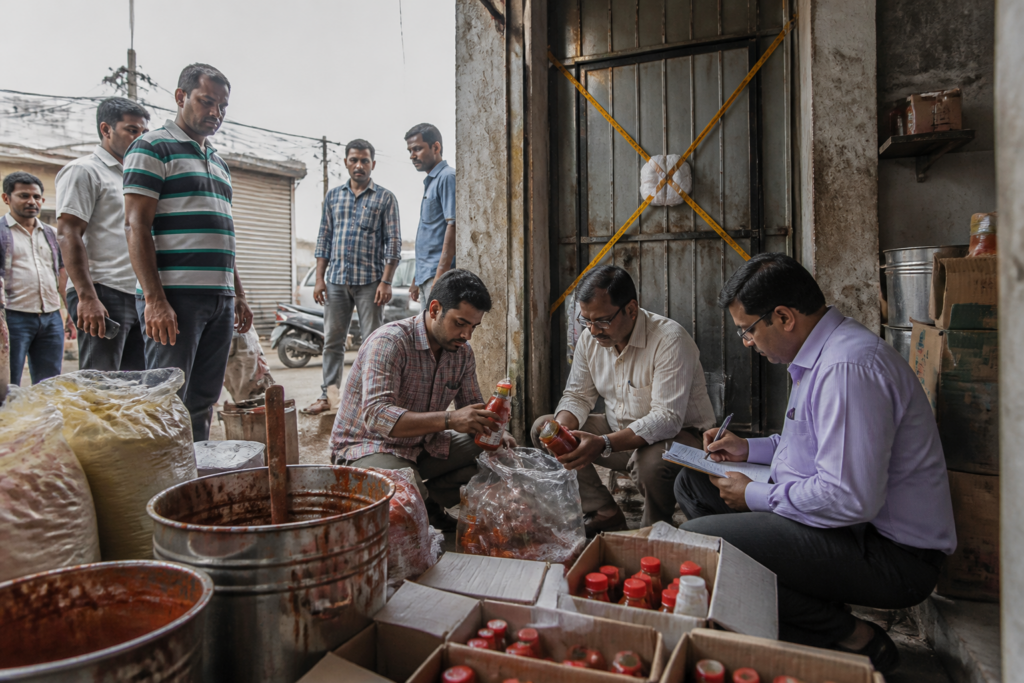
The Ahmedabad Municipal Corporation’s Food Department has sealed an unlicensed unit on the Danilimda-Pirana Road after seizing about 2,000 kg of raw material and prepared sauce allegedly being manufactured and sold as tomato sauce for sandwiches, burgers and other fast food.
According to the Food Department’s findings reported by Gujarat Samachar – Ahmedabad, the unit was operating in the Behrampura area without a valid licence and in unhygienic conditions. Officials reportedly found that potato powder and acidic colours were being used in place of, or alongside, ingredients expected in tomato sauce production.
The sauce was allegedly being sold under the name “Tasty Snacks Ketchup” to different shops and food carts. The report said the operators could not produce purchase or sales bills when asked by the civic food-safety team, raising questions about the traceability of the product entering Ahmedabad’s informal and small-scale food network.
The inspection also found that the licence shown by the operators was linked to an incorrect address, according to details attributed to the AMC Food Department. The premises, therefore, did not have a valid licence for the manufacturing activity being carried out there, the report said.
The seized material included both raw inputs and prepared sauce. The civic team collected samples from the stock and began the legal process for destroying the material that it classified as unfit for consumption. The entire unit was sealed immediately after the raid.
The case highlights the enforcement challenge faced by city administrations beyond registered restaurants and large food manufacturers. Sauce supplied to snack shops and roadside food vendors can move through informal distribution channels, making licensing, billing and product traceability important parts of municipal food-safety checks. The supplied report, however, does not provide details of any arrests, penalties, laboratory findings or prosecution initiated against the operators.
The AMC Food Department’s immediate action is the sealing of the premises, seizure of the stock, sample collection and initiation of the lawful disposal process. Further action will depend on the samples and proceedings under the applicable food-safety rules.


