

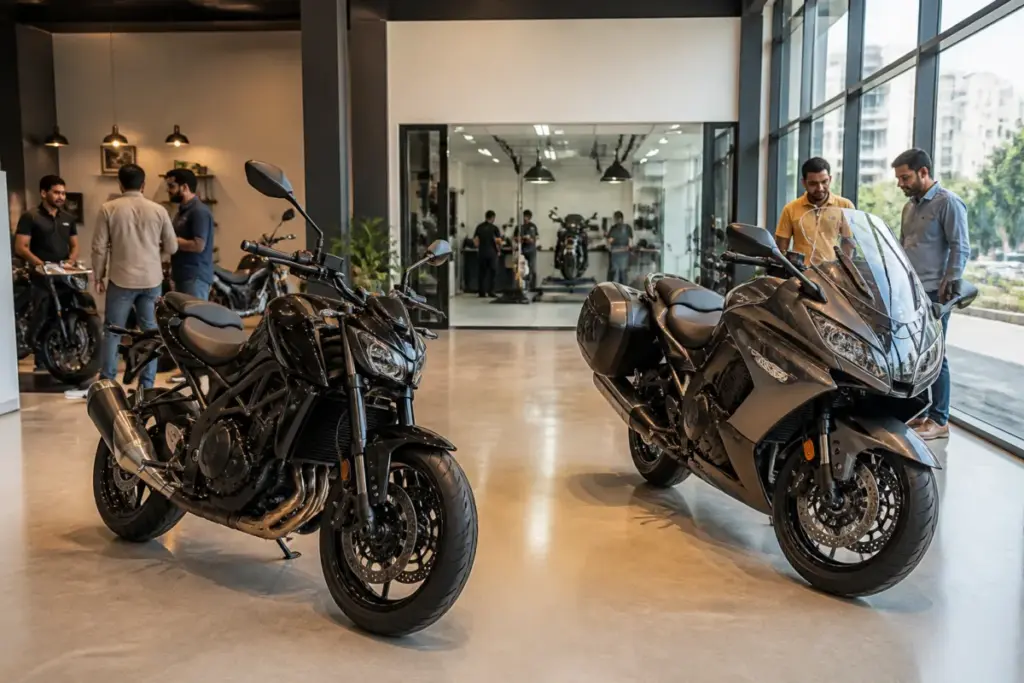
India’s premium motorcycle market is entering its first full festive season under a 40 per cent GST regime, and the contrasting strategies of Kawasaki and Suzuki reveal a market caught between expansion and affordability. Kawasaki has held the price of its 2027 Z1100 at ₹12.79 lakh, while Suzuki has raised the standard Hayabusa to ₹18.99 lakh and introduced a ₹19.90-lakh Special Edition. Their decisions are not simply product-positioning moves. They show how taxation, import exposure, ownership costs and brand-led demand are increasingly shaping mobility choices at the top end of India’s two-wheeler market.
The tracked 1,000–1,600cc motorcycle category grew 22 per cent in FY26, from 905 units to 1,105 units, according to wholesale data from the Society of Indian Automobile Manufacturers. That increase appears substantial, but the absolute market remains small. A little over 1,100 wholesale units across a year is a narrow base for manufacturers operating in a segment that depends on imported components, premium retail infrastructure and specialised after-sales support.
The numbers also show that growth is uneven. Suzuki’s Hayabusa accounted for 543 units, almost half of the tracked category’s sales. Kawasaki followed with 281 units, sharply higher than the 61 units recorded a year earlier. Triumph declined to 159 units from 208, while Harley-Davidson remained broadly stable at 120 units. The category’s expansion is therefore being driven by a limited number of products rather than by broad-based growth across all manufacturers.
That distinction matters because premium motorcycles occupy a different position from mass-market two-wheelers. Buyers are not choosing only between engine sizes or fuel efficiency. They are also paying for performance, brand identity, design, riding communities and the experience associated with ownership. For manufacturers, flagship motorcycles can attract customers to showrooms, strengthen brand positioning and support organised activities such as riding events, track days and touring programmes, even when sales volumes remain modest.
The 40 per cent GST regime has raised the financial pressure on this model. Since September 22, 2025, motorcycles above 350cc have attracted a 40 per cent GST rate, compared with an earlier effective rate of 31 per cent. The change pushed the Hayabusa’s price up by about ₹1.16 lakh. Its wholesale dispatches then fell 32 per cent, from 324 units in the first half of FY26 to 219 units in the second half.
The sales decline cannot be attributed to pricing alone. Wholesale dispatches can also be affected by inventory, product cycles, regional demand and timing. However, the sequence demonstrates the sensitivity of a small premium segment to even a relatively limited increase in the upfront cost. When the customer base is narrow and the product is discretionary, taxation can influence purchase timing as well as the final decision to buy.
Kawasaki’s decision to retain the Z1100’s ex-showroom price at ₹12.79 lakh represents a different response. The motorcycle remains below Honda’s CB1000 Hornet SP, priced at ₹13.29 lakh, giving Kawasaki a clear price-positioning argument within the litre-class performance segment. The 2027 Z1100 is mechanically unchanged from the model introduced in November 2025, and deliveries were scheduled to begin on October 19.
Holding the price does not mean that the cost pressures have disappeared. Kawasaki had also revised prices after the tax change and offered promotional incentives on selected models. Earlier discounts of up to ₹1.5 lakh on the Ninja ZX-10R and Ninja 1100SX indicate that tactical pricing is being used even in the luxury motorcycle market. The company’s approach combines list-price discipline on one model with targeted incentives elsewhere, allowing it to protect the perception of premium value while responding to demand conditions.
Suzuki is taking the opposite route with the Hayabusa. The standard motorcycle now comes with new dual-tone colours, a lighter lithium-ion battery and revised electronics. The ₹19.90-lakh Special Edition adds exclusive styling, exhaust detailing and a factory-fitted single-seat cowl, commanding a ₹91,000 premium over the standard version. When the edition was announced in September, Suzuki Motorcycle India Vice-President for Sales and Marketing Deepak Mutreja said the company aimed to offer customers “an even more exclusive and premium ownership experience.”
This is a classic premiumisation strategy, but its success depends on whether buyers continue to value differentiation enough to absorb higher prices. The Special Edition is not positioned as a lower-cost solution. It attempts to make the higher price part of the product’s appeal by connecting it to exclusivity and ownership identity. In a market where the Hayabusa already dominates tracked sales, Suzuki is testing how far brand strength can support pricing power after a tax-led increase.
The tax structure is only one part of the cost equation. Budget 2025 reduced the basic customs duty on fully built motorcycles up to 1,600cc from 50 per cent to 40 per cent, potentially benefiting manufacturers that depend on imported models. That change creates some relief, but it does not erase the effect of GST, registration, insurance and ownership expenses. It also does not affect all manufacturers in the same way.
Suzuki assembles the Hayabusa locally at Gurugram, while the broader market includes models and brands with different levels of local production and import dependence. The distinction can affect pricing flexibility, supply chains and the speed at which manufacturers respond to tax or currency-related cost changes. The available market data does not establish a direct comparison of each company’s cost structure, but it shows why manufacturers are using different combinations of price holds, feature upgrades, special editions and discounts.
For the customer, the ex-showroom price is only the beginning. The Kawasaki Z1100’s on-road price in Delhi is about ₹14.56 lakh after registration and insurance. Maintenance, tyres and spare parts add recurring costs. These expenses narrow the addressable market further, especially when more affordable middleweight motorcycles can provide a similar sense of performance and touring capability at lower purchase and ownership costs.
That competition from the middleweight segment is important for the future of premium motorcycles. The market above ₹10 lakh includes adventure motorcycles, sport-tourers and performance roadsters from BMW Motorrad, Ducati and other manufacturers, not just conventional superbikes. The 1,000–1,600cc figures cited in the wholesale data therefore capture only part of the broader premium market. They are useful for tracking a defined category, but they should not be treated as a complete measure of high-end motorcycle demand in India.
The category’s expansion also has an urban dimension. Premium motorcycles depend on cities with higher concentrations of affluent consumers, specialised dealerships, service facilities and organised riding networks. Their ownership is tied not only to commuting but also to weekend travel, touring and enthusiast communities. As a result, manufacturers are increasingly competing through the wider ownership ecosystem: service quality, spare-parts availability, events, riding programmes and customer retention.
That ecosystem helps explain why manufacturers may continue to invest in flagship models despite limited annual volumes. A premium motorcycle can serve as a brand anchor and bring prospective buyers into a showroom, where they may consider other models. But the same strategy creates a vulnerability: if taxation or operating costs push flagship products beyond the comfort level of their core buyers, customers may move down to middleweight alternatives or postpone purchases altogether.
The evidence currently confirms a market that is growing, but not evenly and not without friction. FY26 wholesale volumes rose 22 per cent in the tracked category, yet the base remained small, sales were concentrated among a few models and the Hayabusa recorded a 32 per cent decline in dispatches between the first and second halves of the year after its price increased. The available figures do not prove that GST alone caused the decline, but they show the pressure created when a discretionary, high-value product becomes more expensive.
The immediate test is whether festive demand can sustain the category under the 40 per cent GST regime. Kawasaki’s price hold, Suzuki’s premium Special Edition and the continued use of selective discounts represent different answers to the same problem: how to preserve demand when exclusivity, affordability and ownership costs are pulling in different directions. The next meaningful indicators will be manufacturer-level dispatches, the performance of locally assembled and imported models, and whether buyers continue moving towards middleweight motorcycles.


