

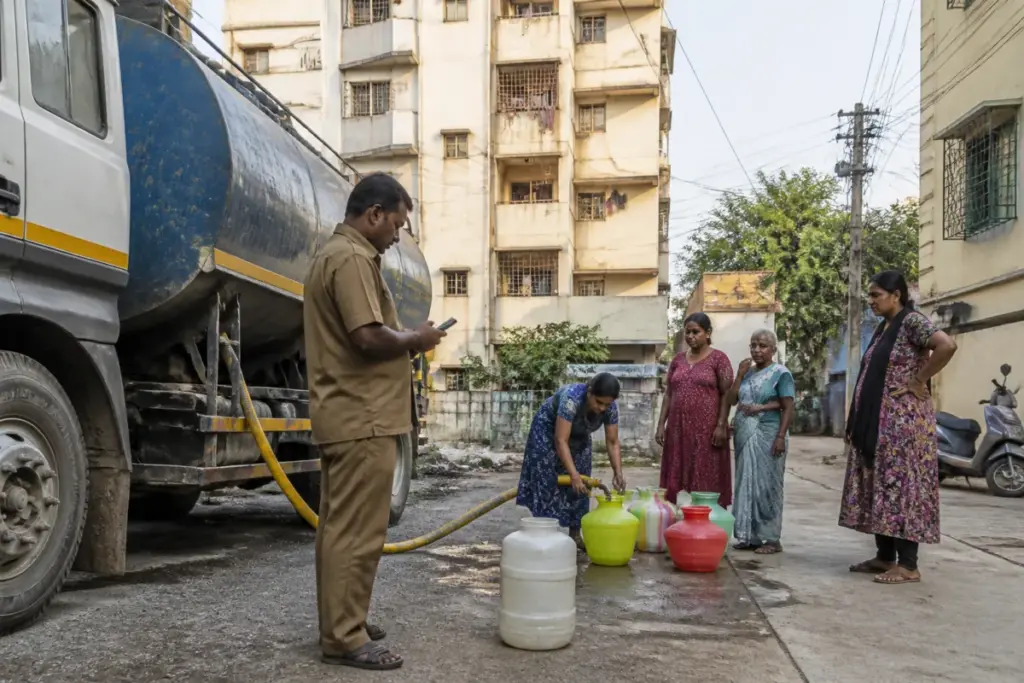
Pune’s OTP tanker system was announced as a way to make emergency water deliveries more accountable, but six months later the mechanism reportedly remains limited to Sus and Mhalunge. The delay exposes a familiar weakness in urban water governance: a digital control promised across a city can have little effect when it is not implemented at every point where citizens depend on the service.
The issue was raised by Vivek Velankar, president of Sajag Nagrik Manch, in a representation to the Pune Municipal Corporation commissioner. According to the Civic Mirror report, Velankar asked when the OTP-based tanker management system would become operational across Pune and sought implementation rather than further announcements. He claimed that, apart from Sus and Mhalunge, the system had not been activated elsewhere.
The municipal corporation had announced the system as part of an effort to make tanker-based water supply more transparent and reduce corruption. The stated model links the completion of a tanker trip to confirmation by the receiving citizen or housing society. When a tanker reaches its designated location, the recipient receives a one-time password by SMS. The trip is recorded as completed only after that OTP is entered into the system.
That design is significant because tanker supply is not simply a transport service. It is a chain involving a demand for water, allocation of a tanker, movement to a specified location, delivery to a resident or society and a record that the trip was completed. If any part of that chain is recorded without confirmation from the recipient, the administrative system may show activity without establishing that water actually reached the intended users.
The OTP is therefore intended to create a basic transaction record tied to the consumer. It is meant to answer three operational questions: whether the tanker made the trip, whether it reached the prescribed location and whether the recipient confirmed delivery. GPS monitoring of tankers is another feature associated with the proposed system. Together, these elements are designed to connect the vehicle’s movement with the citizen’s confirmation rather than relying only on paperwork or internal entries.
Yet the reported limitation of the system to two locations raises a broader question about how pilot projects become city services. A mechanism can demonstrate its usefulness in one area without changing the governance of the wider network. If residents in some parts of Pune receive deliveries under a system that records consumer confirmation, while residents elsewhere remain outside it, the city does not have one transparent tanker network. It has different levels of accountability operating in different neighbourhoods.
The source report states that the system was discussed for areas including Pashan, Baner, Mhalunge and Balewadi, as well as the wider city. It also refers to an earlier pilot involving Sus and Mhalunge and to the possibility of extending the Pune model across Maharashtra. But the reported gap between the pilot locations and the rest of the city means that the expansion question is now tied to Pune’s own implementation record. A model cannot be assessed as a citywide governance reform while most tanker points remain outside its control framework.
This matters because tanker dependence places residents in a position of limited choice. When piped supply is inadequate or water availability is reduced, households and housing societies must rely on scheduled or emergency deliveries. In that situation, the citizen may know that a tanker was expected but have less ability to establish whether the trip was properly recorded, whether the quantity reached the designated point or whether the delivery was delayed. The OTP process is intended to give the recipient a formal role in closing that transaction.
Velankar’s representation also links the issue to the risk of black-market practices and alleged arbitrary conduct by tanker operators. The report does not establish the scale of any such activity, nor does it provide municipal data comparing tanker trips before and after the pilot. What it does establish is the accountability logic behind the demand: a system designed to prevent false entries and confirm delivery has limited value if it is unavailable to residents who continue to depend on tankers.
The implementation gap is consequently not only a technology problem. The technology is relatively straightforward in concept: an SMS-based OTP, a digital record and GPS-based monitoring. The harder administrative task is ensuring that every tanker point, operator and receiving institution follows the same process. It requires the municipal corporation to define where the system applies, ensure that tankers are connected to it, identify the responsible officials and make the status of each delivery visible to the relevant users.
The six-month period cited in the report is important for another reason. It distinguishes an initial development phase from a prolonged transition. A pilot may reasonably require testing, adjustments and technical troubleshooting. But once a citywide announcement has been made, the administration also needs to explain which parts are complete, which remain pending and what prevents expansion. Without that information, a public announcement can continue to suggest coverage that residents do not experience on the ground.
The governance challenge is especially clear in the contrast between a physical service and its digital oversight. Water still has to be sourced, transported and delivered by a tanker. An OTP cannot compensate for inadequate supply, poor scheduling or an incorrect delivery location. It can, however, create a verifiable link between the promised service and the recipient’s confirmation. The system’s purpose is not to replace water planning but to make the emergency distribution process more traceable.
The available evidence does not show whether the Pune Municipal Corporation has fixed a citywide launch date, published a list of operational tanker points or released performance data from Sus and Mhalunge. It also does not establish why other areas have not been included. Those are central administrative facts, because the difference between a temporary pilot and a functioning city service depends on scope, milestones and public reporting.
The source report says water cuts could increase demand for tankers in the coming period, according to Velankar’s representation. That claim is attributed to him and is not accompanied in the supplied material by municipal demand projections or water-supply figures. Even without those figures, the institutional issue is clear: when reliance on tankers increases, the need for reliable records becomes more important, not less. A control mechanism that covers only selected locations leaves the remaining transactions dependent on older forms of verification.
For Pune, the immediate test is therefore whether the municipal corporation treats the OTP system as a citywide accountability platform or as a limited demonstration project. The administration’s response would need to clarify the system’s current coverage, the reasons for the delay outside Sus and Mhalunge, the status of GPS monitoring and the timeline for bringing all tanker points into the network. It would also need to show how residents can know that their confirmation has been recorded.
The reported delay illustrates a wider pattern in municipal administration: the public value of a digital reform lies less in its announcement than in the consistency of its everyday use. In Pune’s tanker network, transparency will be meaningful only when the system covers the places where water is actually being delivered and when each completed trip can be linked to a recipient’s confirmation. Until then, the city’s OTP promise remains an incomplete layer of oversight over a service on which many residents continue to depend.


