

The suspected dengue-related death of a nine-year-old girl from Lohegaon has placed Pune’s mosquito-control and health-surveillance systems under scrutiny, even though the Pune Municipal Corporation has not yet confirmed that dengue caused the death. The case is being reviewed by the civic health audit committee after the child died during treatment at Ruby Hall Clinic on October 18.
The distinction between a suspected and confirmed dengue death is central to the case. The girl, a Class 4 student from Khese Park, tested positive on a non-ELISA NS1 antigen test. The PMC will examine her medical details and test results before deciding whether the death should be classified as dengue-related. Until that review is complete, the case remains an indication of possible mosquito-borne disease risk rather than a confirmed fatality from dengue.
That process also reveals how urban disease surveillance works beyond the hospital. A death occurring in a private healthcare facility does not automatically become a confirmed civic-health statistic. Municipal authorities must assess the diagnostic evidence, clinical history and test results before finalising the cause. In this case, the health audit committee is the institution responsible for making that determination.
The medical timeline described in the available report shows how quickly the child’s condition worsened. She developed a fever after attending a dandiya event on the evening of October 17. Her family initially took her to a private hospital near their residence, where she received outpatient treatment. Her condition later deteriorated, and she was admitted to Ruby Hall Clinic on October 17. She died within 48 hours of admission.
Doctors reported that she was critically ill, with complications affecting her liver and kidneys. Her platelet count, which had been around 2 lakh during the earlier stage of treatment, fell to 50,000 by the time she reached Ruby Hall Clinic and later declined to 9,000 as her condition worsened. These figures describe the severity of her clinical deterioration, but they do not by themselves establish dengue as the cause of death. That determination remains with the civic review process.
The case therefore sits at the intersection of clinical care and municipal administration. Hospitals handle diagnosis and treatment, while the civic body is responsible for reviewing relevant deaths, monitoring potential outbreaks and acting on possible mosquito-breeding risks. The available information does not establish whether an earlier diagnosis would have changed the outcome, nor does it identify where the infection may have occurred. Those limits matter because a suspected case should not be converted into a conclusion about treatment failure, civic negligence or the source of transmission without supporting evidence.
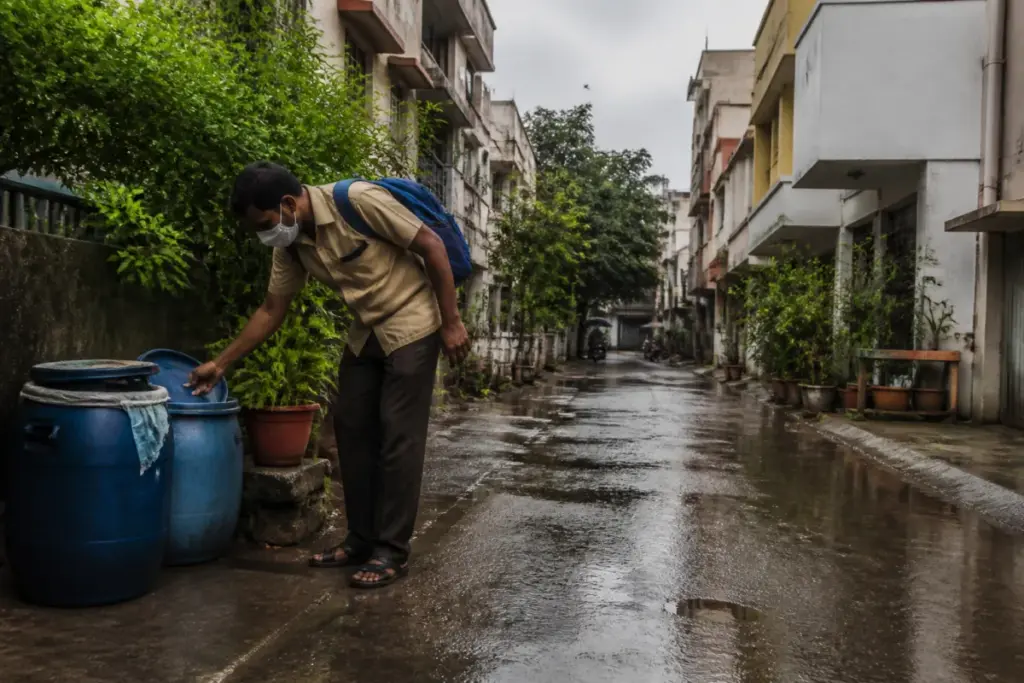
What is established is that the PMC has started vector-control and preventive measures in Khese Park and surrounding areas. The stated objective is to reduce mosquito breeding and limit the risk of further mosquito-borne infections. The response shifts the focus from one patient to the neighbourhood environment: whether breeding sites can be identified, whether preventive action reaches surrounding premises and whether residents receive timely information about possible risks.
This neighbourhood-level response is an important part of the urban health chain. Mosquito-control measures are not limited to hospitals or laboratories. They depend on municipal field operations, access to local areas, identification of breeding conditions and follow-up after complaints or suspected cases. The source material does not specify the exact methods used by the PMC, the number of premises inspected, the locations treated or the results of those operations. It also does not provide a wider case count for Pune or establish whether the suspected death forms part of a broader increase.
That absence of information limits what can be concluded from the case. Pune has not, on the evidence supplied, been shown to be experiencing a confirmed dengue outbreak. Nor does the report establish that this is definitively the city’s first dengue death of the year; it describes it as the first suspected dengue-related death. The wording reflects the unresolved status of the medical review and should remain precise in public communication.
The case also demonstrates why health data requires careful classification. A positive non-ELISA NS1 antigen test is part of the evidence being reviewed, but the PMC has not yet completed its assessment. The civic audit committee’s decision will determine how the death enters official records and how authorities interpret the event for surveillance and response. Until then, the available facts support heightened attention, not a final epidemiological conclusion.
For residents, the immediate concern is practical rather than statistical: whether the vector-control action in Khese Park and nearby areas is timely, visible and sustained. The report confirms that preventive measures have begun, but it does not provide an implementation schedule, inspection data or a follow-up assessment. Those details would help establish whether the municipal response is limited to an initial intervention or forms part of a continuing surveillance effort.
The institutional question is equally important. A suspected mosquito-borne death triggers multiple responsibilities, but the supplied information identifies only some of them. The PMC health audit committee must review the case. Civic field teams have begun preventive action. Hospitals have recorded the clinical deterioration and test results. The report does not state whether any additional public-health advisory has been issued, whether contact or neighbourhood surveillance has been expanded, or whether other suspected cases have been identified.
This is why the event is more consequential than a single hospital death report. It shows how urban health protection depends on the connection between private medical treatment, municipal verification and local environmental action. If any part of that chain is delayed or poorly documented, the city may have difficulty distinguishing an isolated case from a wider risk. At the same time, the present evidence is not sufficient to say that such a failure occurred here.
The next decisive step is the PMC health audit committee’s review. Its findings will determine whether the death is confirmed as dengue-related and may clarify how the medical evidence is interpreted. Further information on the vector-control operation, local surveillance and any additional cases will be necessary to assess whether the Khese Park response has contained a suspected risk or whether the area requires a broader municipal intervention.


