

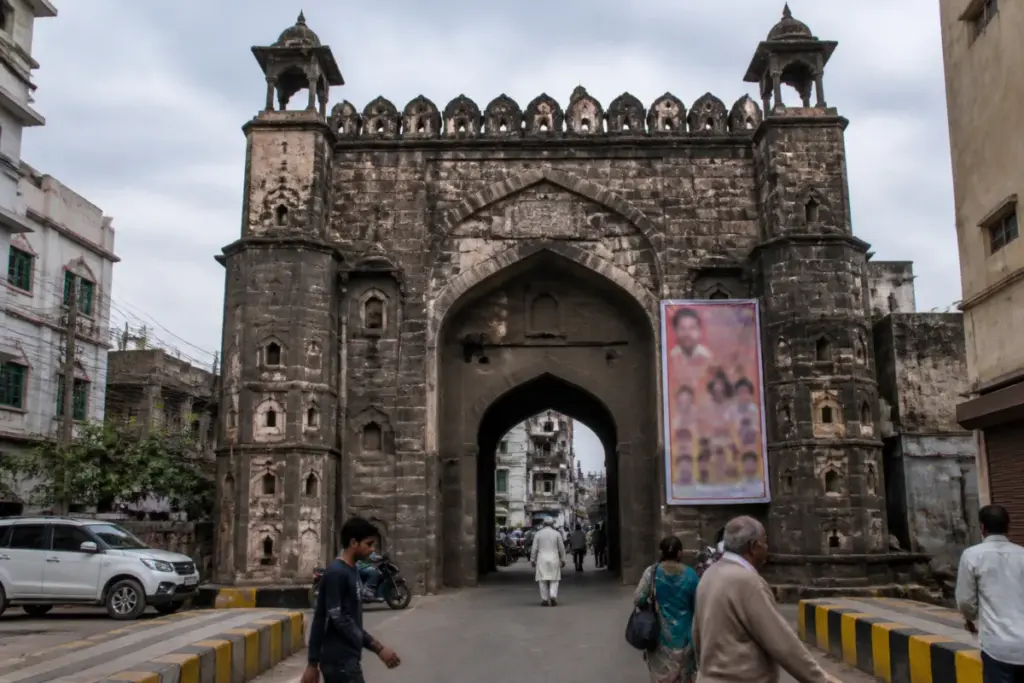
Kala Darwaza, a designated heritage structure near Taj-ul-Masajid in Bhopal, has been defaced with a poster of the Madhya Pradesh Waqf Board chairman, highlighting continuing concerns over the protection and upkeep of the city’s historic gateways.
The gate also serves as an entrance to the Madhya Pradesh Waqf Board office. It is recognised as a heritage structure in Bhopal’s new draft master plan. The poster has raised questions about whether heritage recognition is being matched by routine maintenance and enforcement against unauthorised advertising.
The Directorate of Archaeology spent Rs 28 lakh on restoration of Bhopal’s heritage gates around 2013, with Kala Darwaza among the structures taken up for the work. Restoration and related efforts have also involved the Bhopal Municipal Corporation, the Madhya Pradesh Tourism Development Corporation and the Directorate of Archaeology, Archives and Museums.
Despite those interventions, the structure has not received sustained protection, according to the report. A heritage conservation expert said the defacement reflected a gap between heritage recognition and protection. The expert was not named. The Madhya Pradesh Waqf Board office did not respond to requests for comment.
Local residents said posters had previously been nailed to the gate by Waqf Board representatives and politicians. The practice brings the structure within the scope of laws governing defacement of publicly visible property. Under the Madhya Pradesh Sampatti Virupan Nivaran Adhiniyam, 1994, defacing property visible to the public without the owner’s written permission is a cognisable offence, punishable with a fine of up to Rs 1,000.
A Bhopal Municipal Corporation official also cited Section 335 of the Madhya Pradesh Municipal Corporation Act, 1956, which penalises unauthorised poster-pasting on buildings and other properties. The report did not state whether an offence had been registered or whether the poster had been removed.
Kala Darwaza is part of the historic architectural axis associated with Shahjehanabad, an area that expanded during the 19th century. The gateways were built during the reign of Nawab Shah Jahan Begum, who assumed the throne in 1868 and is credited with the development of Shahjehanabad and the Taj Mahal Palace. Kala Darwaza and the Taj Mahal Gate, also known as Teen Mohara Gate, formed part of the area’s boundary.
Historian and author Rizwanuddin Ansari said two parallel gateways once stood along what is now Royal Market. One, located near Thelay Wali Sadak on the road from Gandhi Medical College towards Teen Mohara Gate, was built of red stone and became known as Lal Darwaza. The darker-looking gateway came to be known as Kala Darwaza. Lal Darwaza and Imami Gate were later demolished for road construction.
The reported defacement leaves the immediate administrative response unresolved, including whether the poster will be removed and whether action will be taken under the applicable municipal and state laws.


