

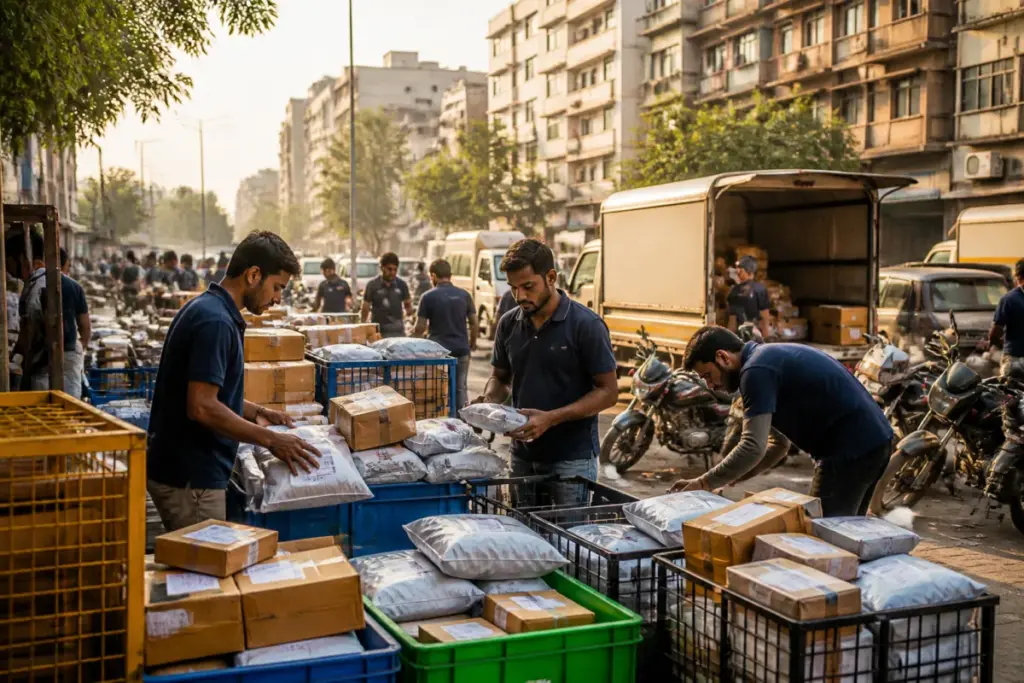
Flipkart’s 2026 Big Billion Days sale points to a significant shift in India’s e-commerce geography: online demand is no longer concentrated primarily in the largest metropolitan markets. The company reported that orders, units and buyers each rose by about 20-22 per cent year-on-year during its 11-day festive event, while nearly 60 per cent of buyers came from Tier 2-plus cities. The figures suggest that the next phase of digital commerce will be shaped as much by smaller urban markets as by established metros.
The sale, which opened on October 9, was described by Flipkart as its 13th edition. About nine in 10 of India’s online shoppers visited the platform during the event, according to the company, with unique visitors rising nearly 10 per cent from the previous year. One in 15 online shoppers visited Flipkart in the first hour. These figures are company-reported and do not, by themselves, establish the total size or profitability of India’s online retail market. They do, however, reveal how large festive sales have become as a window into consumer behaviour across the country.
The more consequential part of the data is the spread across locations and categories. Flipkart said Chhatrapati Sambhajinagar, Nagpur, Jabalpur and Meerut were among the fastest-growing Tier 2-plus markets. Customers in these cities bought products extending well beyond daily essentials, including laptops, gaming tablets and air fryers. The reported purchases indicate that online demand in smaller cities is not limited to low-value convenience products. It is also reaching consumer electronics, appliances, lifestyle goods and other discretionary categories.
That matters because the urban structure supporting e-commerce is different in a metro and in a smaller city. In the largest cities, online retail operates within dense markets with extensive delivery networks, a large base of digitally active consumers and multiple fulfilment options. In smaller cities, the same growth requires platforms to connect dispersed demand with sellers, warehouses, delivery staff and transport links. The sale figures therefore reflect not only consumer interest but also the expansion of the commercial systems needed to serve that interest.
Flipkart reported that beauty, grooming and general merchandise buyers increased by 40 per cent, while lifestyle buyers rose 12.5 per cent. Large appliances grew 30 per cent year-on-year in the opening hour, and demand for big-ticket products remained nearly nine times that of a normal period throughout the sale. These numbers show the intensity of festive demand, but they also highlight the operational challenge: products with different sizes, prices and delivery requirements must move through the same national retail network within a compressed period.
The company also said new customers on Flipkart Minutes rose 1.7 times compared with regular days. The figure is relevant to the development of quick-commerce and local fulfilment models, although the supplied report does not provide order volumes, delivery times, geographic coverage or profitability for the service. It therefore cannot establish whether the growth represents a permanent change in shopping habits or a temporary festive effect. What it does show is that consumers were willing to use a rapid-delivery channel during a period of heightened shopping activity.
The seller data adds another layer to the urban story. Around 31 per cent of transacting sellers reportedly recorded twofold growth over business as usual during the sale. Sellers from Tier 2-plus markets grew 2.15 times, while sellers in Bhiwadi, Panipat, Tirupur and Hisar recorded growth of 2.6 times, 2.5 times, 2.1 times and two times respectively. The data indicates that the geography of online commerce is not only about where customers live. It is also about where goods are produced, stored and sold.
Several of these locations have established industrial or trading identities. The report does not provide a breakdown of seller categories, employment, warehouse capacity or the share of local production in the reported sales. It would therefore be premature to treat the figures as proof of broad-based economic transformation in these cities. Still, the seller growth suggests that smaller urban centres can participate in e-commerce as supply locations as well as consumption markets.
The comparison with Amazon’s Great Indian Festival provides a wider indication of the competitive scale of festive commerce. Amazon reported that overall seller sales grew 3.5 times compared with business as usual, while products sold more than twice as fast. New sellers recorded more than 2.5 times growth in units sold, and the number of small and medium businesses crossing Rs 10 lakh in sales grew more than fourfold. Amazon also reported its highest-ever seller participation, up nearly 30 per cent year-on-year, with more than 70 per cent of participating businesses coming from Tier 2 and Tier 3 cities.
Amazon’s figures, like Flipkart’s, are company-reported and use business-as-usual comparisons that are not defined in the supplied material. The two platforms’ numbers should therefore not be treated as directly comparable measures of market share or national retail growth. Their significance lies elsewhere: both point to smaller cities becoming central to the recruitment of sellers and the expansion of demand.
Amazon’s examples included women entrepreneurs in Churu and Bhopal, traditional artisans in Jodhpur and Saharanpur, and small businesses across India. The company said it was making selling simpler and more affordable, including through zero referral fees on products priced below Rs 1,000. This is an example of how platform-level pricing and fee structures can influence participation, particularly for smaller businesses operating with limited margins. The supplied report does not establish how many sellers benefited from the policy or whether the savings were passed on to consumers.
The institutional structure behind this growth is broader than the platforms themselves. E-commerce depends on digital payments, telecommunications, road connectivity, warehousing, fulfilment centres, local delivery networks and the ability of sellers to meet platform standards. When demand spreads into Tier 2 and Tier 3 cities, the pressure is distributed across these systems. A city may gain new access to products without having the same logistics density as a major metropolitan area. The quality and cost of the final delivery can therefore depend on infrastructure and administrative conditions beyond the online marketplace.
The reported rise in big-ticket purchases also has implications for urban delivery systems. Large appliances and other high-value products require more than a doorstep parcel network. They may involve larger vehicles, storage capacity, installation services, returns handling and coordination with local roads and buildings. The source material does not provide evidence on delivery failures, congestion, packaging waste or service quality during the sale. Those gaps matter because transaction growth does not automatically translate into an equally efficient urban distribution system.
The seller numbers raise a related question about the relationship between digital reach and local economic capacity. If businesses in smaller cities can access national demand, online platforms may reduce the importance of physical distance between a seller and a customer. But the supplied evidence does not show whether these sellers are newly established enterprises, existing businesses shifting channels, or larger firms operating from smaller urban locations. Nor does it show the effect on local employment, rents, production networks or traditional retail.
What the evidence confirms is narrower but still important. Festive e-commerce is drawing substantial participation from outside India’s largest cities. Consumers in Tier 2-plus markets are buying across a widening range of categories, and sellers from smaller urban centres are recording strong platform-reported growth. Both Flipkart and Amazon describe their festive events as increasingly dependent on these markets.
What remains uncertain is whether the reported surge will persist after the sale period, how much of the growth represents new consumption rather than purchases shifted from physical stores, and whether sellers can maintain sales once promotional intensity declines. The supplied figures also do not establish whether access is evenly distributed across smaller cities or concentrated in better-connected urban markets. Those questions will determine whether festive-sale growth is a temporary demand spike or evidence of a deeper reorganisation of India’s retail geography.
For cities, the central issue is not simply that more people are shopping online. It is that consumption, production and distribution are becoming more closely linked across a wider network of urban centres. The next measure of this transition will be whether digital platforms can sustain seller participation, reliable fulfilment and customer access beyond the annual sales cycle. The current data shows the scale of the opportunity, while leaving the longer-term urban and economic effects to be established by more detailed evidence.


