

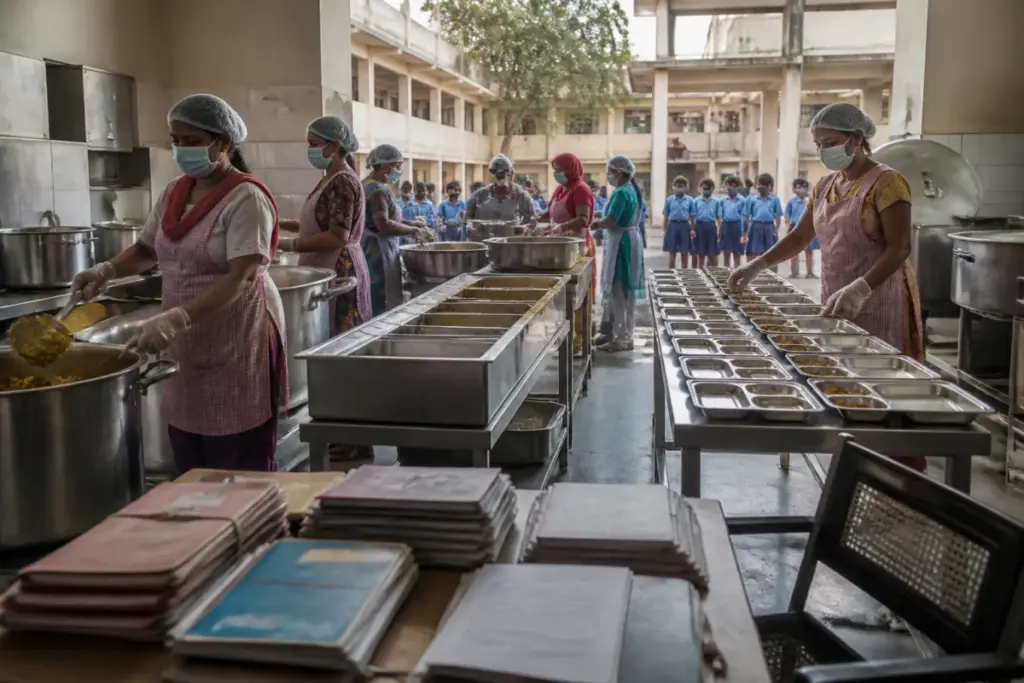
The mid-day meal tender ruling by a Delhi district court has placed a procedural barrier between unsuccessful suppliers and a civil-court challenge to government procurement decisions. The order treats disputes arising from the selection of organisations to supply meals under the PM Poshan scheme as commercial disputes, requiring pre-litigation mediation before a lawsuit can be filed.
The decision matters because the dispute was not about an ordinary private contract. It arose from the delivery of meals to government-school students, a public service that depends on government specifications, institutional eligibility, kitchen capacity and administrative supervision. By placing the tender challenge within the framework of the Commercial Courts Act, 2015, the court has linked the legal route available to bidders with the wider machinery of public-service procurement.
According to the report, the District Judge at Tis Hazari, Tarun Yogesh, dismissed a suit filed by Subharti Jan Kalyan Samiti against Delhi’s Education Department and the organisations selected for the work. The committee had challenged the Technical Evaluation Committee’s recommendation dated 4 February 2026, the letter of acceptance issued on 7 April and the work orders issued on 30 April.
The committee alleged that the selection process involved arbitrariness and a lack of transparency. It also claimed that some organisations had been selected despite not meeting the prescribed eligibility conditions. The committee said it had spent about Rs 60 lakh preparing a kitchen in line with PM Poshan scheme standards, making the tender outcome financially significant for the organisation beyond the immediate question of selection.
The Education Department questioned whether the suit was maintainable and argued that the dispute was commercial in nature. The court accepted that position, holding that a dispute connected with services supplied through a tender falls within Section 2(1)(c)(18) of the Commercial Courts Act, 2015. The court consequently found that the civil court did not have jurisdiction to entertain the case in the manner it had been filed.
The ruling therefore turns on procedure rather than on whether the allegations about the tender were correct. The report does not state that the court examined and upheld the eligibility of the selected organisations, nor does it record a finding that the allegations of arbitrariness were proved. The suit was rejected because the court found that the pre-litigation mediation requirement had not been followed and that the forum used by the petitioner was not competent in the circumstances described.
That distinction is important in public procurement disputes. A challenge can contain two separate questions: whether the government or its evaluation committee acted lawfully, and whether the challenger followed the correct route to seek a remedy. The Delhi court’s decision addresses the second question. It indicates that, for disputes classified under the Commercial Courts Act, an aggrieved bidder cannot move directly to a civil suit without first completing the statutory pre-litigation mediation process.
The institutional consequence is that procurement disputes involving public services may be filtered through a dispute-resolution mechanism before they reach conventional litigation. Mediation is intended to provide an opportunity for settlement before a case is filed, but the ruling, as reported, treats that step as mandatory rather than optional. For agencies issuing tenders, this creates a defined legal framework for responding to challenges. For suppliers and non-governmental organisations, it makes procedural compliance an essential part of contesting a tender decision.
The case also shows how the design of a public programme can create overlapping administrative and legal responsibilities. The Education Department is responsible for the procurement decision described in the report, while the selected organisations would be responsible for supplying meals to government schools. The dispute sits between these two layers: it concerns a commercial selection process, but the service being procured is connected to school nutrition and the daily functioning of public education.
The report says that the court referred to three similar matters filed by Vishwakarma Education and Charitable Society, the Bharatiya Manav Kalyan Parishad and the Dalit Manav Utthan Sansthan. Those cases sought similar relief and had been dismissed or rejected on 14 October, according to the report. The reference to multiple cases suggests that the court was applying a consistent procedural approach to a group of challenges arising from the same or a related procurement process.
At the same time, the available material does not establish how the mediation requirement will affect the timing of meal-service contracts, whether any mediation was later attempted, or whether the petitioners intend to pursue another legal remedy. It also does not provide the tender’s full eligibility conditions, the evaluation scores, the names of the selected organisations or the operational status of the kitchens referred to by the petitioner. Those details are necessary to assess the substantive procurement allegations but are not contained in the supplied report.
The financial claim of about Rs 60 lakh adds another dimension to the dispute. For an organisation preparing infrastructure specifically for a government programme, an unsuccessful tender outcome can leave behind sunk costs. However, the court’s reported decision does not determine whether those costs created any legal entitlement to the contract, nor does it decide whether the tender process was unfair. The expenditure claim remains part of the petitioner’s position as reported, not a finding by the court.
The larger governance question is how public authorities can preserve both administrative efficiency and contestability in essential service contracts. Tendering allows governments to select organisations against stated conditions, but the ability to challenge that selection is also part of procurement accountability. The court’s interpretation places that challenge within a specialised commercial-law process, making the pre-litigation stage a formal gateway rather than a preliminary courtesy.
For bidders, the practical lesson from the ruling is procedural: identifying a possible irregularity is not enough if the challenge is filed in the wrong forum or without completing a mandatory step. For public authorities, the decision provides support for treating service-procurement disputes under the Commercial Courts Act where the statutory conditions are met. For school communities, the immediate concern remains whether procurement disputes affect the continuity, quality and accountability of meal supply, an issue on which the supplied report provides no operational update.
The ruling therefore clarifies the route for one category of PM Poshan tender challenge without resolving the underlying allegations about eligibility or transparency. The next developments to monitor are whether the dismissed organisations seek relief through the legally appropriate process, whether mediation is initiated, and whether the Education Department’s meal-supply arrangements continue under the issued work orders.


