

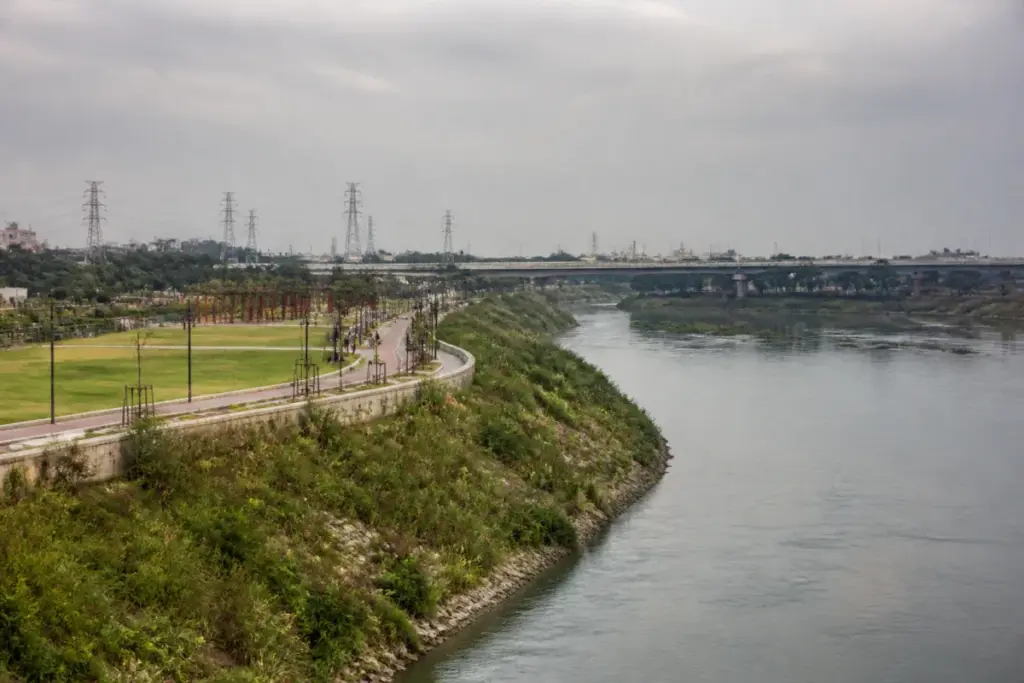
Delhi’s proposed Yamuna riverfront is being presented as a future public space, but the project’s real test will be whether riverfront construction advances alongside the less visible work of sewage treatment and river restoration. The government has begun preparing a memorandum of understanding with the Sabarmati Riverfront Development Corporation and plans to implement the project in two phases, linking a high-visibility urban design exercise to one of the capital’s most persistent environmental and infrastructure challenges.
The first phase is planned from Palla to Wazirabad, while the second would run from Wazirabad to Kalindi Kunj near the Okhla barrage. The government intends to complete the first phase before proceeding with the second, using the initial stretch to demonstrate the overall design. Walking and cycling tracks, sports facilities and recreational areas are proposed along the river. Water Minister Parvesh Verma has said the project’s model could become visible to Delhi residents during the government’s current term.
That sequencing matters because the plan is not simply a beautification project. The Yamuna runs for approximately 52 kilometres through Delhi, and the 22-kilometre stretch between Wazirabad and Okhla has been identified as a key focus area for rejuvenation. The riverfront proposal is therefore being developed alongside sewage treatment and river-cleaning efforts. The government’s stated objective is to improve the river while creating a clean, green and accessible public space for walking, yoga, sport and leisure.
The institutional design is still at an early stage. The Delhi government has initiated the process for an MoU with the Sabarmati Riverfront Development Corporation, the body associated with Ahmedabad’s riverfront model. Consultants are also being hired to guide the Delhi project. These steps indicate that the project has moved beyond a broad political announcement, but they do not yet establish the final design, land requirements, construction schedule, financing structure or operating arrangements.
The decision to study Ahmedabad’s riverfront model gives the proposal a recognisable template, but Delhi’s river conditions and administrative responsibilities make direct replication difficult to assess from the information currently available. The government has said that the Ahmedabad visit was intended to identify features and practices that could be adapted to Delhi’s requirements. Officials from the Delhi Jal Board and the Irrigation and Flood Control Department accompanied the minister, bringing water and flood-management institutions into the early planning process.
This administrative involvement is important because a riverfront is not only a landscape project. Its construction can require coordination across water supply and sewage agencies, flood-control authorities, land-owning bodies, urban planners and local administrations. In Delhi’s case, the proposed riverfront is being developed in the same policy space as the clean-up of the Yamuna. That means the project’s public-facing elements—tracks, sports grounds and open spaces—will depend on infrastructure that residents may never see, including treatment capacity and the management of wastewater entering the river.
According to Verma, 28 of Delhi’s 37 sewage treatment plants have been upgraded over the past 18 months. The government is also developing new plants intended to add 250 million gallons per day of treatment capacity. These figures are central to the riverfront proposal because they connect the visible promise of a usable waterfront with the capacity of the city’s wastewater system. The minister has said the government expects the Yamuna to become visibly cleaner within around two-and-a-half years.
The supplied report does not provide plant-wise performance data, details of the treatment upgrades, the locations of the proposed new plants or the financing arrangements for the additional capacity. It also does not specify how the government will measure whether the river has become cleaner. As a result, the treatment figures establish the scale of the stated intervention but not yet its effect on water quality or on the river’s ecological condition.
The same distinction applies to the proposed public realm. The government has identified the uses it wants the riverfront to support—walking, cycling, yoga, sport and leisure—but the available information does not yet describe the proposed width of the riverfront, access points, universal accessibility measures, maintenance model or safeguards for areas exposed to flooding. These details will determine whether the project functions as a citywide public asset or remains concentrated in selected, heavily designed stretches.
The two-phase structure could allow the government to test the riverfront’s design before committing to the full corridor. The first phase, from Palla to Wazirabad, would serve as the initial showcase, while the second phase would extend southwards to Kalindi Kunj near the Okhla barrage. However, the report does not state the length, cost or implementation timeline of either phase. Nor does it clarify whether the first phase is intended to prioritise river restoration, public access, flood management or a combination of these objectives.
This absence of detail highlights the central policy question: what comes first, the river or the riverfront? In the government’s current framing, the two are linked. The proposed public spaces are meant to accompany efforts to improve sewage treatment and rejuvenate the Yamuna. That approach recognises that a waterfront cannot be sustained by paving and landscaping alone if the river remains affected by inadequate treatment or untreated discharges.
At the same time, the project’s institutional structure will determine how those objectives are balanced. The Delhi Jal Board and the Irrigation and Flood Control Department have been involved in the study visit, while consultants are being brought in to guide the project. The eventual MoU with the Sabarmati Riverfront Development Corporation may shape the transfer of planning knowledge, but the report does not establish which Delhi agency will have final responsibility for land, construction, water quality, flood safety, public-space management or long-term maintenance.
For residents, the most immediate promise is improved access to open space along the Yamuna. Walking and cycling tracks, sports facilities and recreational areas could expand the city’s public realm if they are connected to neighbourhoods and remain accessible. Yet access will depend on more than the existence of a designed edge. It will also depend on safe connections, regular maintenance and whether the river environment becomes suitable for sustained public use. None of those operational details has been finalised in the information available.
The proposal therefore represents two parallel projects. One is a visible riverfront intended to change how Delhi residents encounter the Yamuna. The other is an underlying sewage and river-rejuvenation programme that must address the conditions limiting that public use. The government’s own description places both within the same effort, making treatment capacity and river cleanliness as important to the project’s credibility as the eventual appearance of its tracks and recreational grounds.
The next stages will provide the clearest evidence of the plan’s seriousness. Those stages include finalising the MoU, appointing consultants, defining the first-phase design and clarifying how the sewage-treatment programme will support the river-cleaning objective. The government has said the first phase will precede the second and that a visible model could emerge during its current term. Until the design, responsibilities, costs, timelines and performance measures are made public, the Yamuna riverfront remains a significant urban proposal whose success will depend on whether Delhi can align public-space development with the infrastructure required to restore the river itself.


