

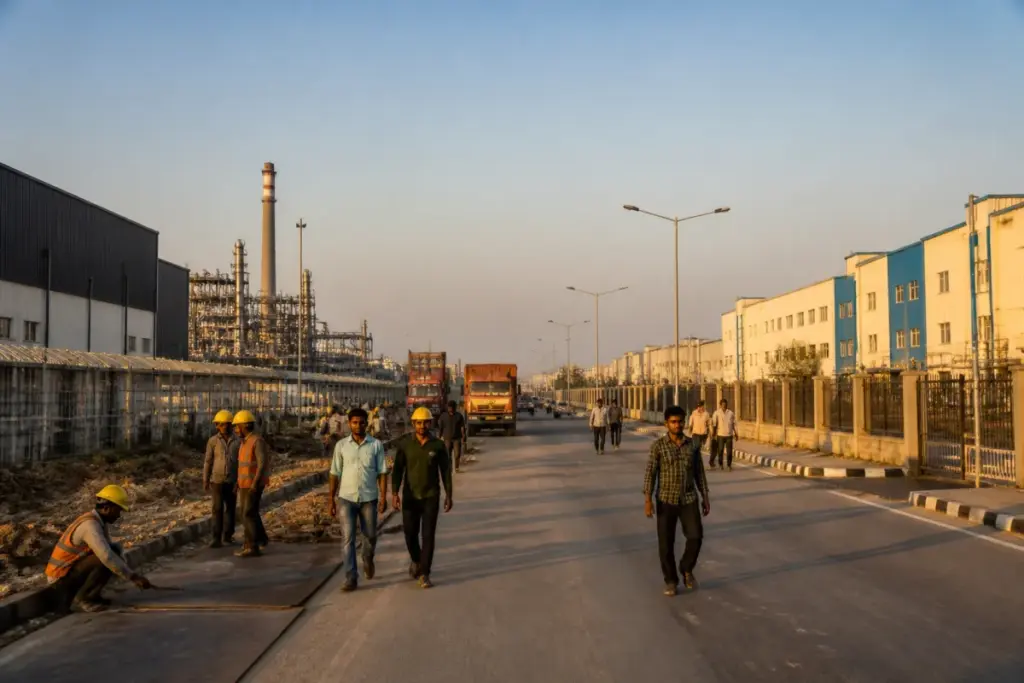
Gorakhpur industrial growth is no longer centred on the revival of one fertiliser plant. Over the past nine years, the city’s economic profile has been reshaped by the combined expansion of manufacturing, industrial land, roads, aviation, healthcare and education. The change is most visible around the Gorakhpur Industrial Development Authority (GIDA), but its consequences are extending into the wider urban region and the economic geography of eastern Uttar Pradesh.
The scale of the shift is reflected in investment figures cited from Invest UP. Industrial investment in Gorakhpur reached Rs 11,618.75 crore between 2017 and 2025, compared with Rs 29.33 crore during 2012–17. GIDA had 319 operational units generating 39,448 jobs, according to the same state investment-promotion material. These figures indicate a sharp change in the flow of capital into the district, although the longer-term urban significance will depend on how much of the announced investment becomes sustained production, local employment and durable supply chains.
For decades, Gorakhpur’s industrial potential was constrained by the closure of its old fertiliser plant, limited large-scale manufacturing and inadequate industrial infrastructure. The plant had remained closed for more than three decades before a new gas-based fertiliser facility was commissioned in December 2021. Developed at an investment of around Rs 8,600 crore, the facility has an annual capacity of 12.7 lakh metric tonnes of neem-coated urea.
The fertiliser plant matters because an industrial anchor changes more than the output of a single factory. Its operation creates demand for transport, logistics, maintenance, services and ancillary businesses. It also provides a large industrial presence around which smaller firms and service providers can organise. In Gorakhpur’s case, the plant’s location gives it significance beyond the municipal boundary, as it strengthens the industrial base of the Purvanchal region.
This is the institutional role increasingly being assigned to GIDA. The authority has attracted projects in food processing, beverages, dairy and manufacturing. Invest UP has highlighted investments involving Keyan Industries, Varun Beverages, Ankur Udyog and India Auto Wheels, as well as plans for Plastic and Garment Parks. The mix suggests an attempt to move from dependence on one large industrial facility towards a broader ecosystem of factories and supporting enterprises.
The expansion is also being designed to include smaller businesses. In 2026, 34 companies were allotted industrial plots in GIDA, with proposed investment of more than Rs 218 crore and employment potential of about 1,650 jobs, according to a report citing GIDA-related information. A flatted factory complex inaugurated in GIDA during the year was designed to accommodate 80 MSME units, with estimated employment potential of around 1,000 people.
Flatted factories are significant in a city where industrial expansion cannot rely only on large tracts of land. By placing smaller units in a compact industrial format, such complexes can bring enterprises closer to shared infrastructure and established industrial networks. The available material does not establish how many of the allotted units are already operational, but the model points to a more layered industrial geography in which large companies and MSMEs occupy the same regional ecosystem.
The next stage of Gorakhpur’s expansion is being planned beyond the established GIDA area. An industrial corridor along the Gorakhpur Link Expressway and the proposed Dhuriyapar Industrial City are intended to create additional space for manufacturing and investment. Invest UP has reported plans for an 800-acre industrial corridor along the expressway and a large land bank for the Dhuriyapar industrial area.
This shift from individual factories to planned industrial zones is important because industrialisation requires more than land allotment. It depends on roads, utilities, logistics, worker access, housing and everyday services. When these elements are planned together, industrial land can become part of an urban system rather than an isolated cluster of factory plots. GIDA’s current master-planning activity indicates that the authority is treating expansion as a long-term process, although the supplied material does not provide details of the plan’s implementation schedule or infrastructure financing.
Connectivity is central to this proposition. State investment-promotion material reports that Rs 7,486.89 crore was spent on constructing 1,492 km of roads in the district during the period covered by its assessment. The projects cited include the Jungle Kauria–Sonauli four-lane highway, the Gorakhpur Greenfield Bypass, the TP Nagar–Padley Ganj six-lane flyover, the Pipraich–Gorakhpur four-lane road and the Gorakhpur Link Expressway.
For manufacturers, these projects can reduce the logistical distance between factories, suppliers and markets. Gorakhpur’s position near Bihar and Nepal gives road connectivity an additional regional dimension. However, the investment figures alone do not show whether travel times, freight costs or congestion have improved by a measured amount. What they establish is that road-building has been treated as a parallel requirement of the district’s industrial expansion rather than as a separate civic programme.
Air connectivity has also grown. Airports Authority of India data cited in the report shows passenger movements at Gorakhpur Airport rising from 6.02 lakh in 2021–22 to 10.02 lakh in 2025–26. A new terminal building has been proposed, and the state government has acquired 42.14 acres for the project. The increase in passenger traffic reflects a broader demand for regional access, though passenger numbers alone cannot distinguish between business travel, medical travel, education-related movement and other forms of mobility.
The city’s economic transition is not limited to factories and transport infrastructure. The commissioning of AIIMS Gorakhpur alongside the fertiliser plant in 2021 added a major tertiary healthcare institution to eastern Uttar Pradesh. The same development package included the new building of the ICMR Regional Medical Research Centre. Education infrastructure has also expanded through institutions and facilities including a Sainik School, Atal Residential School, government colleges, ITIs and polytechnic institutions, according to state investment material.
These institutions widen the meaning of industrial growth. A city that attracts factories but lacks healthcare, education and technical training may generate limited local economic depth. Healthcare and education create their own employment and service demand while also supporting housing, retail, transport and professional activities. They can make the city more capable of retaining workers, students, patients and associated businesses. The available evidence does not quantify these secondary effects, but their simultaneous development shows that Gorakhpur’s expansion is being presented as a multi-sector urban transformation.
The policy landscape behind this transformation involves several distinct institutional functions. Invest UP is supplying the investment narrative and figures; GIDA is providing the industrial platform and land-allocation mechanism; road agencies are delivering regional and intra-urban connectivity; the Airports Authority of India is associated with passenger data; and healthcare and education institutions are expanding the city’s regional service role. The result is not a single urban project but a network of public authorities, industrial bodies and private firms operating across different parts of the built environment.
That institutional spread also creates a coordination challenge. Industrial corridors and new land banks require utilities, transport links and development controls to arrive in the right sequence. Factories require workers, and workers require affordable housing, safe mobility and access to public services. The supplied material identifies roads, industrial land and major institutions, but it does not establish whether housing, public transport, water supply or waste-management capacity is expanding at the same pace.
The available data nevertheless shows a clear change in scale. Industrial investment increased from Rs 29.33 crore in 2012–17 to Rs 11,618.75 crore in 2017–25. GIDA’s 319 operational units are associated with 39,448 jobs, while the 34 companies allotted plots in 2026 represent proposed investment of more than Rs 218 crore and potential employment of about 1,650 people. The fertiliser plant adds annual capacity of 12.7 lakh metric tonnes, while passenger movements at the airport rose by roughly two-thirds between 2021–22 and 2025–26.
These numbers should be read as indicators of investment, capacity and planned employment, not as proof that the entire regional economy has already changed. Proposed investment and employment potential are different from completed projects and realised jobs. Similarly, a rise in airport passengers indicates growing demand for air travel but does not, by itself, establish the nature or distribution of the economic benefits. The distinction will matter as Gorakhpur moves from project announcements to operational performance.
The larger urban question is whether the city can convert a set of major interventions into an integrated growth centre. The fertiliser plant provides an anchor, GIDA provides an industrial platform, the expressway and road projects expand market access, and AIIMS and educational institutions strengthen regional services. Dhuriyapar and the expressway-linked corridor could extend this geography further, but their effect will depend on how effectively land, infrastructure, jobs and urban services are connected.
Gorakhpur’s story therefore represents a shift from industrial stagnation towards planned economic diversification. The evidence confirms a substantial increase in investment and infrastructure activity since 2017, supported by major industrial, institutional and connectivity projects. What remains to be established is how deeply these projects are integrating with local firms, workers and neighbourhoods. The operation of new units, implementation of industrial-area plans, delivery of the proposed airport terminal and expansion of essential urban services will determine whether the city’s new growth-centre identity becomes a durable regional economic structure.


