

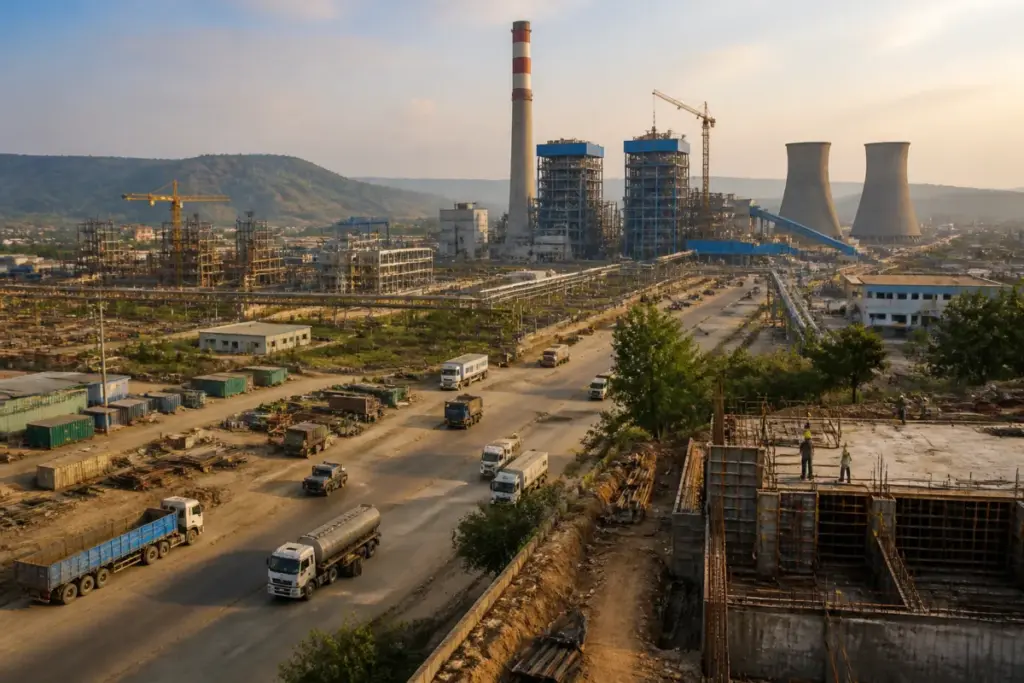
Sonbhadra’s investment push is reshaping the district’s long-standing identity as Uttar Pradesh’s energy and mineral centre. The district has signed memoranda of understanding for 33 projects involving proposed investments of Rs 14,612 crore, taking it closer to the Rs 20,000 crore target set for Ground Breaking Ceremony 5.0. The more important question, however, is not the scale of the proposals but whether they can be converted into operating projects, local employment and a broader urban-regional economy.
The current pipeline includes a proposed Rs 7,400 crore pumped storage power plant by the Adani Group at Panaura and a proposed Rs 6,400 crore investment by Tehri Hydro Development Corporation at Basudhari. Together, these two projects account for a substantial share of the announced pipeline and reinforce the district’s continuing importance in Uttar Pradesh’s energy system.
They also indicate a shift in the nature of Sonbhadra’s energy economy. The district has historically been associated with mineral resources and thermal power stations. Pumped storage introduces energy storage into that established industrial profile. The supplied report describes such projects as capable of helping balance electricity demand and supply and supporting the integration of renewable energy into the power system. That gives the proposed Panaura project a significance beyond its investment value, although the report does not establish its construction or commissioning status.
The distinction between a signed MoU and an operating asset is central to understanding the district’s transition. The Rs 14,612 crore figure represents proposed investment linked to signed agreements. It is not presented as capital already deployed, projects already commissioned or employment already created. The district still has an investment gap of Rs 5,388 crore against its GBC 5.0 target, and the administration is working to mobilise that amount. The next test will therefore be the movement from proposal to implementation.
### Sonbhadra investment and the implementation challenge
Investment announcements create an initial signal of intent, but their urban and economic value depends on the administrative systems that follow. The supplied report says the district administration is focusing on coordination between departments so that projects can reach the ground. That coordination is important because large energy and industrial projects typically require decisions and clearances across land, transport, utilities, construction, labour and local administration. The report does not provide a project-wise implementation schedule, land status, financing structure or construction milestones for the 33 proposals. Those omissions limit what can yet be concluded about delivery.
For Sonbhadra, the investment pipeline is closely tied to infrastructure capacity. Roads, logistics, communications, power supply, warehousing, housing and civic amenities will influence how effectively the district can support new industrial activity. A large project does not operate in isolation from its surrounding settlements. It requires movement of workers and equipment, access to services and connections to suppliers and markets. As a result, the investment programme has implications for the district’s wider settlement pattern, even though the supplied material does not specify which new roads, housing projects or urban facilities are planned.
This is where Sonbhadra’s established industrial base can offer an advantage. Existing energy infrastructure and industrial experience may help the district attract projects that depend on power, engineering services and transport networks. At the same time, a legacy of resource-based development does not automatically ensure diversified local growth. The proposed shift will have to be assessed by the range of businesses and workers able to participate in it, rather than by the value of headline investments alone.
The report identifies several possible links between large projects and the local economy. Construction companies, transport operators, equipment suppliers, maintenance agencies, accommodation providers, food businesses and professional services could receive additional demand. Traders, contractors and service providers may also enter supply chains around major industrial facilities. These are plausible channels of economic connection identified in the source, but the supplied material does not provide contracts, procurement data or evidence that local firms have already secured such opportunities.
### From energy projects to a wider employment ecosystem
Employment is one of the main reasons industrial investment matters to a district. Large energy projects can require skilled, semi-skilled and support workers during construction and operations. The report lists electrical and mechanical work, construction, logistics, equipment maintenance, security, hospitality and technical services as potential areas of employment. Ancillary industries could add opportunities beyond the main project sites.
Yet the employment outcome will depend on the match between local skills and industry requirements. The source makes a case for stronger skill development and industry-linked training, but it does not state how many jobs the proposed projects may generate or identify specific training institutions and programmes. This is a significant gap in measuring local impact. Without project-level employment commitments and information on local recruitment, the economic benefit to residents remains an expectation rather than an established outcome.
The same distinction applies to small and medium enterprises. The presence of large companies can create a market for local suppliers, but participation depends on procurement standards, technical capability, working capital and timely payments. The report presents local entrepreneurs as potential participants in industrial supply chains. Whether that potential becomes a durable business ecosystem will depend on how procurement is structured and how accessible it is to firms based in the district.
The investment pipeline may therefore broaden Sonbhadra’s economy, but it does not by itself demonstrate diversification. Diversification would mean that new activity extends beyond the core energy assets into engineering, logistics, maintenance, services and other sectors that can continue to support livelihoods around the main projects. The supplied evidence establishes the proposed scale and direction of investment; it does not yet establish the breadth or durability of the resulting economy.
### Infrastructure, settlements and regional growth
Industrial expansion also changes the demand placed on public infrastructure. Increased activity can raise the need for transport, warehousing, commercial establishments, housing and basic services. In a district with large industrial projects, these requirements are not secondary concerns. They determine whether workers can access jobs, whether goods can move efficiently and whether nearby settlements can absorb additional economic activity.
The report frames connectivity and infrastructure as growth enablers, linking Sonbhadra’s industrial centres with markets and supply chains within Uttar Pradesh and beyond. This places the district’s transformation within a wider regional planning question: whether industrial growth is supported by coordinated investment in mobility, logistics and civic services. The source does not provide road capacity figures, freight volumes, housing demand estimates or details of planned municipal expansion, so the scale of this infrastructure challenge cannot yet be quantified.
The absence of such information is relevant because investment-led growth can produce uneven outcomes. Large facilities may be financially significant while surrounding communities see limited local procurement or employment. Conversely, if supporting services and businesses develop locally, the projects can become anchors for a wider regional economy. The available report identifies both the opportunity and the intended mechanism, but not the measured results.
Sonbhadra’s transition should therefore be tracked through implementation indicators rather than announcements alone. These would include the number of projects that reach construction, the amount of investment actually deployed, the jobs created, local procurement achieved and infrastructure delivered around industrial areas. None of these indicators is provided in the supplied material. Their absence does not negate the current investment momentum, but it means the district remains at an early and partly unmeasured stage of transformation.
The policy landscape described in the report combines investment facilitation, infrastructure development, ease of doing business and time-bound project implementation. The district administration’s role is presented as one of coordination and mobilisation, while the state government’s wider approach is described as infrastructure-led growth. The success of this framework will depend on how responsibilities are divided between state departments, district authorities, project developers and local institutions. The source does not provide a detailed governance framework or project approval timeline, leaving those institutional mechanics to be established through subsequent official documents.
Sonbhadra’s investment push is significant because it connects energy infrastructure with the possibility of a more diversified regional economy. The Rs 7,400 crore Panaura pumped storage proposal and the Rs 6,400 crore Basudhari proposal show the scale of projects being associated with the district, while the 33-project pipeline indicates a broader investment ambition. But the evidence currently confirms proposals and signed MoUs, not completed assets or realised employment.
The next phase will determine whether Sonbhadra remains primarily an energy-producing district with a large investment pipeline or develops into a more connected industrial and service ecosystem. The most important developments to monitor are the mobilisation of the remaining Rs 5,388 crore, project-level progress, supporting infrastructure, local skill preparation and evidence that smaller businesses and residents are participating in the growth process.


