

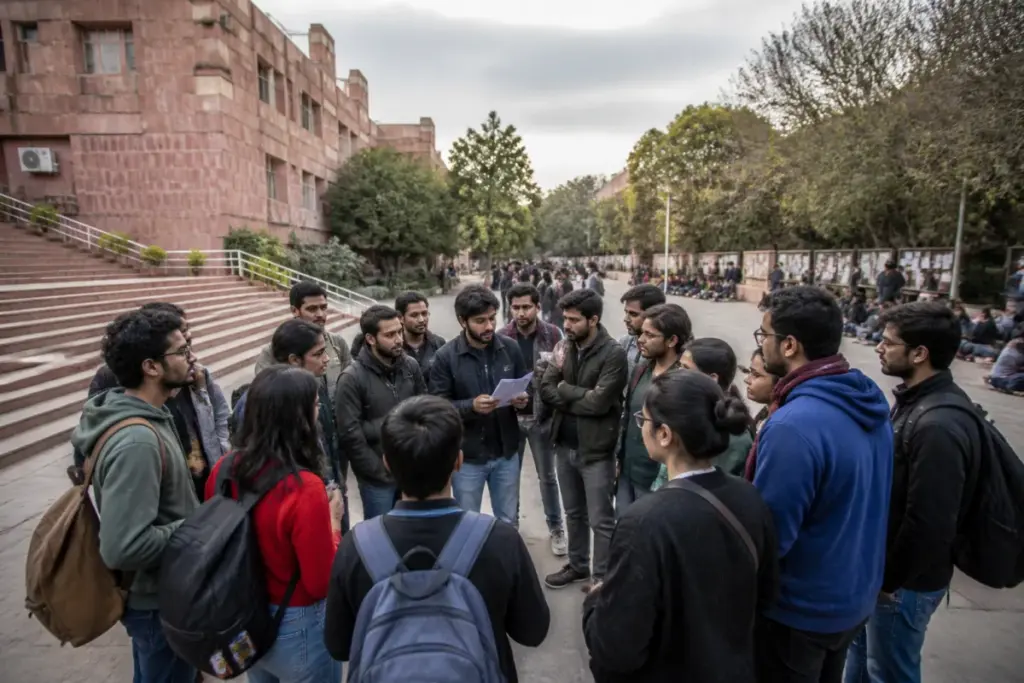
The Jawaharlal Nehru University Students’ Union (JNUSU) has called off its 17-day indefinite protest after the university administration agreed to act on demands covering student disciplinary proceedings, hostel infrastructure, campus facilities and representation in key committees.
The decision followed a meeting on Monday between student representatives and a committee headed by Prof Vivek Kumar, Dean of the School of Social Sciences. According to the minutes of the meeting, the university agreed to revoke the rustication of five students, including JNUSU president Aditi Mishra, vice-president K Gopika Babu and general secretary Sunil Yadav. A notice dated October 19 said Vice-Chancellor Santishree Dhanapalan had directed that the rustication be revoked with immediate effect. The students were advised to pay their respective fines.
The administration also agreed to constitute a committee to review contentious provisions in the Chief Proctor’s Office manual, which sets out rules on student discipline and conduct. The committee will include a JNUSU office-bearer and an elected student representative. The university further agreed to withdraw proctorial enquiries initiated during protests related to University Grants Commission regulations and hostel infrastructure.
Several commitments concern campus facilities. Structural audits will be initiated at Tapti and Mahi-Mandavi hostels and at the Teflas cafeteria. The university said geysers in all hostels would be made functional within two weeks. It also agreed to open a canteen at the Centre for the Study of Law and Governance, keep school libraries open until 9 pm, and form a committee to examine the reopening of the Barak Hostel mess and the provision of WiFi.
The minutes also recorded proposed changes to student access and representation. Committees will be formed on hostel reservation and the Joint Entrance Examination, with JNUSU office-bearers represented on both. The university said it would provide an audit report on the Equal Opportunity Cell within a week and reorganise the cell with JNUSU office-bearers. A 25% increase in Merit-cum-Means scholarships will be considered and recommended.
The committee also agreed to recommend discontinuing Siddhanta Knowledge Foundation, a university initiative that students said created difficulties for those without electronic gadgets and raised concerns about its curriculum. The administration’s commitments therefore extend beyond the immediate dispute over disciplinary action to the way students access facilities, financial support and decision-making processes on campus.
In a statement issued on Monday, the university said committees had held discussions with students on October 9 and October 14. It said students ended their hunger strike after assurances during the October 9 meeting, while subsequent discussions continued on their demands. The university also said its Chief Medical Officer had been checking the health of students on strike daily.
The committee is scheduled to meet again after 14 working days to take forward the demands and discuss their implementation. That meeting will determine how the commitments on hostel audits, campus services, student representation and disciplinary rules are translated into administrative action.


