

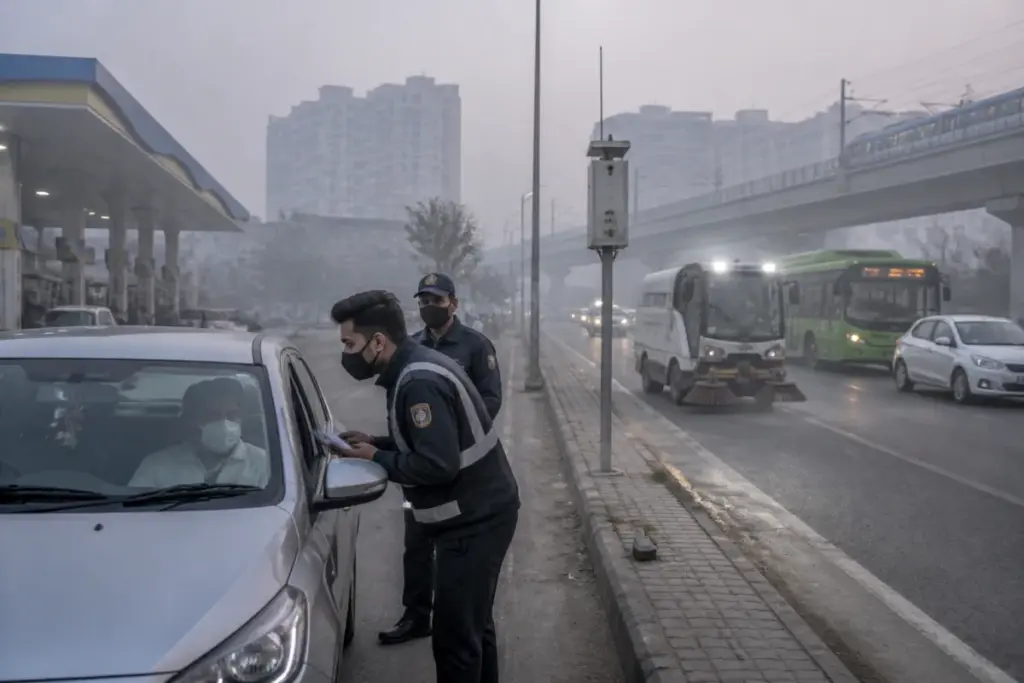
Delhi’s winter pollution plan for 2026-27 will introduce a ‘No PUC, No Fuel’ policy, restrictions on older and polluting vehicles, construction controls and a 50% work-from-home requirement from November 1, the Delhi government announced on Tuesday.
The 10-point plan will remain in force until February 28 and will be implemented through coordination between the Centre, Delhi government, Commission for Air Quality Management, Central Pollution Control Board, local bodies, Delhi Police, Delhi Metro Rail Corporation and other agencies. Chief Minister Rekha Gupta said public participation would be central to the campaign.
Under the fuel policy, vehicles without a valid Pollution Under Control Certificate and those that have exceeded their prescribed lifespan will not be allowed to refuel at 500 petrol pumps fitted with Automatic Number Plate Recognition systems. The restriction is scheduled to begin on November 1.
The government will also bar petrol and diesel vehicles registered outside Delhi that do not meet BS-VI emission standards from entering the city. CNG and electric vehicles will be exempt from this restriction.
Construction-related restrictions will be introduced in phases. Dust-generating demolition and outdoor civil construction work will be prohibited from November 1 to January 31. A broader ban covering all types of construction and demolition activity will apply from December 10 to January 20. Construction sites will be required to have complete CCTV coverage, while registration on the Malba App will be mandatory for building-plan approvals.
To reduce traffic and vehicular emissions, 50% of employees in government and private offices will be required to work from home, or work from home for two days each week, from November 1. Office timings will also be revised, with municipal corporation offices scheduled to operate from 8.30 am to 5 pm and Delhi government offices from 10 am to 6.30 pm.
Parking charges at authorised facilities will be doubled, although Metro parking facilities will be excluded. The government has set a target of raising daily Delhi Metro ridership to 72 lakh and Delhi Transport Corporation bus ridership to 42 lakh. Delhi currently has 6,840 buses, including 5,088 electric buses. A campaign encouraging residents to download the Delhi Metro Sarathi App for last-mile connectivity will run from October 1 to 10.
The plan includes AI-enabled monitoring, mechanised road sweeping, water sprinkling, deep cleaning, footpath improvements, road paving and the clearing of garbage accumulation points. The government has targeted the redevelopment of 3,000 km of roads to control dust. Work on 1,193 km has been completed, while concrete roadwork is scheduled to finish by October 31 and bitumen work by November 15.
Weekly inspections will be conducted at 37 identified air-quality and traffic hotspots by MPs, MLAs, councillors and nodal officers. The government also plans to make 15 major road stretches signal-free and congestion-free by October, with eight already completed. Ninety-eight mechanical road-sweeping machines have been deployed in two shifts, and deep cleaning of major roads is scheduled to be completed by October 31.
Other measures include a ‘Zero Burning’ campaign against the open burning of waste and biomass, heating booths for security guards and stricter action against polluting industries. The government said 2,283 polluting units had been sealed or shut down after a survey of 11,271 units.
A total of 334 enforcement teams are working in two shifts around the clock, including 256 teams from the Municipal Corporation of Delhi, New Delhi Municipal Council and Delhi Cantonment Board, and 78 teams from the Delhi Pollution Control Committee. Financial incentives under the Parivartan Yojana and the EV Policy 2026 will also support the scrapping of old vehicles and adoption of electric vehicles.


