

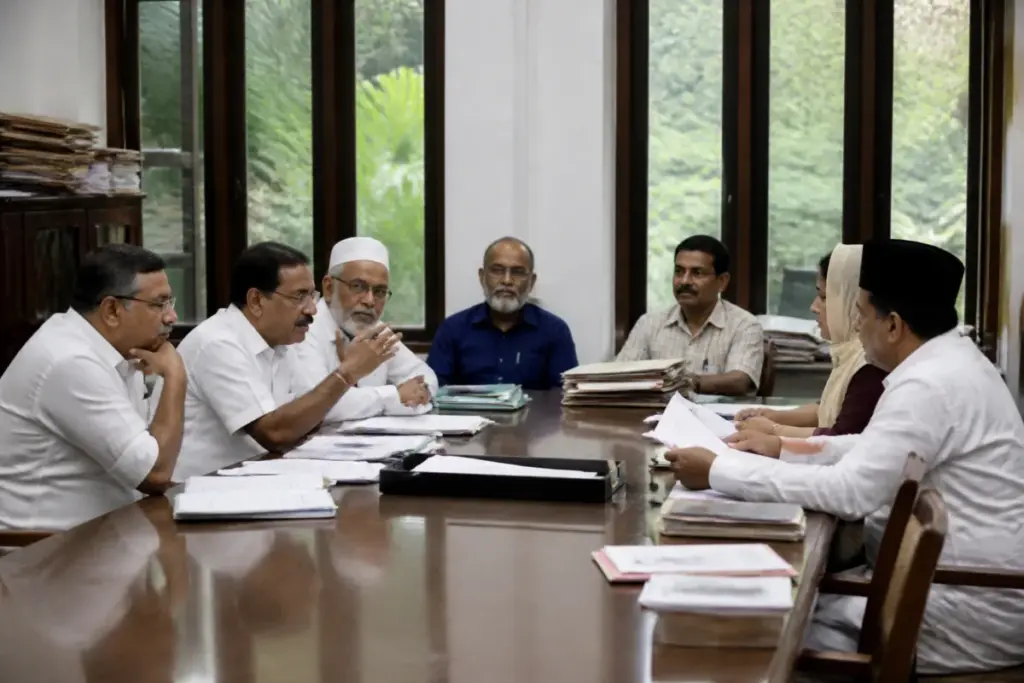
The Kerala Waqf Board dispute over factional representation has eased after Minority Welfare Minister N Samsudheen said on Tuesday that the government and Muslim community factions had reached a consensus, while declining to disclose the details of the understanding.
Samsudheen said the reconstituted nine-member board could not accommodate every faction because two or three positions were reserved for members of the general category. He said the government had not intended to exclude any group and that appointments had to be made according to the categories prescribed for the board.
The minister was responding to concerns raised by the Kanthapuram A P Aboobacker Musliyar faction of the Samastha Kerala Jem-iyyathul Ulama, which had objected to its lack of representation on the new board. Samsudheen said representatives who could not be included in the board would be considered for other committees, including those connected with minority welfare and the Haj.
“That is the stand of the Department, party and the UDF,” Samsudheen said, according to the report. He also said a consensus had been reached but did not provide details of the proposed arrangement or identify the committees to which the excluded representatives could be appointed.
The minister’s statement came a day after Indian Union Muslim League state president Sayyid Sadiq Ali Shihab Thangal convened a meeting with leaders of different factions of the Muslim community. The meeting followed the controversy over the composition of the reconstituted board and the representation of competing organisational groups.
The Kerala government dissolved the Waqf Board headed by K S Hamsa last Friday and appointed a new board, even though more than four years remained in the tenure of the board constituted by the previous Left Democratic Front government in March this year. The new board is headed by Indian Union Muslim League leader M C Mayin Haji.
Its other members are IUML leader and MLA Kurukkoli Moideen, Musthafa Faizi, Siras D Capsi, Thodiyoor Muhammed Kunju Maulavi, Sajna Firoz, Jaseem Sabaha, Dr Abdul Majeed Swalahi and C Madina Begham. The composition has placed the question of representation at the centre of the transition between the two boards.
Samsudheen also said the Kerala High Court had approved the reconstituted board and had therefore not interfered with it despite two petitions challenging the change. He maintained that the board had been reconstituted in accordance with the law and that it was not possible to include every group within the available positions.
The Waqf Board is responsible for the administration of Waqf institutions and properties in the state. The immediate outcome of the reported consensus, including the names or structure of any additional committees, remains undisclosed. The government’s next steps will determine how the proposed accommodation is implemented alongside the functioning of the new nine-member board.


