

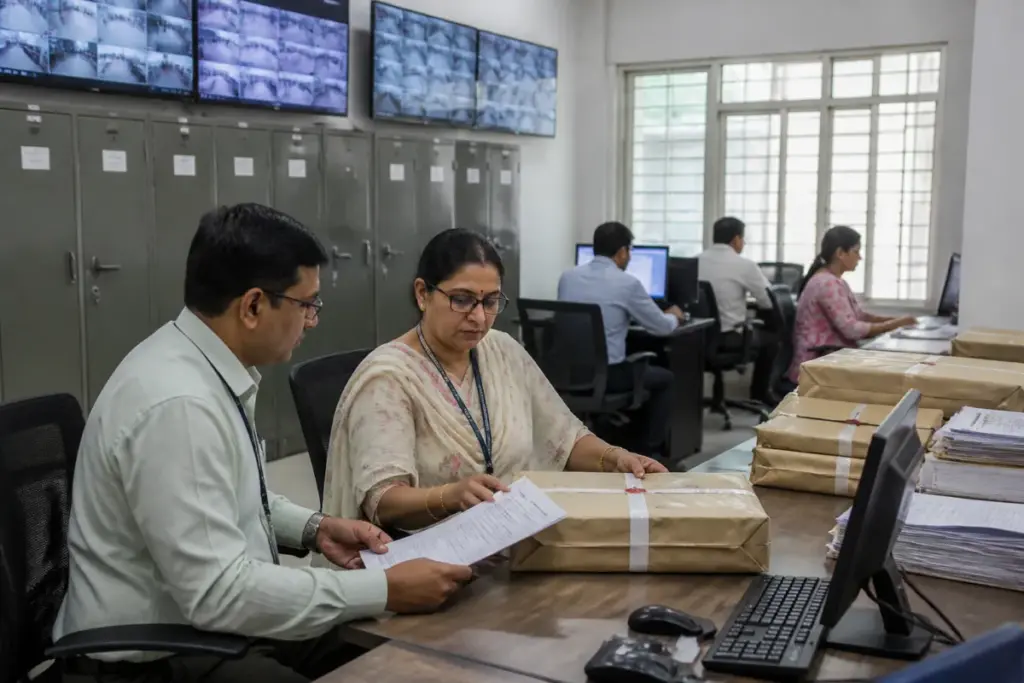
Maharashtra’s decision to bar contractual staff from sensitive examination departments is being presented as a paper-leak prevention measure, but the larger change is administrative: universities and affiliated colleges will now be expected to assign examination responsibilities to designated permanent employees and hold them accountable when procedures fail. The directive places staffing, chain of command and institutional responsibility at the centre of examination security.
The higher and technical education department issued the directions after a meeting between minister Chandrakant Patil and vice-chancellors of public universities held the previous week, according to a report by The Times of India. Universities have been asked to issue notifications assigning examination-related duties to university officers or permanent employees. The instruction also applies to affiliated colleges, an official told the newspaper.
That matters because examination systems are not confined to the final act of setting or evaluating a paper. They include question-paper preparation, printing, storage, movement, access control, distribution, invigilation and the handling of student records. The government’s reported response focuses on who performs these functions and who can be held responsible if there is a breach.
The immediate trigger was a paper leak involving the University of Mumbai’s final-year BCom examination earlier this year. The paper was leaked from the university’s Centre for Distance and Online Education. According to the report, CCTV footage showed a temporary staff member photographing the question paper on a mobile phone while it was being printed. The centre-in-charge was a permanent employee, but the examination duties had been assigned to the temporary staff member. The staff member was found guilty of serious misconduct and removed from service.
The government’s response therefore goes beyond removing the individual accused in that case. The reported directive says contractual appointments in examination departments will not be allowed and that permanent employees will also be held responsible for lapses. This shifts the focus from individual misconduct to supervisory accountability. It also raises a practical administrative question: whether assigning work to permanent staff, by itself, will create stronger controls unless universities clearly define access, supervision and escalation procedures.
The report does not provide the text of a formal government notification or specify the full list of posts and duties that will be covered. It does, however, record the department’s direction that all universities prepare a uniform statement of purpose for examinations. Vice-chancellors have also been asked to organise a one-day workshop for examination controllers across universities. These steps suggest an effort to standardise procedures across institutions rather than leave examination security entirely to individual campuses.
The proposed uniform statement of purpose could become important because examination administration is distributed across multiple levels. Public universities operate their own examination systems, while affiliated colleges participate in delivery and student-facing processes. The reported extension of the contractual-staff restriction to affiliated colleges indicates that the state sees the examination chain as a wider institutional network, not simply a university office function.
The policy also links staffing decisions to the larger question of responsibility. When work is distributed among permanent employees, temporary staff, centre-in-charges and examination controllers, a failure can become difficult to trace unless the institution records who authorised each task and who had access at each stage. The Maharashtra directive, as reported, attempts to address that gap by requiring universities to designate responsibility in advance.
That approach is different from treating a paper leak only as an isolated disciplinary incident. In the Mumbai University case, the reported presence of CCTV footage made it possible to identify the staff member photographing the paper. But surveillance after an incident is not the same as a complete preventive system. The government’s other instructions—uniform procedures, designated responsibility and training for examination controllers—are aimed at creating a process in which duties are defined before a breach occurs.
Technology forms the second major part of the proposed reform. Maharashtra has decided to adopt the recommendations of the Nandan Nilekani-led central task force on examination reforms as soon as the task force releases its report. The state intends to implement the recommendations across state-level competitive examinations, particularly computer-based examinations, according to the report.
One measure under consideration by the task force is a large question bank from which a question paper could be generated at the last minute using artificial intelligence. The official quoted in the report said such a system could be adopted in Maharashtra if finalised and would be particularly relevant to computer-based tests. The supplied report does not establish that the task force has approved this method or that Maharashtra has already selected a technology provider. At this stage, it remains a proposed reform that the state says it will consider after the report is released.
The distinction is important. A technology-based examination system may alter how questions are selected and delivered, but it does not remove the need for institutional controls. The state’s own directives combine digital reform with personnel reform: possible AI-assisted question generation is being discussed alongside restrictions on contractual staffing and the assignment of responsibility to permanent employees. The policy therefore treats examination security as both a technology issue and a governance issue.
The proposed use of blockchain for academically important student certificates follows a similar logic. The government has recommended formulating a policy for blockchain-based certificate security to prevent forgery. The report does not specify which certificates would be covered, how universities would participate, how corrections would be recorded or when such a system could begin. What is clear from the reported decision is that certificate integrity is being included in the same reform conversation as paper-leak prevention.
These measures cover different points in the examination lifecycle. The ban on contractual staff addresses access and responsibility inside examination departments. The uniform statement of purpose addresses procedures. The workshop for examination controllers addresses administrative coordination. Last-minute question generation addresses the handling of question papers, particularly in computer-based tests. Blockchain certificates address the security of records after examinations are completed. Together, they show an attempt to treat examination administration as a connected system rather than a series of unrelated tasks.
The next stage will determine whether the reforms remain directives or become operational standards. Universities have to issue notifications assigning responsibilities, prepare a uniform statement of purpose and conduct the proposed workshop. The state also has to wait for the Nilekani task force report before deciding which recommendations to adopt in full. A policy on blockchain-based certificates is still to be formulated.
The evidence currently supports a clear conclusion: Maharashtra is responding to examination risks by tightening institutional accountability while preparing to introduce more technology into question-paper and certificate systems. It does not yet establish how the new procedures will be funded, audited or measured, nor how quickly they will be implemented across universities and affiliated colleges. Those details will determine whether the reforms produce a consistent examination system or remain a set of administrative instructions after the Mumbai University paper leak.


