

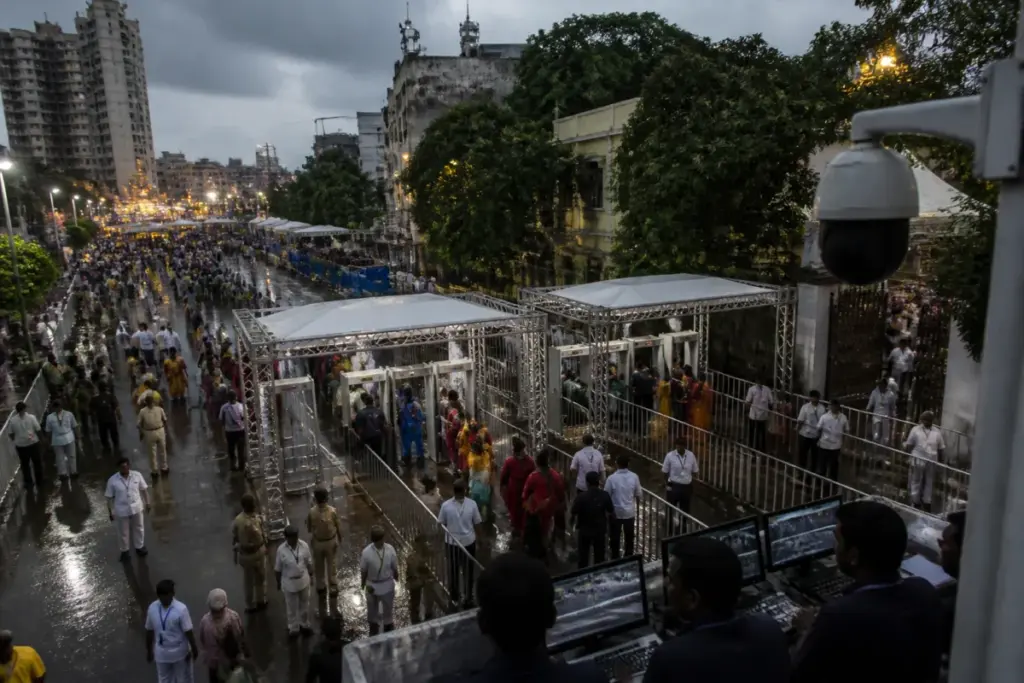
The stampede at Kolkata’s Chorbagan Durga Puja pandal, in which 19 people were killed and 25 injured, has revived a question that reaches far beyond one event: can India’s public venues detect dangerous crowd movement early enough to prevent a disaster? The answer depends less on the number of cameras installed than on whether the information they produce is connected to decisions on entry, movement, evacuation and emergency response.
According to the Times of India report, heavy rain was said to have driven visitors towards the entrance before the stampede. That detail matters because crowd disasters rarely depend on density alone. Weather, entry restrictions, gate design, barricades, exit capacity and the speed at which people move can combine to create unsafe conditions. A monitoring system that counts people but does not understand how they are moving may identify congestion without preventing it.
India has already invested heavily in CCTV cameras in public places, transport hubs and mass gatherings. But conventional cameras primarily document what has happened. Their preventive value is limited unless someone is watching the feeds continuously, identifying a dangerous pattern and acting before the crowd reaches a critical condition. The shift now under consideration is from passive surveillance to an early-warning system.
Artificial intelligence can analyse live video feeds, estimate crowd density, track movement and flag sudden surges. It can count people entering and leaving a venue, map congestion at individual gates and identify unusual clustering, reversals in movement or people falling. These functions could give control rooms a more detailed picture of a crowd than a general headcount can provide.
The distinction between counting and understanding is central. A single crowd figure cannot establish whether a venue is safe. The same number of people may produce very different risks depending on the width of an entrance, the availability of exits, the direction of movement and whether visitors are being pushed into one corridor. The report therefore points to safety thresholds based on the layout of a venue and the patterns of movement, rather than on a uniform number applied everywhere.
This is where technology becomes an institutional question. An alert has value only when it reaches people who can act. The report identifies police officers, event organisers and teams managing entry and exit points as the operational recipients of warnings. If density crosses a pre-set threshold, authorities may temporarily stop incoming visitors, create dispersal routes, redirect people from choke points or deploy personnel to relieve pressure.
Those actions require a clear chain of responsibility. A control room must know who is authorised to close an entrance, who can change the flow of visitors, who communicates with people already inside and who coordinates medical and emergency teams. Without that chain, an automated alert risks becoming another item on a screen rather than an intervention that changes conditions on the ground.
The experience cited from the 2025 Maha Kumbh illustrates the scale at which such systems are being deployed. An integrated command and control centre monitored crowd density and movement using inputs from 500 AI-enabled cameras and drones. The example demonstrates that large gatherings can combine multiple information sources, but it does not by itself establish that technology can prevent every stampede. The critical question remains whether alerts are accurate, timely and followed by effective action.
Entry management is another part of the same system. Digital ticketing, people counters and gates connected to live occupancy data can help organisers prevent a venue from exceeding its safe capacity. Public-address systems should also be connected to crowd-control teams so that instructions remain consistent when conditions change. This is particularly important when visitors are responding to rain, blocked routes or sudden changes in access.
The Kolkata incident also highlights the role of weather information in crowd safety. If heavy rain contributes to a rush towards a particular entrance, weather alerts need to be linked to precautionary measures. The report identifies temporary entry restrictions, additional personnel and clear directions for visitors as possible responses. Such measures are not technological substitutes; they are operational decisions informed by technology.
The physical design of a venue sets the limits within which any digital system operates. Narrow exits, badly placed barricades and inadequate evacuation plans cannot be corrected by an algorithm. Cameras may also fail to capture activity in blind spots. Rain, poor lighting and dense crowds can reduce the quality of readings, creating a risk that operators either miss a dangerous development or receive information that requires rapid human verification.
For that reason, the report places physical safety audits alongside AI monitoring. Major events need clearly marked emergency routes, trained personnel, medical teams and regular evacuation drills. These measures address risks that video analytics cannot resolve, including whether people can physically leave an area, whether instructions are understood and whether emergency responders can reach those who need help.
This combination changes the way cities should think about crowd infrastructure. A festival ground, railway station or religious gathering is not merely a site that requires cameras. It is a temporary urban system with entrances, exits, movement corridors, communication networks, emergency services and changing demand. The safety plan must bring these components together before the event begins and test whether they work under pressure.
The report calls for a common operating framework for high-footfall religious gatherings, festivals, railway stations and public events. Such a framework would connect CCTV analytics, entry counts, weather alerts and emergency response teams. It would also require post-event audits to establish whether alerts were issued, who received them and whether they were acted on in time.
That audit function is important because the performance of a crowd-monitoring system cannot be measured by installation numbers alone. A venue may have extensive camera coverage and still remain unsafe if blind spots are not addressed, thresholds are poorly designed or officials lack authority to intervene. Reviewing alerts and responses after every major event would help distinguish a functioning safety system from a collection of disconnected technologies.
There is also a governance issue in expanding automated surveillance. The report identifies privacy protections and independent verification of automated systems as critical as adoption grows. Systems that track movement across public spaces need rules governing how information is collected, accessed and retained. Independent verification is equally relevant because automated warnings must be assessed for reliability before officials rely on them during a fast-moving emergency.
The evidence in the supplied report does not establish a single technology that can predict or prevent stampedes. It shows a more limited but practical proposition: AI can help identify crowd build-up, sudden movement and other warning signs, while cameras, drones, occupancy data and weather alerts can improve the information available to control rooms. Prevention still depends on physical design, trained staff, communications and the authority to change crowd flows.
The larger urban question is whether Indian cities are building integrated safety systems or simply adding surveillance equipment to venues without changing how those venues are managed. The Kolkata tragedy and the Maha Kumbh example point in opposite directions: one shows the consequences of dangerous crowd movement, while the other shows the growing technical capacity to monitor it. The decisive test is whether that capacity is connected to timely decisions that move people away from harm.


