

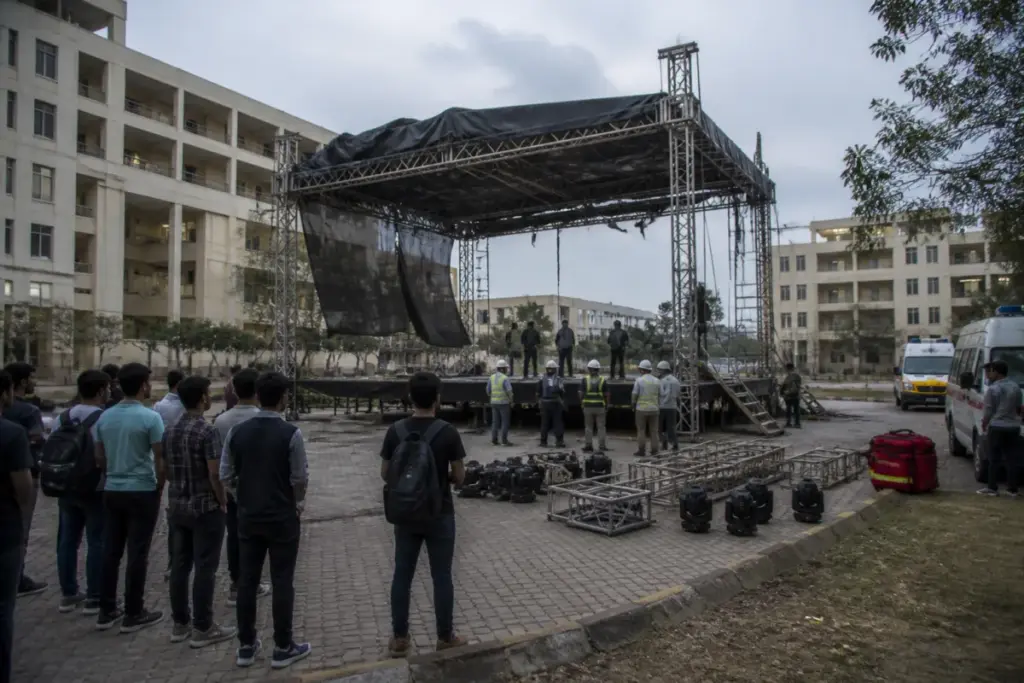
The fatal accident during a Dandiya event at Hyderabad’s MVSR Engineering College has moved beyond a single-campus incident. With students protesting for accountability and stronger safety measures, the Telangana Council of Higher Education (TGCHE) is preparing to seek a detailed report from the college and consider a broader framework for campus events.
TGCHE chairman Balakista Reddy said the council would issue a notice to MVSR Engineering College and examine its report before deciding on further action. He also said the incident had prompted the council to consider safety protocols covering temporary structures, fire safety, emergency exits, medical facilities and arrangements for large gatherings.
The significance of the proposed response lies in what it reveals about the way educational institutions treat events that fall between ordinary academic activity and public gathering management. Colleges routinely host festivals, cultural programmes, hackathons, exhibitions, competitions and student gatherings. Yet the safety systems governing these events may not be as clearly defined as those applied to larger public venues.
The available account does not establish the complete sequence of events, the precise cause of the accident or the responsibility of individual actors. Those questions are expected to depend on the report sought by TGCHE and any separate official inquiry. What is already clear, however, is that the incident has exposed a gap between the scale of campus events and the formal safety arrangements that may be required to manage them.
## Campus event safety is an institutional responsibility
Reddy described the incident as an “eye-opener” and said the council was considering whether more specific rules were needed for educational institutions. He pointed to existing police procedures relating to permissions, crowd management and emergency access at public events, but argued that colleges require a framework tailored to their responsibility for student safety.
That distinction matters. A college campus is not simply an open public venue. Students are present as part of an institutional relationship, and the college controls or influences the use of its premises, the appointment of vendors, the installation of temporary structures and the conduct of organised events. This creates an administrative responsibility that cannot be reduced to obtaining permission or managing a crowd on the day.
The proposed framework, as described by the TGCHE chairman, could include checks on temporary structures, fire safety, emergency exits and medical facilities. These are not separate technical details. Together, they form a chain of prevention and response: structures must be stable, combustible risks must be controlled, people must be able to leave quickly and medical assistance must be available when an incident occurs.
The incident also raises a question about how responsibility is divided inside colleges. Event management may involve college administrators, student committees, contractors, equipment suppliers, security personnel and local authorities. The source material does not identify the roles played by each party in the MVSR event. A meaningful safety framework would therefore need to make responsibilities visible before an event begins, rather than leaving accountability to be determined only after an accident.
## The missing layer between permission and preparedness
Reddy said police already have procedures for permissions, crowd management and emergency access at public events. His comments suggest that permission processes alone may not cover the full range of risks present at college functions.
A permission is an administrative approval. Preparedness is an operational system. It involves assessing the site, checking temporary installations, confirming that exits remain usable, deciding how many people can safely occupy a space, ensuring that emergency vehicles can reach the venue and establishing who will act when something goes wrong.
The proposed TGCHE guidelines could help connect these elements. The chairman specifically mentioned safety requirements for temporary structures and large gatherings, along with medical and first-aid arrangements. Student demands reported after the incident also included mandatory safety audits before stages, lighting equipment and other structures were installed. They called for heavy structures to be avoided where possible and for ambulances and paramedics to be kept on standby at campus events.
These demands indicate that students are not seeking only a response to the particular accident. They are asking for a system that makes safety checks routine and visible. That distinction is important in institutional governance. A rule that exists only on paper, or a safety check that is carried out informally, gives students and parents little assurance about whether an event is actually ready to proceed.
The source does not establish whether MVSR Engineering College had conducted a safety audit, what arrangements were in place or whether any warnings had been raised before the event. Those facts remain part of the information that the council’s notice and the college’s report may clarify.
## Medical preparedness cannot be limited to examinations
One of the more significant points in Reddy’s statement concerns medical facilities. He said medical preparedness had earlier been considered mainly during examinations and summer, but that TGCHE was examining whether such requirements should be extended throughout the year and incorporated into the registration process.
This indicates a broader institutional issue. Medical support on a campus is often treated as a routine service associated with illness, examinations or seasonal conditions. Large events create a different risk profile. They can involve concentrated crowds, temporary infrastructure, extended operating hours and activities that are not part of the normal daily campus routine.
The council is considering whether colleges should appoint medical officers or strengthen first-aid facilities throughout the year. It has not announced final provisions or a timeline. Even so, the proposal shifts the discussion from event-specific arrangements to permanent institutional capacity.
That shift could affect how colleges plan their annual operations. If medical preparedness becomes part of registration or institutional compliance, it would no longer depend entirely on the discretion of an event organiser. Colleges would need to demonstrate that students can access timely first aid and that larger gatherings have clearly defined medical and emergency-response arrangements.
The available evidence does not show how many colleges would be covered, what staffing levels might be required or how compliance would be monitored. Those details will determine whether the proposed framework becomes a meaningful safety mechanism or remains a general advisory.
## Students are also identifying a communication failure
The protests following the accident point to a second layer of campus governance: communication with students and parents after a serious incident. One student quoted in the report said the college management had not sent official communication to student or parent WhatsApp groups about the incident or planned safety measures. The student added that management may have contacted victims and their families privately, but that this was not known to the wider student community.
This account is attributed to a student and does not establish the college’s complete communication record. It nevertheless shows why timely institutional communication matters after an emergency. Students need to know whether the campus remains open, whether activities will continue, what immediate precautions have been introduced and where official information can be obtained.
Another student said uncertainty remained over what would happen when the college reopened after the Dasara vacation. The uncertainty was not limited to academic schedules. It also concerned whether campus activities would proceed as usual or be adjusted after the accident.
A safety protocol that addresses structures and ambulances but does not define communication responsibilities would remain incomplete. Colleges need a clear system for informing students, parents, staff and event participants during and after an emergency. That system should identify the authorised source of information and establish how updates will be issued when facts are still being verified.
## What the proposed framework must clarify
TGCHE has not yet announced the final provisions or implementation timeline. The council’s next step is to seek and examine the college’s report before considering action against the institution. This means the immediate regulatory response remains at an early stage.
The details will matter. A workable framework would need to clarify which events require prior safety approval, who conducts inspections, how temporary structures are certified, what emergency exits and access routes must be maintained, and when medical personnel or ambulances are mandatory. It would also need to establish whether responsibility rests with the college, an event organiser, a contractor or more than one party.
The council may also have to decide how these requirements fit within existing college registration and oversight systems. Reddy’s comments suggest that year-round medical preparedness could be linked to registration. If that approach is adopted, the framework would connect event safety with the broader institutional approval process rather than treating each event as an isolated administrative matter.
No final policy, compliance mechanism or penalty structure has been announced in the supplied material. It is therefore too early to assess how the proposal would work across Telangana’s colleges. The immediate evidence supports a narrower conclusion: the accident has prompted the state’s higher education regulator to consider rules that were not previously set out in a specific campus-event framework.
## The larger urban safety question
College campuses are part of the city’s built environment. They contain assembly spaces, temporary installations, electrical equipment, access roads and large populations that may gather within a limited area. Safety failures in these spaces are therefore not only internal management problems. They raise questions about how institutions, regulators and local authorities coordinate responsibility for public-facing infrastructure.
The MVSR incident has brought those questions into view through student protests and the TGCHE’s proposed response. The key issue is not simply whether one event had adequate arrangements. It is whether colleges have a consistent, auditable system for preventing accidents, responding to emergencies and communicating with the people in their care.
The evidence currently confirms that TGCHE will seek a report, that further action against the college will be considered after review, and that the council is examining guidelines on structural safety, fire safety, emergency exits, medical facilities and large gatherings. It does not yet establish the final cause of the accident, the findings of any institutional report or the content and timeline of future regulations. Those developments will determine whether the incident leads to enforceable change in how campus events are planned and monitored.


