

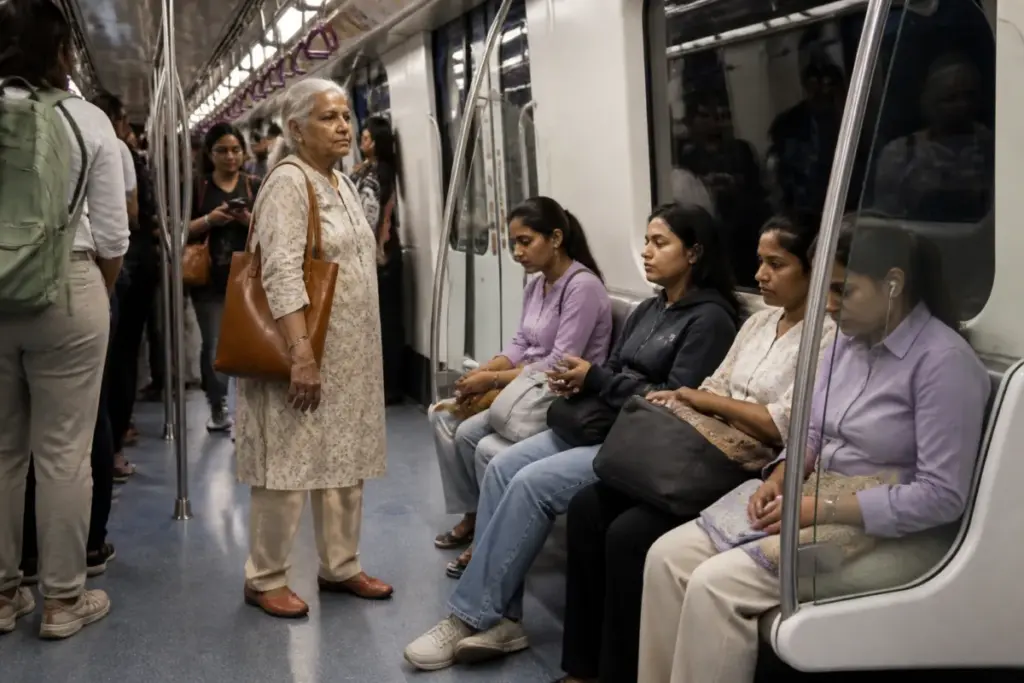
A complaint of an alleged assault on a 67-year-old passenger in Bengaluru Metro has brought attention to a routine but poorly enforced question in public transport: what happens when reserved seating rules are challenged inside a crowded train? The complaint, filed with Bengaluru Metro Rail Corporation Ltd (BMRCL), alleges that a young woman attacked the passenger after she asked her to vacate a seat reserved for senior citizens and pregnant women.
According to the report by Prajavani, Shailaja M. boarded the Green Line at Sandal Soap Factory station on September 19 while travelling towards Konanakunte. She entered the women’s reserved coach and saw a young woman occupying a seat designated for senior citizens and pregnant women. Senior citizens were standing, prompting Shailaja to ask the passenger to give up the seat.
The account becomes significant because the disagreement allegedly moved from a dispute over seating to physical confrontation. Shailaja said she decided to take a photograph and complain after the young woman refused to vacate the seat. She alleged that the woman knocked her mobile phone down, struck her on the forehead and cheek, and pulled her hair. Shailaja also said that she was unable to defend herself because she is 67 years old.
The report attributes the allegations entirely to Shailaja’s complaint. It does not include a response from the young woman, an official confirmation from BMRCL, a police statement, or details of a medical report. The alleged assault should therefore be understood as a complaint awaiting examination rather than as an independently established finding.
Shailaja said other passengers tried to restrain the woman, but that she pushed through the crowd and got off at Majestic station. The incident allegedly took place between Sampige Road and Majestic stations. She has asked BMRCL to examine footage from the metro’s closed-circuit television cameras and take action against the woman.
That request places the immediate responsibility with the metro operator. CCTV footage could potentially help establish what happened inside the coach, identify the passenger who left at Majestic, and clarify whether other passengers witnessed the confrontation. The supplied report, however, does not state whether BMRCL has reviewed the footage, whether the woman has been identified, or whether the complaint has been transferred to the police.
The case also exposes the difference between having a reserved-seat rule and making that rule work in practice. A marked seat can communicate priority, but it does not by itself provide a safe or predictable process for resolving a dispute. In a moving train, the passenger who asks for the seat may have no staff member immediately available, while the passenger occupying it may reject the request. If the disagreement escalates, vulnerable commuters can be left to manage the situation themselves.
This is especially important in a metro system where the interaction is compressed into a few minutes between stations. A passenger may not know whether to contact train staff, use an emergency communication facility, alert security personnel at the next station or approach the operator through a later complaint. The report does not establish which of these channels Shailaja used during the journey. It does establish that she filed a complaint with BMRCL and specifically sought a review of onboard CCTV footage.
The seating dispute also raises a question about the meaning of accessibility in public transport. Senior citizens and pregnant passengers may have a formal priority under the seating arrangement described in the report, but access depends on recognition, compliance and enforcement. A person who is elderly may not be able to stand for a long journey, and may also be less able to withstand confrontation. In this case, the complainant said she could not defend herself during the alleged attack.
At the same time, the available material does not provide enough evidence to determine whether the young woman knowingly occupied a reserved seat, whether she had a disability or another reason for needing to sit, or whether any announcement or signage was present in the coach. Those details should not be assumed. They are relevant to understanding the original seating dispute, but they do not remove the need to examine the alleged physical assault independently.
The incident therefore contains two separate issues. The first is compliance with priority seating. The second is passenger safety when a disagreement over that seating becomes hostile. Treating the matter only as a question of etiquette would miss the more serious institutional issue: whether passengers have a clear, accessible and trusted way to seek intervention before a dispute turns into violence.
For BMRCL, the available evidence points to a straightforward first step: preserve and examine the CCTV footage from the relevant coach and stations. The footage could provide a record of the interaction and the woman’s exit at Majestic. Any further action would depend on what the footage and other evidence establish. The report does not say whether the operator has announced a review or whether law-enforcement proceedings have begun.
The timing also matters. The alleged incident occurred on September 19, while the report was published on October 18. This makes the story less about an immediate travel disruption and more about the handling of a passenger complaint after the event. The central question is no longer simply whether a disagreement occurred, but whether the operator’s complaint and surveillance systems can provide a credible account and a response.
The case should not be used to generalise about metro passengers or women’s reserved coaches. One complaint cannot establish a wider pattern of assault, nor can the supplied report show how frequently reserved-seat disputes occur on Bengaluru’s network. What it does show is the vulnerability created when a rule depends on one passenger confronting another without visible intervention from the transport system.
Bengaluru Metro’s response will determine what is established next. A review of the CCTV footage, identification of the woman alleged to have left at Majestic, and clarification of whether the complaint has been referred to the police would move the matter beyond a single account. Until then, the available evidence confirms a complaint by a senior passenger and a request for institutional action, while leaving the alleged assault and the operator’s response to be verified.


