

A representation by Panjab University student group SAAKHI has reopened a question that planned cities often leave unresolved: what happens to the villages and communities displaced to create new campuses, sectors and institutional landscapes? The group has asked Panjab University to formally recognise the original Puadhi villages whose land was acquired for the university campus and Chandigarh, placing the city’s physical expansion alongside the history of the people who occupied the land before it was built.
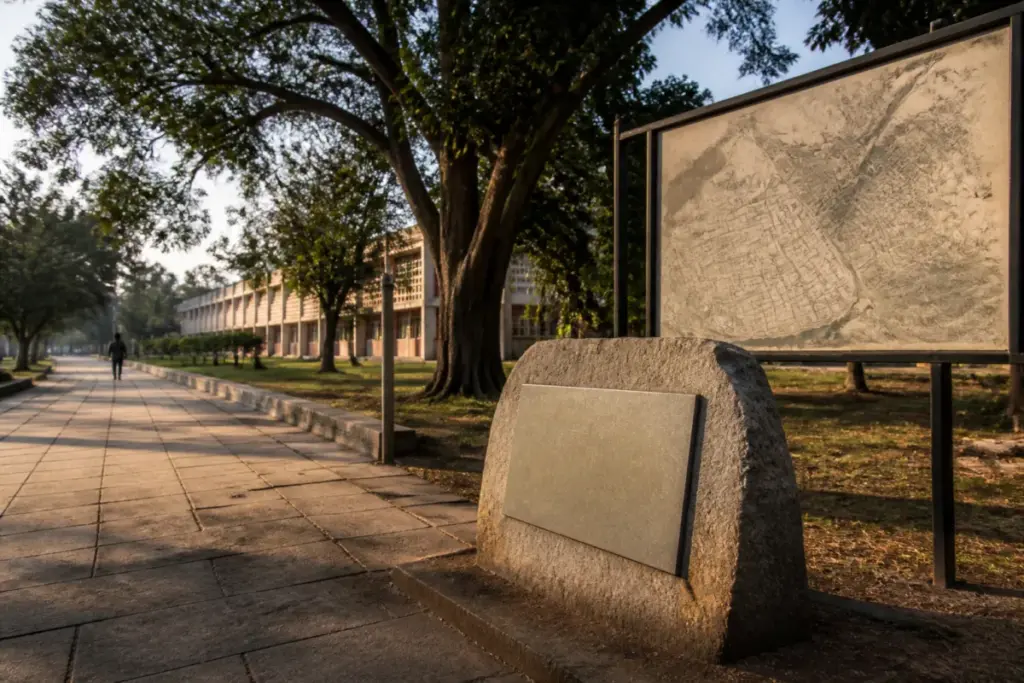
The demands are modest in form but significant in urban meaning. SAAKHI has sought an acknowledgement statement on the university website, a memorial plaque or monument on campus, and a research-based map identifying the original Puadhi villages associated with different sectors of Chandigarh. The proposals would not reverse the acquisition of land or restore the displaced settlements. They would, however, make the origins of the urban landscape more visible to students, residents and visitors.
The representation was submitted to the Panjab University vice-chancellor, and the university’s response is awaited. The immediate event is therefore a request for institutional recognition rather than a policy decision. Its importance lies in the question it places before a major public institution: whether the history of a campus and city should begin with their planned construction, or also include the villages, languages and communities that preceded them.
SAAKHI’s account identifies villages including Kanjimajra and Dhanas as places whose land was acquired for the university campus. The group has described the displaced settlements as part of the Puadh region and has emphasised the area’s historical, linguistic and cultural identity. Its proposal is based on historical documents and references concerning the region’s distinct dialect and heritage, according to the report.
That framing matters because land acquisition is usually recorded administratively through property, compensation and construction records. The resulting city, by contrast, is experienced through roads, sectors, institutions and neighbourhoods. The social and cultural geography that existed before those structures can become difficult to see once the built environment is complete. A campus map may show buildings and departments; a sector map may show roads and plots. Neither necessarily shows the villages that made way for them.
SAAKHI is asking the university to address this gap through three linked measures. The first is an official statement, to be published in Punjabi, Hindi and English, naming the original inhabitants and relevant villages. The second is a physical memorial plaque or monument on campus documenting the history of the displaced villages. The third is a research-based map that connects the original Puadhi villages with different sectors of Chandigarh and is displayed on campus as well as published online.
Together, these proposals move beyond a symbolic plaque. They suggest that institutional memory should be supported by research, mapped spatially and made accessible in multiple languages. The proposed map would also create a way to connect the current city’s geography with the landscape that existed before its present boundaries and institutional uses were established. SAAKHI has proposed that Panjab University’s departments of history, geography and Punjabi collaborate on the exercise.
The proposal also exposes an institutional question. Panjab University is not being asked only to acknowledge a historical event; it is being asked to use its academic capacity to document the relationship between land, language and urban development. The involvement of history could establish the chronology and documentary basis. Geography could examine the spatial relationship between villages and present-day sectors. Punjabi could help record the linguistic and cultural identity of the Puadh region. The report does not establish whether the university has accepted this proposed collaboration or begun a formal process.
The reference to international universities is part of SAAKHI’s case for institutional acknowledgement. The group cited Columbia University, the University of British Columbia, the University of Toronto and the University of Sydney as examples of institutions that recognise histories connected to their campuses. The representation uses these precedents to argue that a university can acknowledge the communities and places linked to the land on which it operates.
The comparison does not by itself establish that the cited universities use identical forms of recognition or that their institutional histories are directly comparable with Panjab University’s context. Its importance is more limited and specific: SAAKHI is proposing that public-facing acknowledgement, memorialisation and research can form part of how an institution explains its relationship with land and society.
This is a recurring challenge in planned urban development. A new city is often presented through its design, administrative structure and infrastructure. That framing is useful for understanding how the city was planned, but incomplete for understanding how it was assembled. Land is not an empty surface awaiting roads and buildings. It is also the location of homes, livelihoods, local identities, cultural practices and remembered boundaries. When these layers are not carried into the new city’s public narrative, the official record can become narrower than the lived history of the place.
The representation highlights this problem without supplying a complete account of the displacement process. The report does not provide the number of affected villages, the extent of land acquired, the number of displaced families, the compensation arrangements or the timeline of acquisition. It also does not establish whether all the villages proposed for inclusion are documented in a single authoritative map. These are important gaps for any future institutional exercise.
A credible map would therefore need more than a commemorative purpose. It would need a transparent method: identifying the historical documents used, defining the relationship between original village locations and current sectors, recording variations in names and boundaries, and distinguishing documented evidence from community memory. The supplied report does not say whether SAAKHI’s references include revenue records, maps, oral histories or other archival material. Those details would determine how the proposed map could be reviewed and updated.
The language of the proposed acknowledgement is equally important. SAAKHI has requested publication in Punjabi, Hindi and English, reflecting the need to make the record accessible across the university and the wider city. A multilingual statement would recognise that historical memory is not only an academic product. It is also communicated through language, and the choice of language can determine who can read, contest and contribute to an institutional account.
The proposed plaque would serve a different purpose from the website statement and map. A digital record can provide detail and links to research. A map can establish spatial relationships. A physical memorial would place the history within the everyday movement of the campus. Students and visitors would encounter the account not only when they search for it online, but while using the institution built on the acquired land. Whether the university chooses a plaque, monument or another format remains undecided.
The most consequential next step is not the design of a memorial but the university’s response to the representation. The administration could acknowledge the request, seek further documentation, refer it to academic departments or create a formal process for examining the proposals. Each option would affect how the issue moves from a student demand to an institutional record. At present, the report confirms only that SAAKHI has requested a meeting with administration officials and that no response has been reported.
For Chandigarh, the larger urban question is how a planned city records the people and places displaced by its making. For Panjab University, the question is narrower but equally concrete: whether its campus history should include the original Puadhi villages named in the representation. The evidence currently establishes the demand, the proposed forms of recognition and the institutional response still pending. It does not yet establish whether the university will adopt the proposals, what its own records show, or how a research-based map would be prepared. Those developments will determine whether the request remains a symbolic appeal or becomes a documented addition to Chandigarh’s public geography.


