

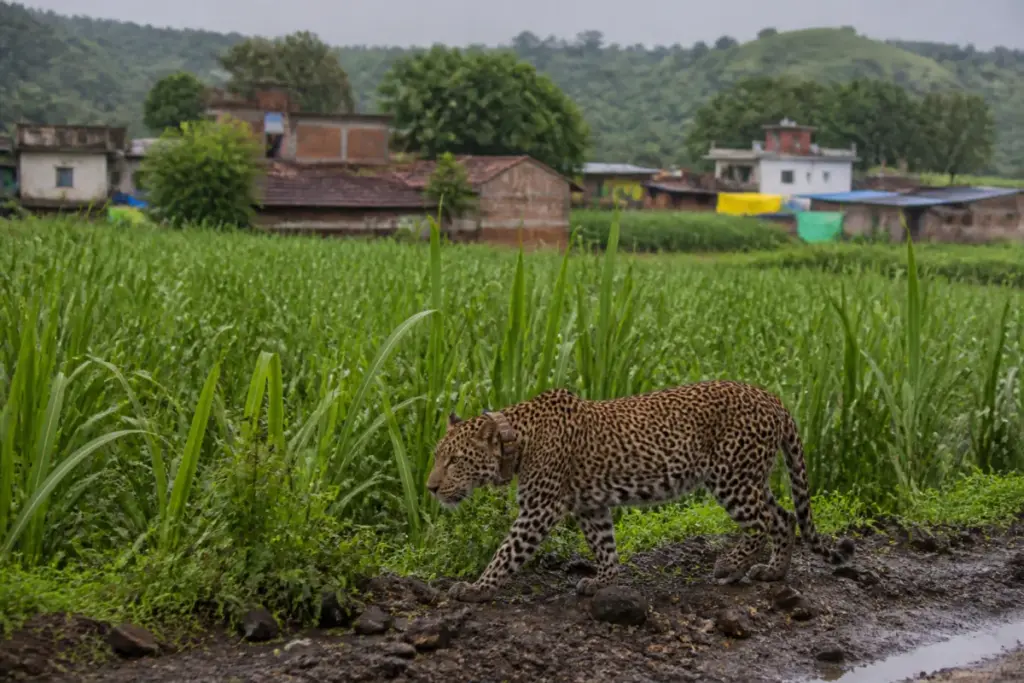
The launch of India’s first approved field trial of leopard immunocontraception in Junnar marks a significant shift in how authorities are examining human-wildlife conflict. Instead of treating the problem only through capture, relocation or emergency response, the experiment is testing whether fertility control can become one part of a longer-term management strategy in a landscape where farms, livestock, settlements and leopard habitat overlap.
The Junnar forest division has released two radio-collared female leopards after administering immunocontraceptive drugs. Forest officials are tracking their movements, behaviour and hormonal changes, while monitoring whether they conceive after mating in the wild. The animals were released about two weeks before the report was published, and officials said they had not shown significant behavioural changes so far.
Ashish Thakare, chief conservator of forests, Pune, told the Times of India that the experiment was the first approved immunocontraception trial in big cats in India. He said its success would be assessed by whether the released female leopards conceive. The department is also conducting a parallel study involving captive and free-ranging leopards to compare physiological and behavioural responses to the treatment.
That design is important because the experiment is not simply testing a drug in isolation. It is testing an intervention on free-ranging animals in a complex landscape, where animal behaviour, food availability, farming practices and human settlement patterns influence the likelihood of conflict. The forest department’s stated objective is to establish what happens to the animals after treatment and whether the method can eventually be governed through a common operating framework.
The Junnar conflict is substantial by both its human and economic costs. Forest department records cited in the report show that leopard attacks killed 22 people and injured 42 others between 2021 and the time of the report. During the same period, leopards killed 16,593 cattle. A separate statement by Maharashtra forest minister Ganesh Naik in February put the number of human deaths from leopard attacks in the Junnar wildlife division at 27 over seven years. The figures come from different time periods, but together they show why the region is under pressure to find a response beyond repeated emergency interventions.
Junnar’s landscape also illustrates why the conflict cannot be understood only as a question of leopard numbers. Sugar cane fields provide cover for leopards, while livestock and feral animals provide potential prey. This creates conditions in which wildlife can move through or remain close to cultivated areas, increasing the chances of encounters with residents and farm workers. The presence of leopards near human activity is therefore connected to the way land is farmed and the way food and shelter are distributed across the landscape.
This is the central limitation that the immunocontraception experiment must address. Suppressing reproduction in selected female leopards may reduce births for a period, but it does not by itself remove agricultural cover, alter livestock practices or change the availability of prey. Wildlife Institute of India scientist Bilal Habib said the treatment could prevent breeding for two to three years, while stressing that rigorous scientific evaluation would be necessary before wider use.
The reported treatment is intended to temporarily suppress reproduction and differs from surgical sterilisation. The vaccine-based method does not involve removing reproductive organs and is described as reversible. That reversibility makes it potentially distinct from permanent population-control measures, but it also means that the duration and consistency of the effect become key scientific questions. Officials must establish whether the treatment produces the intended reproductive outcome without causing unacceptable changes in health or behaviour.
The trial’s monitoring system is designed to answer some of those questions. The two leopards carry radio collars that allow the team to follow their movements. Blood samples collected before release will be compared with fresh samples after the animals are recaptured. Officials will also observe behaviour and examine whether the animals conceive after mating in the wild. These observations are intended to connect physiological changes with actual outcomes in the field rather than relying only on laboratory or captive data.
The parallel captive and free-ranging studies are equally significant. Conditions in captivity are easier to monitor, while free-ranging leopards encounter environmental variables that cannot be controlled in the same way. Comparing the two groups may help officials identify whether the treatment works differently according to habitat, stress, movement patterns or access to food. The supplied material does not establish the eventual findings, but it makes clear that the department considers both settings necessary to evaluate the intervention.
Smita Rajhans, assistant conservator of forests, said the long-term impact on free-ranging leopards would be studied by experts from the Indian Council of Medical Research and the forest department. She said the findings could be used to develop a uniform framework for other parts of the country. That proposed framework would cover drug administration, selection of animals, post-treatment monitoring and assessment of reproductive outcomes.
This administrative component may be as important as the drug itself. A wildlife intervention cannot be expanded simply because an initial animal does not show an immediate behavioural change. Authorities need rules for deciding which animals are selected, how treatment is administered, how often animals are recaptured, which health indicators are tracked and what evidence is sufficient to determine whether the intervention has worked. The forest department’s proposed standard operating procedure is an attempt to convert a field experiment into a controlled governance process.
It also places limits on what can be claimed at this stage. The release of two treated leopards does not demonstrate that immunocontraception reduces attacks, lowers livestock losses or changes the wider leopard population. The immediate findings are limited to the early monitoring period, during which officials reported no significant behavioural changes. The central outcomes—whether the animals conceive, how long fertility suppression lasts and what long-term effects emerge—remain to be established through continued observation and recapture.
The experiment therefore represents a test of evidence, not a ready-made solution. The demand for population control from villagers reflects the urgency experienced on the ground, particularly where people face repeated encounters and livestock losses. But a scientifically valid intervention must distinguish between public pressure for immediate action and evidence that a particular method can deliver safer outcomes without harming conservation objectives.
The wider policy question is whether human-leopard conflict should be managed through a single intervention or through a combination of measures. The forest department has described immunocontraception as potentially one component of a broader strategy. The report also records the need to examine ecological factors, including agricultural practices that provide cover and the availability of livestock and feral animals as prey. That emphasis places the experiment within a larger landscape-management problem rather than presenting it as a standalone population-control programme.
Junnar is consequently functioning as both a conflict zone and a testing ground for wildlife governance. The division has to protect people, respond to livestock losses and conserve leopards while working in a landscape shaped by intensive agriculture. The experiment’s value will depend not only on whether the treatment suppresses reproduction, but also on whether the department can produce reliable evidence and integrate it with decisions about land use, livestock protection and conflict response.
The evidence currently confirms that two radio-collared female leopards have been treated and released as part of India’s first approved field trial of leopard immunocontraception, with captive and free-ranging studies being conducted in parallel. It does not yet confirm whether the intervention will reduce conflict or whether it can be applied across other regions. The next milestones are the animals’ reproductive outcomes, comparisons between pre- and post-treatment blood samples, longer-term behavioural monitoring and the development of the proposed standard operating procedure.


