

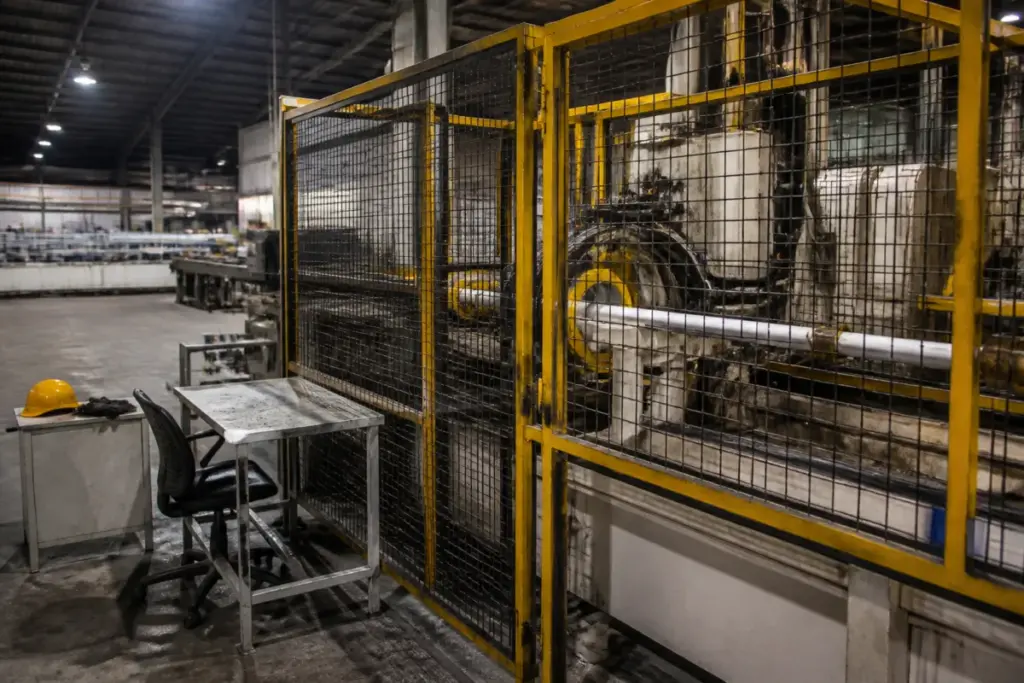
The Gummidipoondi factory accident, in which a 16-year-old guest worker from Bihar lost four fingers while operating a PVC-cutting machine, has brought a basic industrial question into sharp focus: how did a minor end up handling dangerous machinery in a shift that began around 3 am? Police have registered a case against the factory supervisor for alleged negligence and for engaging a child labourer in hazardous work, while labour officials have been informed to inspect the unit.
The incident occurred at a factory in the Gummidipoondi SIPCOT industrial area on October 11. According to police, the worker, identified as Ranjan Kumar, had joined the company barely a month earlier. His left hand was pulled into the moving blade of an extrusion cutter, causing crush injuries and the severing of four fingers.
Co-workers stopped the machine and took Kumar to a private hospital in Gummidipoondi for first aid. He was subsequently shifted to another private hospital in Kolathur, Chennai, where he remains an inpatient, according to the report. The immediate facts establish the severity of the injury. They also point to a wider chain of responsibility involving recruitment, work allocation, supervision, training and machine safeguards.
The case is not only about one worker’s injury. It concerns the way industrial employment is organised at the edge of a large metropolitan region, where manufacturing units depend on shift-based labour and where workers who have recently arrived from other states may have limited familiarity with local institutions, workplace procedures or complaint mechanisms. The available report does not establish how Kumar was recruited, whether his age was verified before employment, or who authorised him to operate the extrusion cutter. Those are among the questions now before the investigating authorities.
What the police case establishes
The complaint was lodged by Kumar’s relative, Narayana Yadhav, with SIPCOT police on Friday. Based on that complaint, police registered a case against factory supervisor Aravind for negligence and for engaging a child labourer in the operation of dangerous machinery. The report does not identify the factory by name or specify the sections applied in the case.
Police said they are examining shift rosters, safety training records and whether protective guards had been installed on the machine. These records matter because they can help establish how the worker was assigned to the machine, whether the company maintained a documented safety process and whether the equipment had safeguards intended to prevent contact with the moving blade.
The investigation is therefore moving beyond the injury itself. A shift roster can indicate who was present and who was supervising at the time. Training records can show whether the worker received instruction before being placed near the equipment. An examination of protective guards can help determine whether the machinery was being operated with the required physical barriers or whether those safeguards were absent, removed or ineffective. The report does not say what investigators have found on any of these points.
Labour department officials have also been informed to inspect the unit. Their inspection could provide a separate administrative record of the workplace, although the supplied report does not state when the inspection will take place or whether any notice, direction or penalty has been issued.
The central failure is not only the machine
Industrial accidents are often described through the moment of physical contact: a hand enters a machine, a blade moves, and a worker is injured. But the circumstances preceding that moment are equally important. In this case, the worker was reportedly 16, had joined only a month earlier and was operating an extrusion cutter during a 3 am shift. Each detail raises a distinct safety question.
The worker’s age is central because the complaint alleges that a minor was engaged in hazardous factory work. The report does not state whether the company had collected and verified age documents, whether the worker had been placed on a formal payroll or whether he was supplied through an intermediary. It also does not establish whether the company knew his age or whether the employment arrangement obscured it. These facts will determine how responsibility is assessed.
The short period since joining the company is also significant. A new worker may require closer supervision, machine-specific training and a clear understanding of emergency procedures. The report does not say whether Kumar had prior experience with PVC processing or extrusion equipment. It records only that he had joined the company barely a month before the accident. That makes the police inquiry into training records particularly important.
The timing of the accident adds another layer. It happened around 3 am, when the factory was operating a night shift. The source does not describe staffing levels, the supervisor’s location, lighting conditions, fatigue management or whether a second worker was assigned to the machine. These details cannot be assumed, but they are relevant to determining how the machine was being operated and supervised at the time of the accident.
Why SIPCOT’s industrial setting matters
SIPCOT industrial estates are planned locations for manufacturing and industrial activity, but the presence of planned infrastructure does not by itself guarantee safe work. Safety is created at the level of each unit through recruitment practices, training, equipment maintenance, supervision, protective devices and enforcement. The Gummidipoondi case shows the difference between an industrial estate as a physical zone and a factory as a governed workplace.
The report does not provide the number of workers in the unit, the factory’s production capacity, its compliance history or the identity of the company. It therefore cannot support a conclusion about safety conditions across Gummidipoondi SIPCOT. However, the alleged employment of a minor on dangerous machinery raises an institutional question for every agency involved in industrial governance: which authority checks the age, training and job allocation of workers inside operating factories, and how frequently are those checks carried out?
That question is particularly important in industrial areas that operate across multiple shifts. A factory may be visible as a building, road connection or utility consumer within an estate, while the conditions inside its production floor remain difficult for the public to observe. Workers and relatives may be the first to report violations, as appears to have happened in this case. Formal inspections and employer records then become essential to determining whether the incident was an isolated breach or evidence of a wider failure in workplace controls.
The available information does not establish whether the factory had previously faced complaints, whether the machine had been inspected earlier or whether any violation had been recorded. It also does not indicate whether other workers were interviewed after the accident. These are unresolved matters rather than evidence of additional wrongdoing.
The migrant-worker dimension
Kumar is described as a guest worker from Bihar. That description places the incident within a wider pattern of labour mobility between states, but the supplied material does not provide data on the number of migrant workers employed in Gummidipoondi or in Tamil Nadu’s industrial units. It does, however, show how a worker who had recently joined a factory could become dependent on relatives and co-workers during a serious emergency.
His co-workers stopped the machine and arranged the initial hospital transfer. A relative later lodged the police complaint. The report does not identify the employer’s response, whether the company arranged medical assistance beyond the first transfer, or whether compensation or other support was offered. Those omissions are important because the immediate response after an industrial injury can affect both treatment and the ability of a worker’s family to pursue formal remedies.
Language, documentation and knowledge of local institutions can also affect access to protection, although the report does not provide evidence about Kumar’s ability to communicate with supervisors or authorities. Any assessment of that issue would require statements from the worker, his family, co-workers and the employer. At this stage, the confirmed public-interest concern is narrower: a young inter-state worker was injured while reportedly operating hazardous machinery, and the police are examining whether his employment and supervision were unlawful or negligent.
What remains to be established
The investigation will need to clarify the factory’s employment and safety chain. It must establish how Kumar entered the workplace, how his age was recorded, who assigned him to the extrusion cutter and what training he received. It must also determine whether the machine had protective guards, whether they were functioning and whether the worker was operating it under direct supervision.
The condition of the shift is another unresolved issue. Police are examining rosters, but the report does not say whether the supervisor was present when the accident occurred or how many workers were on duty. Nor does it state whether the machine had emergency-stop mechanisms, whether they were accessible or whether the equipment had been recently serviced.
The labour inspection may provide answers on the unit’s compliance with applicable employment and factory-safety requirements. At present, no finding from that inspection has been reported. The police case is also at the investigation stage, so the allegations against the supervisor have not been established by a court.
The incident nevertheless demonstrates why industrial safety cannot be reduced to protective equipment alone. A guard on a machine is important, but it cannot substitute for lawful recruitment, age verification, training, supervision and a system that prevents inexperienced workers from being placed in high-risk tasks. The evidence supplied so far confirms that each of these controls requires examination in the Gummidipoondi unit.
The next significant developments will be the labour department’s inspection and the police findings from shift rosters, safety records and the machine itself. Those steps will determine whether the accident resulted from an individual act of negligence, a broader breakdown in workplace management, or both. Until those findings are available, the case establishes a serious injury and a credible allegation involving hazardous child labour, but not the final allocation of responsibility.


