

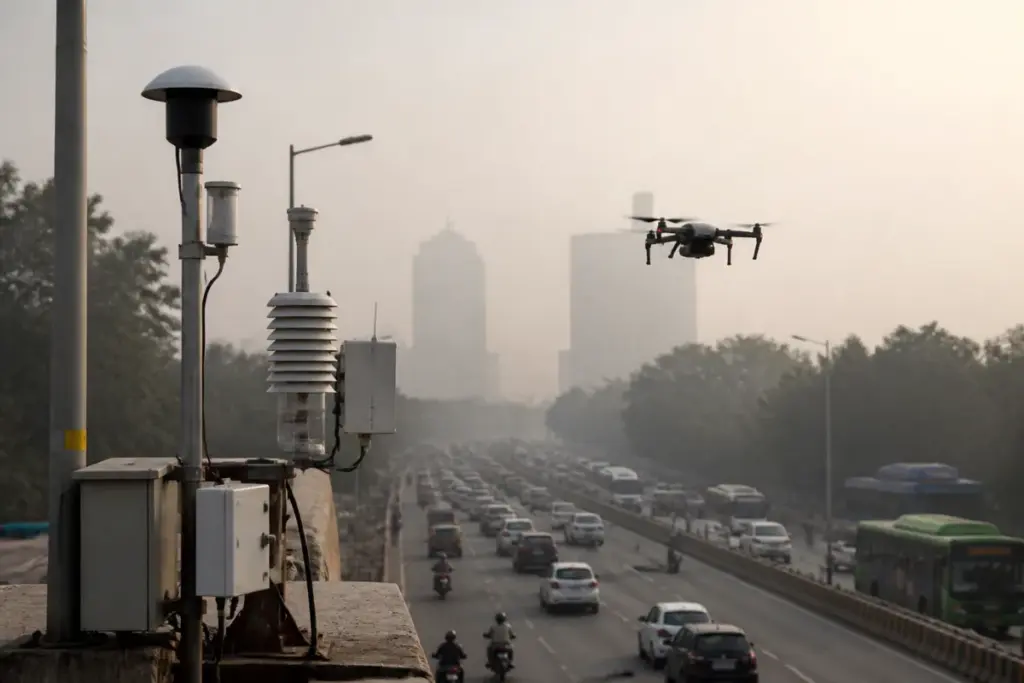
Union Environment Minister Bhupender Yadav has held discussions with start-ups and innovation companies on using artificial intelligence, sensors, drones and data analytics to improve real-time monitoring and mitigation of air pollution across Delhi-NCR.
The interaction, held on Saturday, focused on practical and scalable technologies for understanding pollution levels, identifying sources and supporting faster government intervention. The solutions presented included hyperlocal air-quality monitoring, city-wide pollution mapping, pollution hotspot identification and forecasting.
According to the information shared after the interaction, the proposed technology applications also include AI-based source apportionment, real-time identification of pollution sources and predictive traffic-congestion management. These systems are intended to provide more detailed information on how pollution changes across locations and time, rather than relying only on broad city-level readings.
The start-ups also presented technologies linked to road and dust management, including low-cost mechanised road sweeping, monitoring of road-dust resuspension, portable pothole repair and modular systems for containing dust. These interventions connect air-quality management with everyday road maintenance, construction activity and the condition of urban streets.
Technologies for detecting stubble and open biomass burning around the clock were also displayed. Other systems demonstrated during the interaction can identify vehicles without valid Pollution Under Control certificates and over-aged vehicles. Such tools could support enforcement agencies by helping them detect potential violations more quickly and target interventions in specific areas.
The discussion covered the use of remote sensing, satellite-based technologies and drone systems alongside ground-level sensors. The Minister said the central focus was to move towards a real-time understanding of air pollution and the factors contributing to it. The approach brings together monitoring, source identification, forecasting and enforcement rather than treating air-quality measurement as a standalone activity.
An official said some of the participating companies are already working with different government bodies, while more are expected to work with the government at different levels in the coming months. The report did not specify the names of the companies, the government agencies involved, the locations of existing deployments or the implementation timelines for the technologies discussed.
The meeting therefore marks a technology-focused push within the wider NCR pollution response, but its operational effect will depend on how these systems are integrated into government monitoring and enforcement processes. Further details on agency partnerships, deployment areas and implementation schedules are awaited.


