

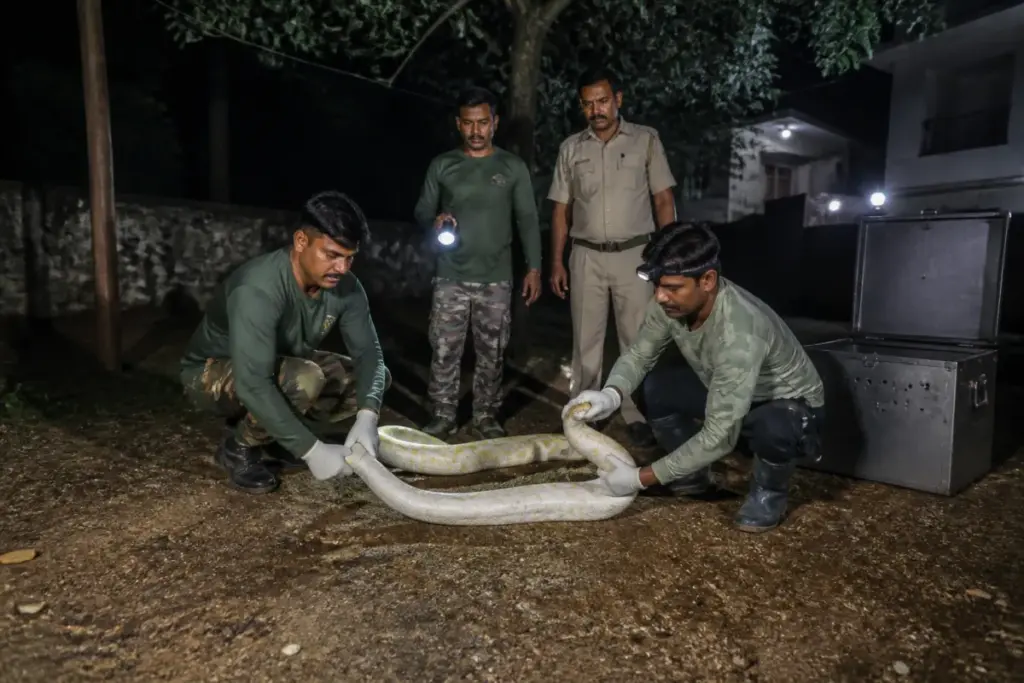
A rare white Burmese python was rescued from outside Radio Colony in Chhatarpur late Friday after it was found in a residential area, prompting forest officials to investigate whether the CITES-listed exotic reptile had been privately kept as a pet and escaped.
Snake rescuer Akash Rathore caught the python at about 11 pm on October 16. Divisional Forest Officer Rishi Mishra identified it as an exotic specimen and said officials were trying to establish where it came from and who had kept it. No person has come forward to claim the snake, according to the officials quoted in the report.
The python has been placed in the reptile enclosure at Mukundpur Safari, where it will remain pending further action. Forest officials have registered a case and are continuing their inquiry into the animal’s origin and the legality of its possession.
The Burmese python, scientifically known as Python bivittatus, is native to parts of Southeast Asia. It is non-venomous and kills prey by constriction. Adults commonly grow to between three and five metres, although some can become longer. The species inhabits forests, wetlands and grasslands in its native range.
The white colouration is an unusual morph that can make such snakes attractive to collectors in the exotic pet trade. That demand has also brought rare Burmese python variants into trafficking investigations. The report cited an April 2026 seizure by customs officials at Chennai airport involving albino Burmese pythons in a consignment of exotic animals.
The species is listed in Appendix II of the Convention on International Trade in Endangered Species of Wild Fauna and Flora, or CITES. The listing controls international commercial trade through documents such as export permits and re-export certificates. It is intended to ensure that specimens are legally sourced and that trade does not threaten the species’ survival. The listing, by itself, does not automatically prohibit all private possession.
In India, the Wildlife (Protection) Act, 1972, as amended, provides for the registration of living specimens of CITES-listed species under Section 49M. Rules governing the registration of such specimens were notified in February 2024. Covered animals, including their possession and transfer, must be registered, while births and deaths must also be reported.
Whether the Chhatarpur python was lawfully held will depend on the documents available to establish its origin and ownership. Until those details are verified, forest officials have not identified the person responsible for keeping the animal or confirmed how it reached the area outside Radio Colony.
The inquiry will determine the snake’s provenance and whether its possession, transfer or import complied with applicable wildlife-trade and registration requirements. The python remains at Mukundpur Safari while officials pursue those next steps.


