

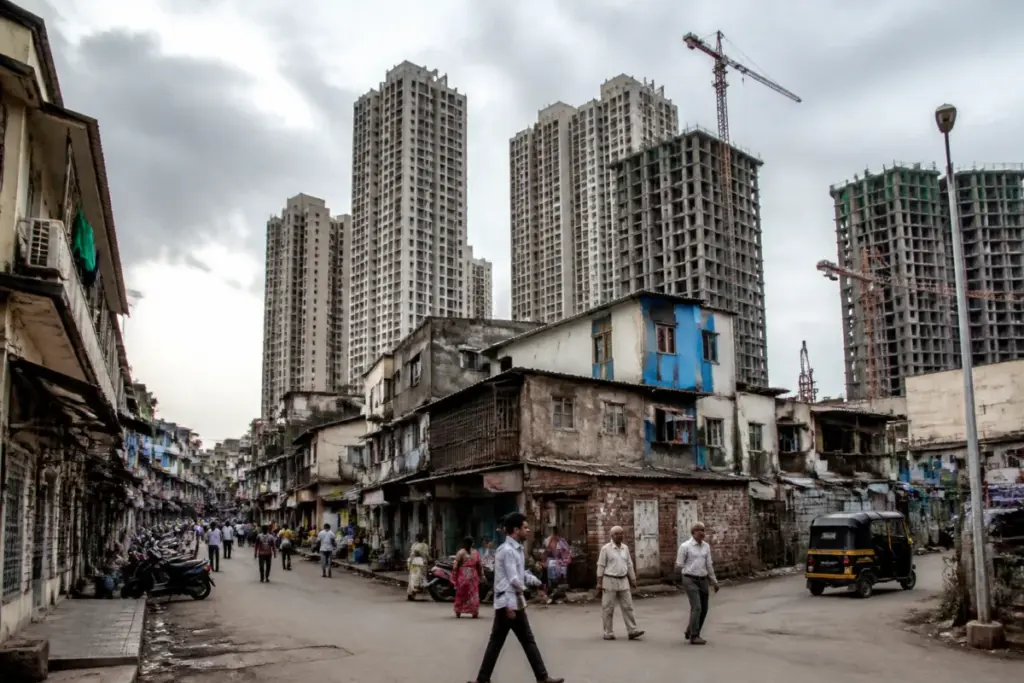
Mumbai’s residential real estate market could face an oversupply risk as regulatory changes, redevelopment schemes and a cluster of project launches expand the pipeline of homes across the city. A report by the Times of India has cited market watchers and a property consultant who expect higher permissible Floor Space Index, relaxed height restrictions and large redevelopment projects to add substantial inventory, particularly around the Diwali launch window.
The report’s central claim is a forecast rather than a confirmed market outcome. It does not provide project-wise construction figures, the number of homes expected to enter the market, current unsold inventory, sales velocity or absorption data. That limits the extent to which the reported oversupply risk can be independently assessed. However, the regulatory and redevelopment mechanisms identified in the report point to a significant question for Mumbai: whether the city’s ability to approve and build additional homes is beginning to outpace the market’s ability to sell them.
The supply expansion described in the report is linked first to changes in the amount of construction that can be permitted on urban land. Higher Floor Space Index, or FSI, allows a larger built-up area on a given plot, subject to applicable regulations and approvals. The report says considerable FSI is being sanctioned under Mumbai’s Development Control and Promotion Regulations, 2034, including Regulations 33(20)(B) and 33(11). It does not specify the total FSI sanctioned, the number of permissions issued under each provision or the location-wise distribution of the resulting projects.
That missing detail matters because additional permissible construction does not automatically translate into homes being completed or sold. Between a regulation allowing more built-up area and a finished residential project lies a long chain of approvals, financing decisions, land or redevelopment agreements, construction activity and market decisions by buyers. The available report identifies an expanding project pipeline, but it does not establish how much of that pipeline has reached construction, how much is scheduled for launch or how much may ultimately be delayed.
The second driver identified is the relaxation of height restrictions. In a dense city, changes to height rules can alter the economics of redevelopment by allowing a project to accommodate more floor area vertically. The report presents this as one of the factors expanding Mumbai’s potential buildable area. It does not, however, state which specific height rules have been relaxed, where the changes apply, or how many additional homes are expected to result.
The report also links potential supply growth to redevelopment activity facilitated or undertaken by government and civic bodies. The projects and programmes mentioned include schemes connected with the Maharashtra Housing and Area Development Authority, the Brihanmumbai Municipal Corporation, the Dharavi redevelopment, the BDD Chawl redevelopment in South Mumbai and multiple projects under the Slum Rehabilitation Authority. These are not a single category of development. They involve different institutional arrangements, land conditions, beneficiary obligations and implementation structures.
Grouping them together as a future source of inventory highlights the scale of Mumbai’s redevelopment pipeline, but it does not show when each project will deliver homes or how many units will enter the open market. Some redevelopment housing may be intended for existing residents or eligible occupants rather than conventional market purchasers. The report does not distinguish between rehabilitation housing, replacement homes, sale components and market-rate inventory. That distinction is essential to determine whether the city is facing a broad residential oversupply or a more specific increase in particular segments and locations.
The report says additional supply is expected even in dense neighbourhoods with narrow internal lanes and smaller by-lanes. This suggests that the impact of development permissions may extend beyond large, easily assembled plots. Smaller and irregular urban parcels can become part of a wider redevelopment pipeline when regulations and project economics make construction viable. Yet the report does not identify the affected neighbourhoods, the infrastructure capacity of those areas or whether local access, water, sewerage, parking and emergency-response systems have been assessed alongside the proposed increase in built density.
This is an important institutional dimension of the reported trend. FSI and height permissions determine the development potential of land, while civic infrastructure determines how additional residents and buildings are supported. The supplied report establishes that market observers are concerned about the volume of future residential launches, but it does not examine whether municipal services and transport networks are being expanded in parallel. It also does not state whether the approvals mentioned include conditions relating to local infrastructure capacity.
Environmental approvals form another part of the reported supply story. The article says market observers have pointed to a recent wave of environmental clearances granted to several projects. It does not name those projects, identify the approving authorities, provide clearance dates or state the residential capacity associated with them. As a result, the clearances cannot yet be used to calculate the amount of housing likely to be added to Mumbai’s market.
The timing of launches could nevertheless affect competition. According to the report, many developments may be launched around Diwali, creating a clustered period in which several projects compete for buyers at the same time. The property consultant quoted in the report said increased supply and simultaneous launches could put pressure on sales velocity, pricing discipline and overall market absorption in the months after the festive season.
Sales velocity refers to the pace at which units are sold, while absorption describes the market’s capacity to take in new supply over a given period. If launches increase faster than purchases, developers may face longer selling periods or greater pressure to maintain prices through incentives and other commercial measures. The report does not provide current sales-velocity or absorption figures for Mumbai, so the scale of that pressure remains unquantified.
The possible concentration of launches also raises a question about the type of housing being delivered. The report describes the emerging pipeline as residential real estate but does not break it down by unit size, price band, tenure, location or buyer segment. A large number of homes does not necessarily mean that buyers will have a wider choice in the parts of Mumbai where demand is strongest or at price points that households can afford. Without this information, it is not possible to determine whether the issue is overall oversupply, an imbalance in specific neighbourhoods or excess inventory in a particular segment.
Mumbai’s redevelopment framework makes this distinction especially important. Projects linked to MHADA, the BMC, Dharavi, BDD Chawls and the SRA can produce different kinds of housing outcomes even when they all add built-up area. Some may replace existing structures, some may provide rehabilitation homes and some may include saleable components that help finance redevelopment. The report identifies these programmes as contributors to future inventory but does not explain their respective delivery models or market exposure.
The available evidence therefore supports a narrower conclusion: Mumbai appears to be entering a period in which regulatory permissions and redevelopment activity could generate a larger residential project pipeline, with several launches potentially arriving at the same time. It does not yet establish that the city is already in oversupply or quantify the likely surplus. That distinction should remain central to any further reporting.
Verification would require project-level evidence from the relevant authorities and market participants. This would include the number of approvals under the cited DCPR provisions, the residential units attached to those permissions, environmental clearances granted to identified projects, construction and launch schedules, and current inventory and sales data. It would also require separating rehabilitation and replacement housing from units intended for open-market sale.
The next phase of Mumbai’s housing story will therefore be determined not only by how much FSI is sanctioned or how many redevelopment proposals are approved, but by how much of that potential becomes occupied housing and how quickly buyers absorb it. The Times of India report has identified a significant market concern. The scale, location and consequences of that concern remain to be established through primary documents and verifiable supply and demand data.


