

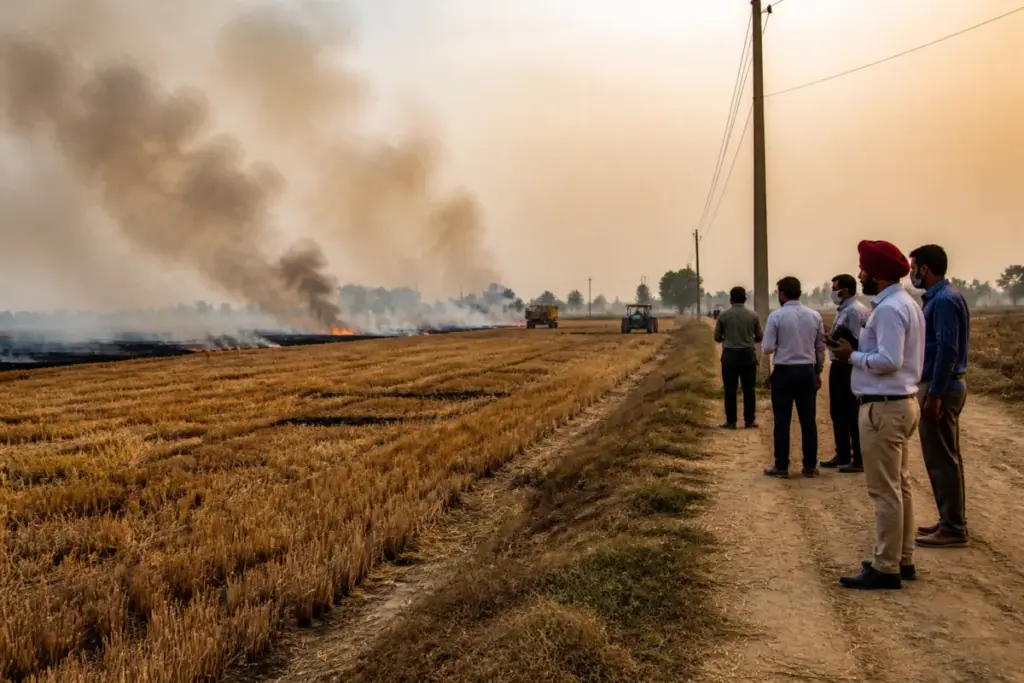
Punjab stubble burning has increased in two key districts, prompting the Commission for Air Quality Management (CAQM) to issue notices to the deputy commissioners and senior superintendents of police of Amritsar and Tarn Taran over alleged enforcement lapses.
The notices, issued on October 16, seek explanations for the rise in farm fires and ask why action should not be initiated under Section 14 of the CAQM Act for alleged non-compliance with directions to prevent crop-residue burning. The officials have been asked to submit their replies by October 21.
According to the notices, Tarn Taran recorded 68 stubble-burning incidents between September 15 and October 14, compared with 47 during the corresponding period last year. The figures represent a 45% increase. Amritsar recorded 78 incidents during the period, against 68 in the corresponding period last year, marking a rise of nearly 15%.
The CAQM said the continued occurrence of farm fires indicated inadequate supervision and enforcement of Punjab’s action plan, despite repeated reviews and directions issued by the commission. It also raised the possibility that some incidents could be going unrecorded under the existing monitoring system.
To strengthen surveillance, the commission called for greater use of drones and low-cost sensors. The monitoring issue is significant because the official count of farm fires forms part of the enforcement system used to identify violations and assess the effectiveness of measures intended to prevent crop-residue burning during the paddy harvest season.
Data from the Consortium for Research on Agroecosystem Monitoring and Modeling from Space (CREAMS), ICAR-IARI, showed that Punjab recorded 191 stubble-burning incidents between September 15 and October 16. The corresponding figure last year was 188, indicating a marginal year-on-year increase across the state.
The figures have emerged despite Punjab’s 2026 action plan targeting the elimination of paddy-stubble burning. The CAQM’s notices follow its review of farm-fire prevention measures, including a visit to the region on October 9 and 10, when the commission stressed strict enforcement during the harvest season.
Under the CAQM Act, violations can attract imprisonment of up to five years, a fine of up to Rs 1 crore, or both. The notices place responsibility on district-level civil and police administrations at a time when harvesting is under way and authorities are under renewed pressure to prevent farm-fire emissions from affecting air quality in the National Capital Region.
The immediate next step is for the Amritsar and Tarn Taran officials to respond to the CAQM by October 21. The commission’s subsequent action will indicate whether it considers the district administrations’ explanations sufficient and whether further proceedings are initiated under the Act.


