

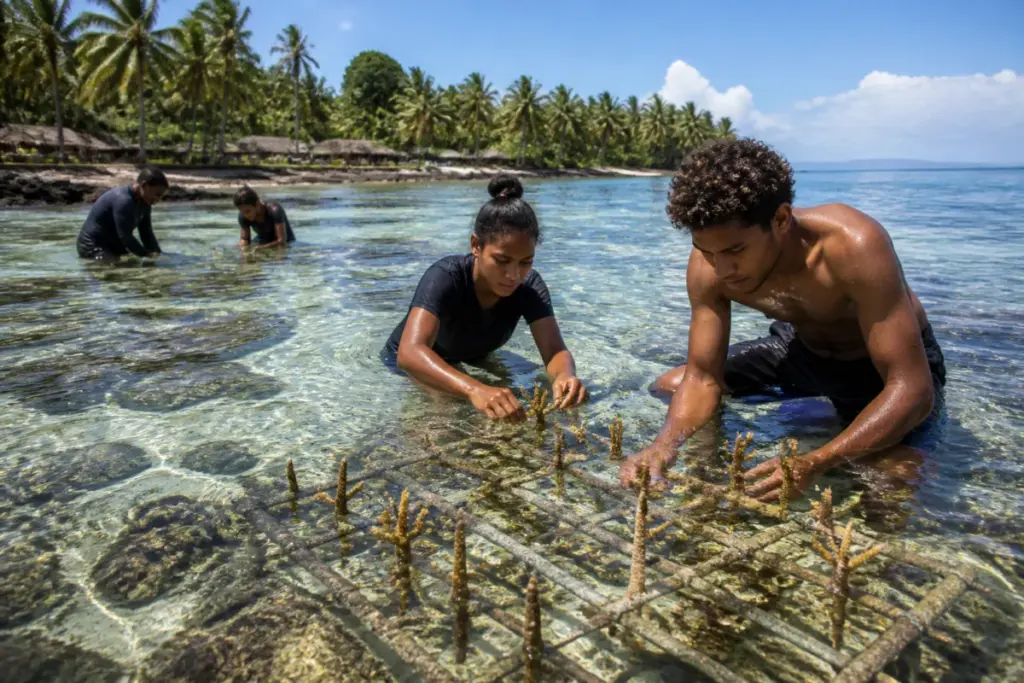
Naidiri Village’s recovery of a depleted fishery is not simply a story about coral planting. It is a long-term experiment in whether a small community can use customary governance, protected waters and youth-led restoration to rebuild an ecosystem on which its food supply and local economy depend. The results, reported by AFP and published by Deccan Chronicle, include the return of larger fish, sharks and hundreds of corals that survived extreme heat.
The village, on Fiji’s Coral Coast, began the effort in 2009 after Manoa Duwai noticed that fishing was producing fewer and smaller fish. On one fishing trip, he caught only tiny, juvenile fish and became concerned about what would remain in the community’s customary fishing grounds in the years ahead. He approached village elders with a proposal to protect part of the reef.
The initial protected area measured 30 by 40 metres. Over time, it expanded to 280 by 240 metres. The village also established a similarly sized area known as “the fridge”, which was temporarily closed to fishing to allow stocks to build up. The arrangement shows that restoration in Naidiri was not treated as a single construction or planting project. It combined spatial protection with restrictions on access and a continuing system of local management.
That institutional detail is central to the village’s experience. The protected area exists within customary fishing grounds, meaning that conservation is connected to the community’s own rules over access and use. The supplied report does not describe a separate government enforcement system or a formal financing model. What it does document is a locally initiated decision, endorsed by village elders and sustained by residents over many years.
The change was gradual. Larger fish began using the protected area and then spreading into neighbouring waters. The village’s population is 147, making the scale of the initiative notable not because it relies on a large administrative apparatus, but because a relatively small community maintained protection and restoration as an ongoing collective responsibility.
The next generation became an important part of that system. Naidiri formed a youth group in 2011 to manage what residents call the “tabu area”, or protected zone. Joseva Kunagado, now 21, leads the village’s youth in preserving the area’s health. He described an early period when young residents used cut barrels, ropes and manual labour to transport corals for planting, walking about 20 minutes to collect them before returning to the reef.
In 2023, the youth group planted 18,000 corals and 10,000 mangroves, according to the report. Those figures indicate that the village’s approach has moved beyond protecting an existing reef. It now includes active habitat restoration across connected coastal ecosystems. The report does not establish how many of the planted corals survived overall, but it records a visible expansion in the reef’s ecological activity and a continuing interest from researchers, charities, students and tourists.
The return of sharks is one of the clearest signs of ecological change described in the account. Sharks had not been seen patrolling the reef for decades, but residents reported their return this year. For Duwai, the event was emotionally significant because it represented the return of species and interactions that had disappeared from the village’s waters. Kunagado also said he had seen sharks on the morning of AFP’s visit.
The recovery is not presented as a complete victory over climate stress. Earlier this year, water temperatures reached as high as 39 degrees Celsius during a heatwave, Duwai said. The planted corals experienced widespread bleaching. At those temperatures, he said, about 20 per cent survived. The surviving corals are now regarded by the village as “super corals” because they endured conditions that would normally kill much of the reef.
That survival has changed the purpose of the restoration work. Naidiri is now transplanting the heat-resistant corals into deeper, cooler waters near Fiji’s capital, Suva. The move links local conservation to a broader effort to preserve biological material that may be better able to withstand rising sea temperatures. The report does not establish whether the transplanted corals will survive at scale, but it shows how a local restoration project is generating material for further experimentation.
The heat-resistant corals also expose a difficult tension in climate adaptation. Restoration can help protect an ecosystem, but it does not remove the heat stress that caused bleaching in the first place. Naidiri’s experience suggests that conservation may increasingly involve identifying which organisms survive extreme conditions, cultivating them and relocating them to places where they may strengthen damaged habitats. That is a more active and uncertain task than simply declaring a marine area protected.
The village’s work also illustrates the difference between a protected area on paper and a protected area with local legitimacy. The original decision came after residents saw their catches decline. The conservation boundary expanded as the benefits became visible. Larger fish returned, neighbouring waters received spillover, and the reef became a site of interest for visitors and researchers. These outcomes helped connect ecological protection to the village’s immediate concerns rather than presenting conservation as an external restriction imposed on fishers.
At the same time, the supplied evidence does not show that every part of the fishery has recovered or that the model can be transferred unchanged to other coastal communities. It provides no independent assessment of fish populations, no long-term survival rate for the planted corals, and no comparison with reefs managed through different systems. The account is therefore strongest as a documented case of community-led restoration, not as proof that coral planting alone can reverse marine decline.
Naidiri’s model has three identifiable components. The first is a protected area within customary fishing grounds. The second is temporary closure through “the fridge”, allowing fish stocks to build up. The third is active restoration carried out by the youth group, including coral and mangrove planting. Together, these measures connect regulation, ecological recovery and community participation.
The sequence also matters. Protection began in 2009, the youth group was formed in 2011, and major planting activity recorded in the report reached 18,000 corals and 10,000 mangroves in 2023. The return of sharks and the identification of heat-resistant corals came after years of work rather than immediately after the first intervention. The timeline suggests that coastal restoration is a long-duration governance process in which ecological results may emerge only after local rules are maintained over time.
For urban and infrastructure observers, the relevance lies in the relationship between settlements and natural protective systems. Naidiri is a village rather than a city, but its experience concerns the same question facing coastal urban areas: how should communities protect food systems, habitats and shoreline resilience as environmental conditions become more severe? The report does not claim that the village’s coral work is an urban infrastructure programme. It does, however, show how ecological assets can function as part of the support system around human settlements.
The account further highlights a governance challenge. The most important actors are not only researchers or charities arriving after the reef begins to recover. They are residents who recognised depletion, elders who approved a protected area, and young people who carried out repetitive physical work. External attention followed the restoration. The sequence matters because it places local authority and participation at the centre of the intervention.
What the evidence confirms is limited but significant: Naidiri protected part of its customary fishing grounds, expanded the protected area, created a temporary closure zone, planted thousands of corals and mangroves, and observed the return of fish and sharks. It also found that a portion of its corals survived water temperatures of 38 to 39 degrees Celsius and is transferring those survivors to deeper waters near Suva. What remains uncertain is the long-term ecological performance of the transplanted corals and whether the recovery can withstand future heatwaves. Those are the next tests for a village whose restoration story has moved from local fishery protection to climate-resilience research.


