

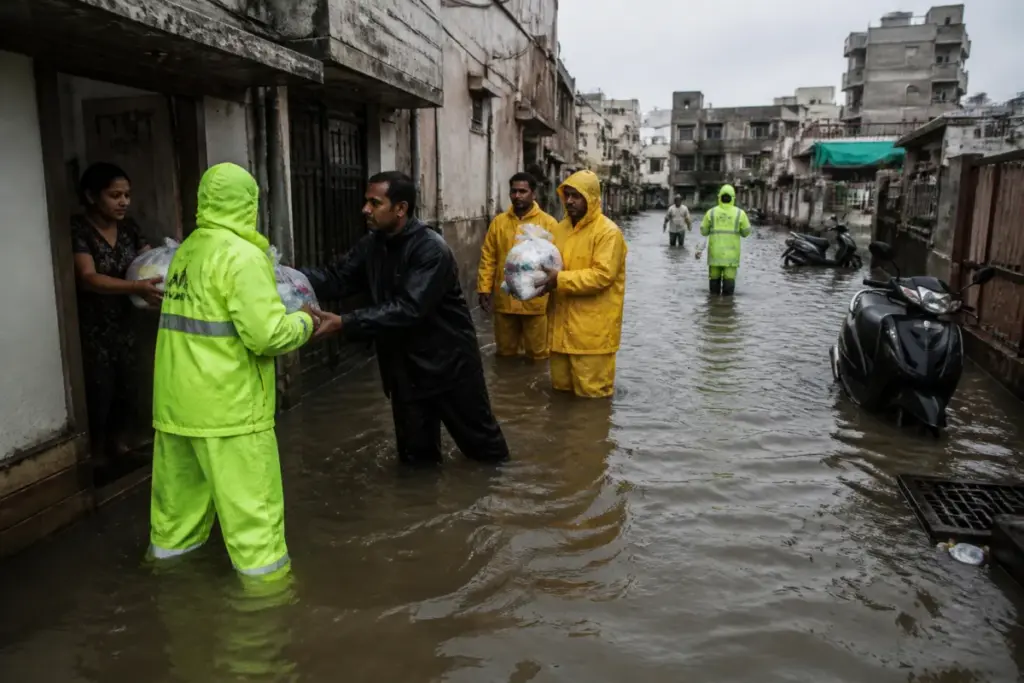
Ahmedabad’s July waterlogging did more than disrupt roads and homes. It pushed the Ahmedabad Municipal Corporation (AMC) into an emergency food-supply operation that cost ₹31.31 lakh, turning a drainage and flood-management problem into a direct municipal expenditure. The episode offers a measurable account of how failures in urban water management can quickly become a public-health, livelihood and relief challenge.
Details of the expenditure were presented at an AMC Health Committee meeting, according to a report by Nav Gujarat Samay. The civic body distributed 29,977 food and snack packets to residents affected by heavy rainfall during July. The report said water entered homes and shops in several areas, leaving some households unable to cook.
The spending figure matters because it captures only one visible consequence of waterlogging: the cost of feeding residents when local living conditions become temporarily unworkable. It does not, on the basis of the information available, include damage to homes, shops, roads, vehicles, electrical systems, household goods or lost working days. Nor does the report establish the total cost of clearing water, repairing infrastructure or restoring affected areas. Even so, the food-distribution bill shows how quickly an intense rainfall event can move from the engineering department’s domain into health, welfare and municipal finance.
The July episode was not confined to one locality. AMC Health Committee chairman Deepakbhai Panchal said the heaviest impact of the July 23 rainfall was recorded in 18 areas, including Gota, Sarkhej, Bopal, Thaltej and Jodhpur. Heavy rain was also reported on July 24, 25, 26 and 31, during which food packets were again supplied to affected residents.
According to the report, the affected locations included Bopal, Thaltej, Jodhpur, Ghatlodia, Bodakdev, Gota, Sarkhej, Maktampura, Vejalpur, Stadium, Sabarmati, Asarwa, Shahibaug, Viratnagar, Nikol, Gomtipur, Vastral, Danilimda and Amraiwadi. The distribution therefore cut across different parts of the city rather than representing a single isolated pocket of flooding.
The largest distribution was recorded in the North-West Zone, where 12,960 food packets were supplied. The report linked the concentration to the growing impact of waterlogging in western Ahmedabad. It also noted a shift in the geography of flooding: areas in eastern Ahmedabad had historically faced greater disruption during heavy rain, while the problem has increasingly become visible in western parts of the city.
That shift is an important urban signal, although the supplied report does not provide the drainage maps, rainfall measurements, land-use changes or project records needed to establish its precise causes. It does, however, identify a pattern that city administration must track: the locations experiencing waterlogging are not necessarily fixed, and emergency preparedness cannot be designed around an older map of vulnerability.
The municipal response also reveals the administrative chain activated by flooding. The immediate requirement was not simply to remove standing water. In low-lying societies and informal settlements, water entered homes to such an extent that residents could not prepare meals. The civic body consequently had to procure, package and distribute food through cooks, hotels and restaurants in the affected areas.
The reported prices show how that emergency arrangement was operationalised. Food packets supplied through the municipal food department cost between ₹95 and ₹110 each, while snack packets cost between ₹19 and ₹59. These figures indicate a variable procurement model rather than one uniform price. The source does not specify how many packets were meals and how many were snacks, which suppliers received orders, how vendors were selected or whether the rates were fixed through existing contracts or emergency purchases.
Those unanswered questions are not minor administrative details. In a flood response, procurement speed is essential because households cannot wait for a normal supply cycle when water has entered their homes. At the same time, emergency spending requires a clear record of demand, delivery locations, beneficiary counts, vendor rates and quality control. The Health Committee agenda, as reported, placed the expenditure in the public administrative process, but the available material does not include the underlying bills, vendor list or ward-wise distribution statement.
The reported ₹31.31 lakh should therefore be read as both a relief figure and an accountability figure. It shows that AMC recognised a basic service failure at household level and intervened with food support. It also raises a more structural question: how often should a city be required to substitute emergency meals for the everyday functions that neighbourhood infrastructure is expected to protect?
Waterlogging is often treated as a transport nuisance because it slows traffic and leaves roads unusable. The July distribution figures show why that framing is incomplete. Once water enters homes and shops, the consequences extend to cooking, food storage, sanitation, work and the ability of residents to remain safely indoors. The civic response then involves more than traffic management. It requires coordination between drainage operations, public health, ward administration, food procurement and local relief delivery.
This is also why the location of flooding matters. A citywide total can conceal sharply different experiences between zones. The North-West Zone’s 12,960 food packets represent the largest reported share, but the supplied report does not provide the corresponding number for each other zone. Without that breakdown, it is not possible to compare the severity of impacts, calculate per-zone spending or determine whether distribution matched the number of affected households.
The available numbers nevertheless establish a useful baseline. Across the reported locations, 29,977 food and snack packets were distributed at a total cost of ₹31.31 lakh. A simple division produces an average expenditure of roughly ₹104 per packet, but that figure should not be treated as a standard meal cost because the source combines food packets priced at ₹95-₹110 with snack packets priced at ₹19-₹59, and does not state the precise mix. The average is therefore an indication of total spending relative to total distribution, not a uniform rate.
The figures also do not establish how many people were affected. A packet may have been intended for one person, a household or a particular meal, and the report does not provide the distribution duration or the number of meals supplied per household. That limits any assessment of whether the relief operation was sufficient. It does not diminish the significance of the total: nearly 30,000 packets were required because ordinary household food arrangements had been disrupted across multiple parts of Ahmedabad.
The incident sits at the intersection of infrastructure and governance. Drainage capacity, road levels, storm-water channels, low-lying settlements, construction activity, land use and rainfall intensity can all influence the extent of waterlogging, but the supplied material does not identify which of these factors drove the July flooding. It reports that AMC officials described the municipal administration as having to respond after water entered homes and that the problem had spread across several western and eastern areas. Establishing causation would require official engineering assessments and rainfall or drainage data that are not included here.
What can be established is the cost of responding after the disruption occurred. Municipal budgets generally have to accommodate both planned infrastructure work and unplanned emergency operations. Food distribution is a relatively immediate and visible expense, while damage assessment, pumping, road repairs and restoration of public services may appear in separate accounts or departments. The report does not say whether the ₹31.31 lakh came from a disaster-relief provision, the health department’s budget or another municipal head.
That budget classification would be important for understanding how Ahmedabad plans for recurring climate and water-related emergencies. If repeated rainfall events are handled mainly through post-event relief, the city’s spending will remain reactive. If the expenditure is linked to a broader preparedness system, it could form part of a more structured approach involving early identification of vulnerable settlements, pre-positioned food supplies, vendor agreements and ward-level response plans. The supplied report does not establish which model AMC currently follows.
The episode also exposes the importance of maintaining a current vulnerability map. The report’s comparison between historically affected eastern areas and increasingly affected western areas suggests that the geography of risk may be changing. But the evidence provided is descriptive rather than statistical. It does not show how rainfall patterns, drainage works, urban expansion or settlement growth have changed over time. Those are precisely the records needed to determine whether the reported shift is temporary, seasonal or part of a sustained trend.
For residents, the institutional question is straightforward even if the engineering answer is complex: when heavy rain makes homes unusable, which municipal systems respond first, and how quickly? In July, the answer included local cooks, hotels and restaurants supplying packets through AMC arrangements. That response addressed an immediate need. It also demonstrated that neighbourhood businesses became part of the city’s emergency infrastructure when normal household operations failed.
The larger urban question is whether such arrangements are being treated as exceptional relief or as a recurring component of monsoon governance. The food-distribution bill cannot, by itself, prove that drainage systems failed or that municipal administration was inadequate in every affected area. It does show that flooding had consequences beyond inundated streets and that the city had to spend public money to restore a basic household function: access to food.
The July data confirm three facts: heavy rainfall affected multiple Ahmedabad neighbourhoods on several dates; 29,977 food and snack packets were distributed; and AMC recorded a total expenditure of ₹31.31 lakh. The material does not establish the causes of the reported shift towards western Ahmedabad, the full economic damage, the number of households served or the budget head used for the relief operation. Those are the next pieces of evidence needed to judge whether the city is reducing flood vulnerability or repeatedly paying to manage its consequences.


