

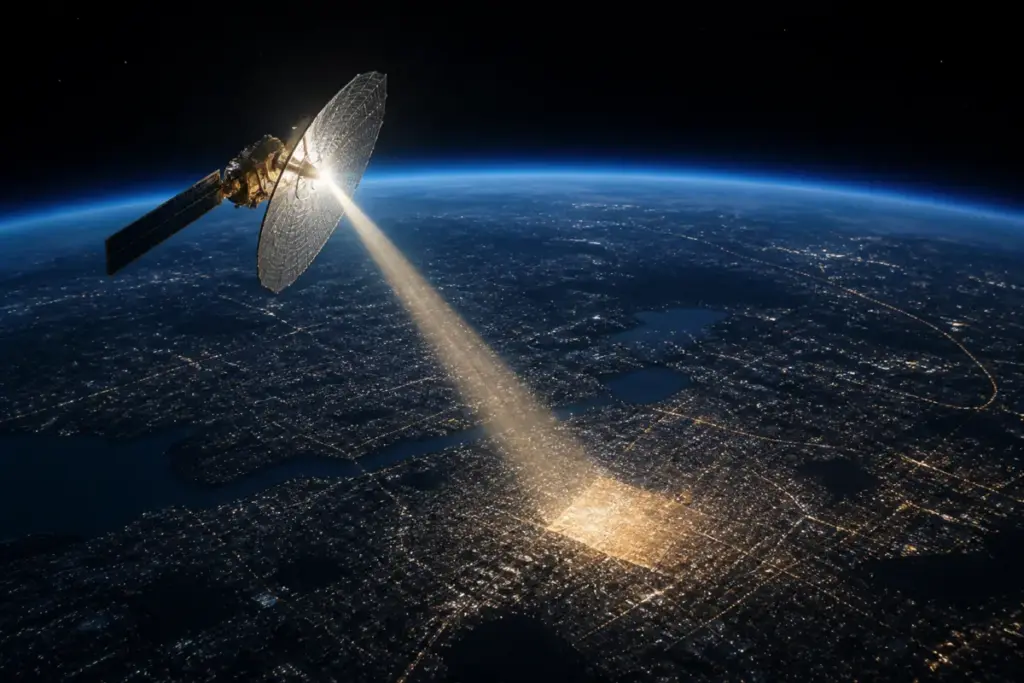
Hyderabad-based Skyroot Aerospace has signed a two-launch contract with US space technology startup Reflect Orbital to deploy orbital mirrors designed to reflect sunlight towards selected areas on Earth after sunset, bringing space-based illumination closer to a practical demonstration.
The proposed system would use mirrors placed in orbit to capture sunlight and redirect it towards the ground at night. Reflect Orbital’s concept is intended to provide adjustable illumination over an area of about five kilometres, according to the report. The technology could eventually be used for selected operations that require additional light after dark without relying solely on conventional lighting systems on the ground.
Skyroot is expected to conduct the launches using two vehicles from its Vikram rocket family. The first launch is planned with the Vikram-1 rocket, while the second is expected to use Vikram-1U, which is under development. The contract places the Hyderabad-based company in a role supporting the deployment of Reflect Orbital’s proposed demonstration satellites.
Potential applications mentioned for the system include search and rescue operations in disaster-hit areas and extending the period of sunlight available to solar farms. In principle, reflected sunlight could provide temporary illumination over a defined location, although the project remains an emerging technology and is not an established replacement for terrestrial lighting.
Reflect Orbital, a California-based startup, received approval from the US Federal Communications Commission in July to construct, launch and operate a demonstration satellite, according to the report. The approval provides a regulatory basis for the company’s planned demonstration, while the launch agreement identifies Skyroot as the launch provider for two missions.
The proposed technology also raises questions about how artificial night-time illumination from orbit could affect the night sky and the environments below. Astronomers may need to assess its impact on observations, while questions remain about possible effects on wildlife and people living beneath illuminated areas. These issues are particularly relevant because the system is designed to redirect sunlight beyond normal daylight hours rather than generate light through an Earth-based source.
For Hyderabad’s growing space sector, the agreement adds another example of a local aerospace company participating in an international commercial space project. Skyroot’s involvement would connect its launch capability with a technology that seeks to use orbital infrastructure for an application directly visible on the ground.
The immediate milestone is the planned demonstration missions, beginning with the launch involving Vikram-1 and followed by the proposed Vikram-1U mission. The technology’s practical usefulness will depend on whether the satellites can be deployed and operated as planned, and on how regulators and researchers evaluate their effects on the night environment.


