

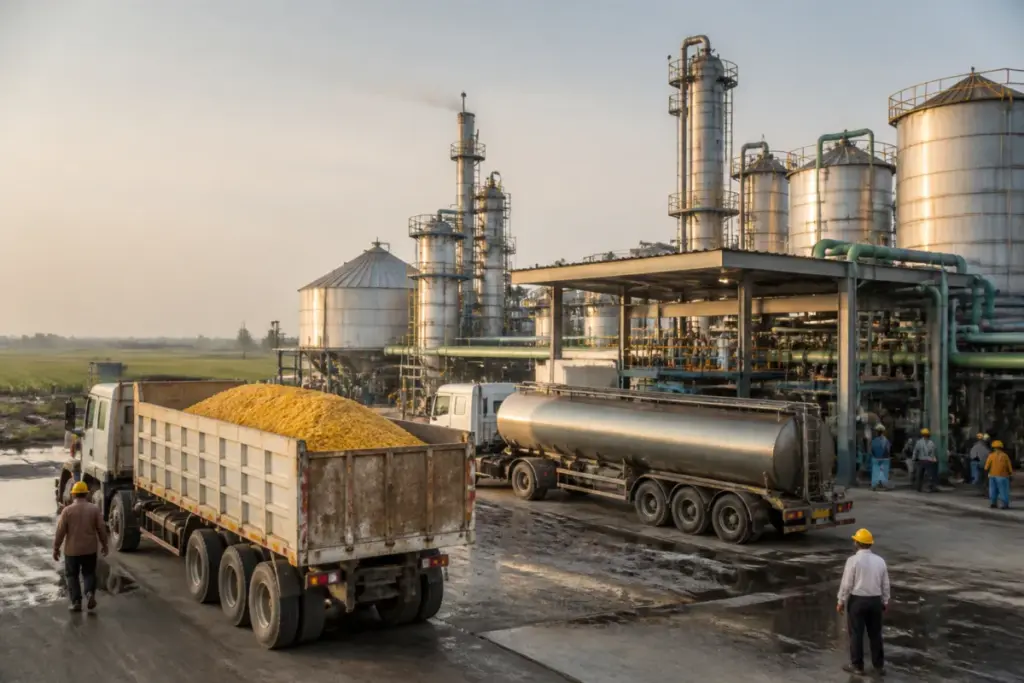
The government has directed oil marketing companies (OMCs) to stop seeking ethanol made from sugarcane juice, sugar, sugar syrup and B-Heavy molasses for the 2026-27 ethanol supply year, pushing procurement towards maize, C-Heavy molasses, damaged food grains, surplus rice and other permitted feedstocks.
The direction was disclosed in the OMCs’ quantity bid tender for the ethanol supply year running from November 2026 to October 2027. The tender states that sugar diversion for ethanol production is to be reduced to zero for ESY 2026-27. It therefore excludes offers based on sugarcane juice, sugar, sugar syrup and B-Heavy molasses.
The change comes amid expectations of lower sugar output and elevated domestic retail prices, according to the report by The Hindu BusinessLine. The tender separately identifies ethanol made from C-Heavy molasses, damaged food grains, surplus rice procured from the Food Corporation of India, maize and other feedstocks allowed under the National Policy on Biofuels, 2018.
The OMCs have floated a cumulative requirement of 1,100 crore litres for the supply year. Of this, 300 crore litres are to be supplied during the first two quarters—November 2026 to January 2027 and February 2027 to April 2027. The requirement for each of the final two quarters is 250 crore litres, covering May to July 2027 and August to October 2027.
Producers can also offer ethanol made from sugar beet, sweet sorghum and starch-containing materials such as cassava, rotten potatoes and agro-food or pulp-industry waste. The tender permits other feedstocks allowed under the national biofuels policy, subject to the stated procurement categories.
The procurement prices vary by feedstock. OMCs will pay ₹57.97 per litre for ethanol made from C-Heavy molasses, ₹64 per litre for ethanol from damaged food grains, ₹60.32 per litre for ethanol made from surplus rice procured from the Food Corporation of India and ₹66.07 per litre for maize-based ethanol. Maize-based ethanol will also receive an incentive of ₹2.79 per litre, excluding goods and services tax, over the basic rate.
The shift separates the government’s ethanol procurement from feedstocks more directly linked to sugar production. B-Heavy molasses and sugarcane juice have been used by the industry as ethanol sources, but their exclusion from the upcoming tender means producers will have to assess alternative raw materials and supply schedules for the full 12-month procurement cycle.
The tender’s feedstock-wise and quarter-wise structure also places the focus on matching supply with OMC requirements across the year. This makes availability of maize, damaged food grains, surplus rice and C-Heavy molasses central to the procurement process, while producers of alternative feedstocks such as sugar beet, sweet sorghum and agro-industrial waste gain eligibility within the stated categories.
Gross sugar output is expected to be 310 lakh tonnes during the sugar season 2025-26, which runs from October to September. Output in the current season is expected to be around 280 lakh tonnes. The industry has not yet issued its estimate for the 2026-27 sugar season, while the government is expected to publish its estimate next month.
The next official milestone will be the government’s estimate for the 2026-27 sugar season, alongside the OMC tender process for supplies beginning in November 2026.


