

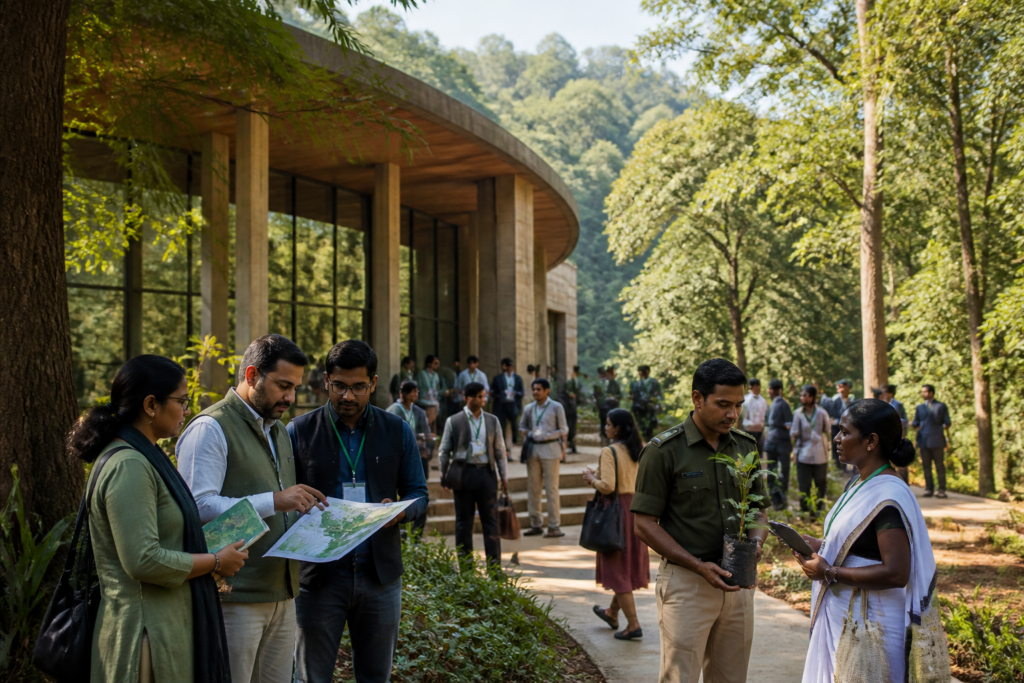
Jharkhand will host its first National Forestry Congress in Ranchi from December 10 to 12, bringing forest governance, biodiversity conservation, climate resilience and forest-dependent livelihoods into a national policy forum. Online registration for the event will open on October 17 and will be free for participants.
Principal chief conservator of forests Sanjeev Kumar unveiled the official brochure and conference website on Friday. The congress will be held at the SKIPA auditorium in Morabadi and will be hosted by Jharkhand’s forest, environment and climate change department under the guidance of the Indian Council of Forestry Research and Education.
The National Forestry Congress 2026 is expected to provide a platform for researchers, forest officials, practitioners and other participants to discuss how forests are managed amid pressures from climate change, biodiversity loss and landscape degradation. The organisers said the event would also address the livelihoods of communities that depend on forest resources.
The congress will cover 12 themes. These include forest genetics and tree improvement, biodiversity conservation, agroforestry, restoration of degraded and mining-affected landscapes, climate change and carbon forestry, GIS and remote sensing, forest governance, wildlife management and forest-based livelihoods.
The focus on mining-affected and degraded landscapes is particularly relevant to Jharkhand, where land restoration, forest management and community livelihoods are closely connected. The supplied event information, however, does not specify individual restoration projects, funding commitments or implementation decisions that may emerge from the discussions.
Participants will be able to register and submit papers through the conference portal at appforest.jharkhand.gov.in/nfc. The deadline for abstract submissions is November 20, while full papers must be submitted by November 30. Organisers have scheduled notifications on accepted abstracts for November 25.
The congress places forest and climate issues within the state’s wider administrative framework by bringing together the department responsible for forests, environment and climate change and the national forestry research and education institution guiding the event. Its outcome will depend on the issues raised, the evidence presented and whether the discussions lead to further official action, none of which has been announced in the supplied information.


