

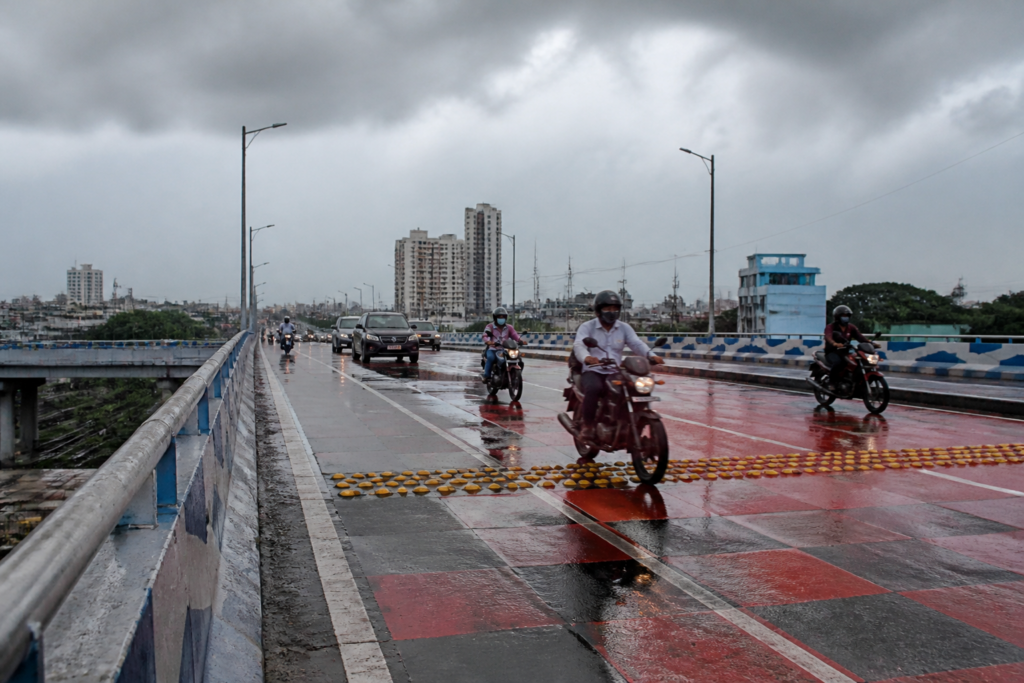
Kolkata’s anti-skid paint is under scrutiny after three motorcycles reportedly skidded on the Chingrighata flyover following rain, prompting an environmental technologist and transport expert to seek technical certification from the city police commissioner.
The accidents took place on Wednesday afternoon, 14 October, after rainfall. A dashcam video recorded by a person identified as Sayandeep Lahiri showed motorcycles losing balance on the flyover and was subsequently circulated on social media. The incident raised questions over whether the brightly coloured surface treatment applied during the city’s pre-festival beautification work had contributed to the skidding.
The Kolkata police commissioner had said that the paint used on the road was anti-skid. He also suggested that riders could have lost balance while attempting to make videos. The claim has now led Somendramohan Ghosh, described in the report as an environmental technologist and transport expert, to write to the commissioner seeking details from the paint manufacturers.
Ghosh has asked whether the material used on the asphalt was a thermoplastic paint suitable for roads and whether it was applied through a hot or cold process. He said manufacturers should provide written technical certification rather than allowing responsibility to be assigned on the basis of assumptions.
According to Ghosh, a matt-finish coating is generally less slippery than glossy enamel, but matt paint does not last well on asphalt. He said thermoplastic paint is therefore normally melted and applied at temperatures between 180 and 220 degrees Celsius. Such paint should last for at least four to five years and should not come off easily, he said. Ghosh also claimed that paint at the Gariahat flyover had begun coming off with limited pedestrian movement, and called for suppliers to explain the material’s quality even if the work had been approved by the relevant government department.
The administration began taking steps on Thursday after the controversy emerged. Yellow fibre blocks, functioning as speed breakers, were reportedly installed on the Chingrighata flyover to reduce the risk of further accidents. At the Gariahat flyover, municipal vehicles began removing the disputed rainbow-coloured surface treatment. Similar paint-removal work was also reported near Shahid Bhagat Singh More in Asansol.
The different responses at the two flyovers have raised questions about how authorities are assessing the road treatment and deciding whether it should be removed or retained. The report also said Trinamool Congress leader Kunal Ghosh criticised the government over the work and questioned who would be responsible for the accidents and the cost of applying and removing the paint.
Chief Minister Shubhendu Adhikari had rejected the theory that the paint caused the accidents, asking whether accidents occurred on other flyovers that had been painted. Urban Development Minister Agnimitra Pal denied that oil paint had been used on the roads and said anti-skid paint had been applied. She added that authorities were examining whether oil paint on the flyover walls could have contributed to the problem.
Pal also said the beautification work had not been funded by the government. According to her, several companies carried it out using funds from their corporate social responsibility allocations. The police commissioner’s response to the request for technical certification and the findings of the authorities’ examination remain the next steps in determining whether the road coating met the required safety and performance standards.


