

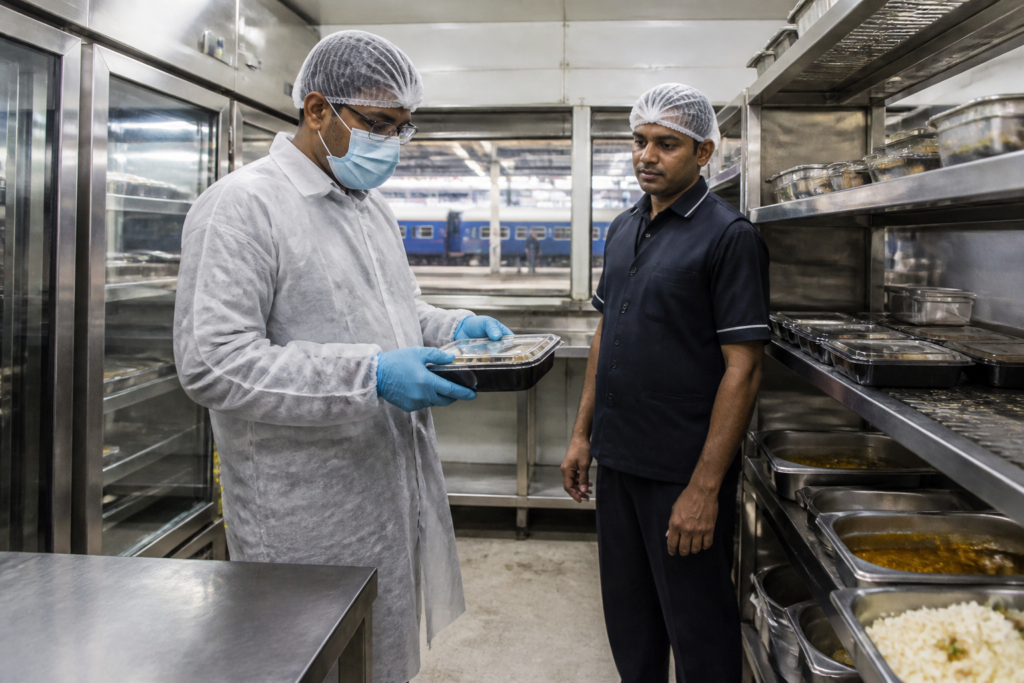
IRCTC has signed an agreement with the Quality Council of India (QCI) to conduct independent inspections of food quality, kitchen hygiene and catering compliance on trains and at railway stations, with inspection reports required within 24 hours. The move is intended to improve food safety and cleanliness for railway passengers.
Under the agreement, trained QCI experts will inspect onboard catering services and food units operating at stations. The inspections may be conducted without prior notice, adding an element of surprise to checks that will examine whether catering contractors are following food safety and hygiene requirements.
The inspection schedule will include checks every three months and six months, according to the report. Compliance with rules of the Food Safety and Standards Authority of India (FSSAI) will receive particular attention during the process.
The agreement also introduces a digital inspection process. Inspectors will use a mobile application to record the location and time of an inspection, along with photographs. The system is intended to make the process more transparent and reduce the possibility of irregularities in inspection records.
Inspection reports will have to be submitted within 24 hours. Where deficiencies are identified at a catering unit, the concerned contractor will be monitored for corrective action. The arrangement places emphasis not only on identifying lapses but also on tracking whether those lapses are addressed.
The inspections will cover the cleanliness of kitchens and food-storage areas, pest control and the maintenance of appropriate food temperatures. They will also examine whether raw vegetarian and non-vegetarian food items are stored separately, a requirement relevant to both food safety and kitchen management.
The condition and conduct of catering staff will form another part of the checks. Inspectors will review employees’ medical fitness, the use of required protective clothing and compliance with personal hygiene rules. These checks will apply to food operations serving passengers on trains as well as catering units located at stations.
For passengers, the agreement creates a faster reporting mechanism for food-related inspections, but the supplied report does not specify the number of catering units covered, the names of the contractors involved or the penalties that may follow repeated violations. It also does not provide details of inspection findings under the new arrangement.
The immediate operational milestone is the submission of inspection reports within 24 hours of each check. Further scrutiny will depend on how consistently surprise inspections are carried out, how deficiencies are recorded through the mobile application and whether contractors complete the required corrective measures.


