

The Pune cyber fraud case involving a 22-year-old software engineer has brought together three vulnerabilities that increasingly overlap in Indian cities: online impersonation, financial extortion and the isolation of young workers living away from home. According to a report by Times of India – Pune, the engineer died by suicide in Kharadi after an online contact allegedly posed as a Haryana police officer, threatened to implicate him in a fake drug case and repeatedly demanded money.
The case is being investigated by Kharadi police, who have registered allegations of abetment to suicide and criminal intimidation against the suspect. Police said the suspect and the engineer became acquainted while playing an online game. The suspect later claimed to be a police officer posted in Gurugram, according to the FIR details cited in the report. The allegations have not been tested in court, and the police investigation is continuing.
The significance of the case extends beyond the individual threat. It shows how a digital interaction can rapidly become a physical safety crisis when a young worker is geographically separated from family, dependent on a private phone connection and living in a paying guest accommodation in a fast-growing employment district. Kharadi and nearby parts of eastern Pune have developed around information technology and service-sector employment, bringing large numbers of young professionals into residential arrangements that may be temporary, informal or unfamiliar to their families.
That urban setting matters because the first response to a crisis is often shaped by distance. The engineer had moved to Pune in July after securing his first job at an IT company in Hadapsar, the report said. His family was based in Haridwar, Uttarakhand. When his phone remained switched off and a caller gave evasive answers, the family contacted a maternal uncle living in Moshi. The uncle went to the accommodation in Kharadi and found the room open, but the engineer was missing. Police then registered a missing-person complaint as a case of abduction, according to the report.
This sequence illustrates a basic administrative challenge in large cities: a family may recognise that something is wrong, but the person who can reach the affected individual is not necessarily a parent or employer. The urban system becomes dependent on relatives, accommodation managers, local police stations and emergency records working quickly across distance. In this case, the family’s first concern was locating the missing engineer. The suspected fraud came into clearer focus only after the family examined his laptop and found WhatsApp activity, screenshots of money transfers to different accounts and suspicious chats.
The alleged fraud also relied on institutional authority. The caller reportedly claimed to be a police officer and threatened arrest in a drug-related case. The FIR, as described by Times of India – Pune, said the caller first presented himself as the engineer’s friend and later demanded to speak to him after asking about his whereabouts. When the family became suspicious, the caller allegedly changed his identity and used the threat of criminal action to pressure the engineer.
Impersonation of police or other authorities is particularly effective because it turns fear of the state into a tool of private extortion. The alleged threat did not depend only on the demand for money. It also invoked arrest, criminal accusation and reputational harm. For a young employee in a new city, these threats can carry added weight because family members may not know the local police system, the employer’s support channels or the difference between a legitimate legal notice and an unsolicited call.
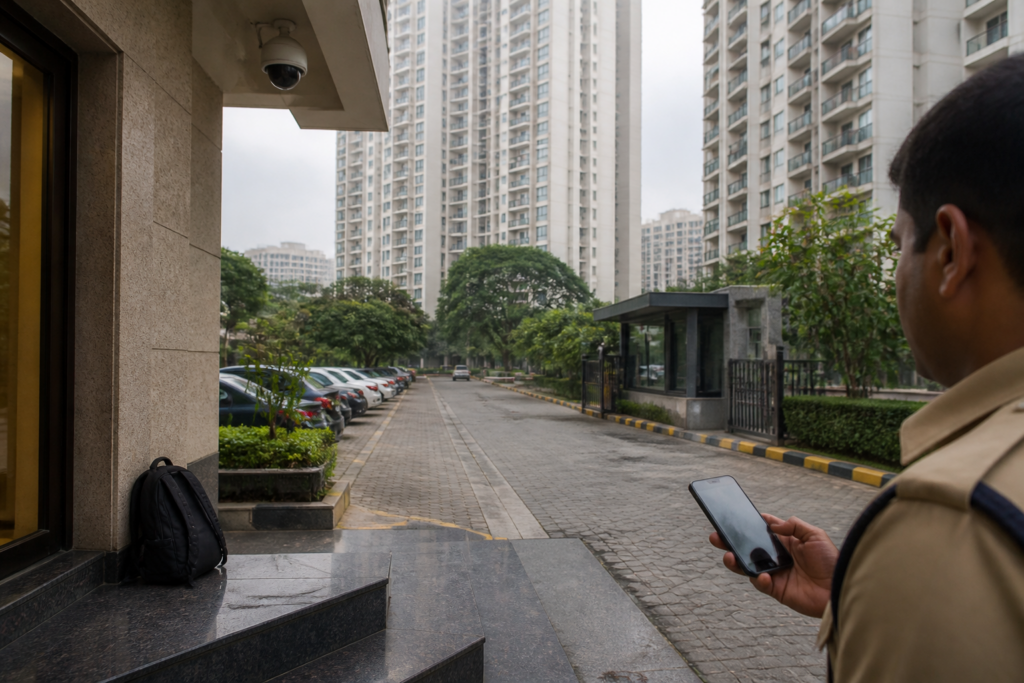
The police response described in the report shows that the case has both a physical and a digital investigation. Officers examined CCTV footage from the residential society and found the engineer walking inside the building. Investigators also examined chats and identified money transfers. Senior Inspector Sanjay Chavan said police had received details of the suspect’s mobile phone number and sent a team to Haryana to trace him. These steps indicate that the inquiry is not limited to the final incident; it is also examining the communications, accounts and identities allegedly used to pressure the victim.
The available account does not establish the complete chain of events or whether all the phone numbers and bank accounts were controlled by one person. On October 13, the father received another call from an unidentified person claiming to be from a courier office and asking about the engineer and a returned parcel. The father suspected that the accused may have used different numbers to seek information. That suspicion remains part of the investigation and should not be treated as a confirmed finding.
The case also exposes a weakness in how digital and urban safety are usually separated. Cyber fraud is often discussed as a financial crime, while the urban response to a missing person or a death is handled through local police and residential security systems. Here, the alleged pressure moved across both domains. The contact began online, the financial transfers were digital, the threats were made remotely, and the immediate search unfolded in a residential building in Pune.
For cities that attract large numbers of first-time workers, the gap between these systems can have serious consequences. A residential society may have CCTV footage, a paying guest facility may know when a tenant is absent, and a police station may receive a missing-person complaint. But these pieces of information become useful only when they are connected quickly. The report does not establish whether any system failed or whether earlier intervention could have changed the outcome. It does, however, show how a digitally initiated threat can become difficult for a distant family to interpret in real time.
The institutional responsibilities are divided. Police must investigate impersonation, intimidation, money transfers and the circumstances surrounding the death. Residential operators and housing societies hold access and surveillance information, although the supplied report does not describe their specific procedures. Employers may be among the few institutions that know when a new worker has suddenly stopped reporting, but the report does not say whether the engineer’s employer was contacted before the incident. Families, meanwhile, often remain the first source of information when a young migrant worker becomes unreachable.
Those divisions make attribution important. The case is based on a complaint by the engineer’s father, FIR details and statements from Kharadi police cited by the newspaper. The police have registered allegations, not secured a conviction. The suspect’s identity, the alleged use of multiple numbers and the full financial trail remain matters for investigators. The report also does not provide data on the number of similar incidents in Pune, the scale of so-called digital arrest or impersonation fraud in the city, or the effectiveness of existing cybercrime reporting systems. Those gaps prevent the case from being used as evidence of a citywide trend on its own.
What the incident does establish is a pattern of exposure. A new worker moved to Pune for employment, lived away from immediate family, formed an online acquaintance, received threats invoking police authority and transferred money, according to the police account. The family’s discovery of the chats and transaction screenshots after the death shows that crucial evidence may remain invisible to relatives until a crisis has already occurred.
The case therefore raises a structural question for Pune and other employment-driven cities: how should urban institutions respond when a private digital threat produces a public safety emergency? The answer cannot be inferred from this report alone. It requires examination of police procedures, cybercrime response channels, employer support systems, accommodation practices and the links between missing-person investigations and online financial crime.
For now, the confirmed institutional next step is the police investigation. Kharadi police have registered the case, examined CCTV footage and chats, reviewed money transfers and sent a team to Haryana to trace the suspect. The inquiry will determine the identity of the caller or callers, the financial trail and the circumstances surrounding the engineer’s death.


