

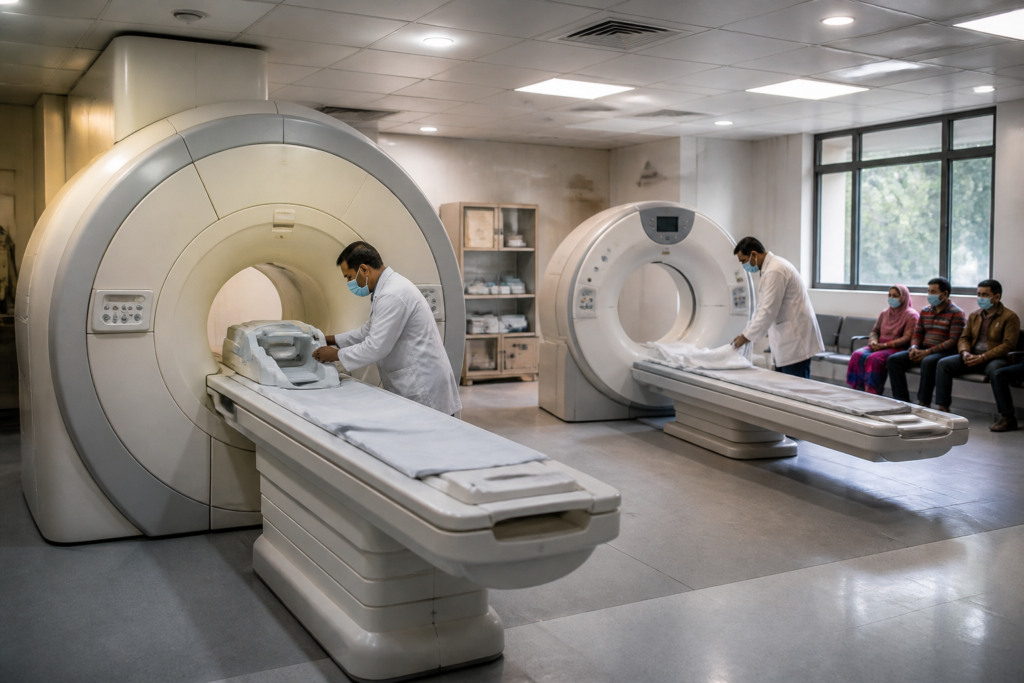
Lok Nayak Hospital in New Delhi has added a Dual Source 256-slice CT scanner and three advanced MRI machines, expanding diagnostic capacity at one of the capital’s major government-run hospitals. Chief Minister Rekha Gupta inaugurated the equipment on Thursday, with the machines provided by Indian Oil Corporation Limited under its corporate social responsibility initiative.
The new facilities are intended to improve the speed and accuracy of diagnosis across several medical specialities, including cardiology, oncology, neurology, urology, orthopaedics and paediatric care. They are expected to support the detection and assessment of conditions such as strokes, cancers, liver and prostate diseases, and musculoskeletal disorders.
Health Minister Pankaj Kumar Singh said the CT scan and MRI facilities would be available to patients free of cost. The announcement is significant for patients relying on public healthcare, particularly those visiting Lok Nayak Hospital from densely populated parts of Delhi and surrounding areas. Advanced imaging can be central to treatment decisions, but access is often shaped by the availability of machines and the ability to pay for diagnostic tests.
The Dual Source 256-slice CT scanner is designed for detailed imaging and can support investigations in areas including cardiac care and emergency diagnosis. The three MRI machines will add capacity for imaging that is used in neurological, orthopaedic, oncology and other clinical assessments. The hospital’s statement, as reported by Millennium Post, did not specify the machines’ individual capacities, operating schedules or the number of additional scans expected each day.
Gupta said her government was committed to ensuring that citizens were not denied quality healthcare because of financial constraints or other difficulties. The equipment was supplied through IOCL’s corporate social responsibility programme, creating a public hospital expansion funded through an institutional partnership rather than a direct capital allocation identified in the report.
The inauguration was also used to highlight other facilities introduced at Lok Nayak Hospital. These include a Lactation Management Unit functioning as a milk bank, a nucleic acid testing machine for HIV and hepatitis screening, and a dedicated ward for patients with rare diseases.
Gupta also referred to the Anmol Yojana, under which newborns are screened for potential genetic disorders. The stated purpose of the programme is to enable early detection and timely treatment. Together, the initiatives cover diagnostic imaging, infectious disease testing, neonatal screening, maternal support and specialised care within the public hospital system.
The immediate implementation question for patients will be how the new CT and MRI capacity is integrated into hospital referrals, appointments and emergency services. The report confirms that the facilities are to be provided free of cost, but does not provide details on eligibility procedures, waiting times or the date on which routine bookings will begin. Those operational details will determine how quickly the additional equipment translates into usable diagnostic access for patients.


