

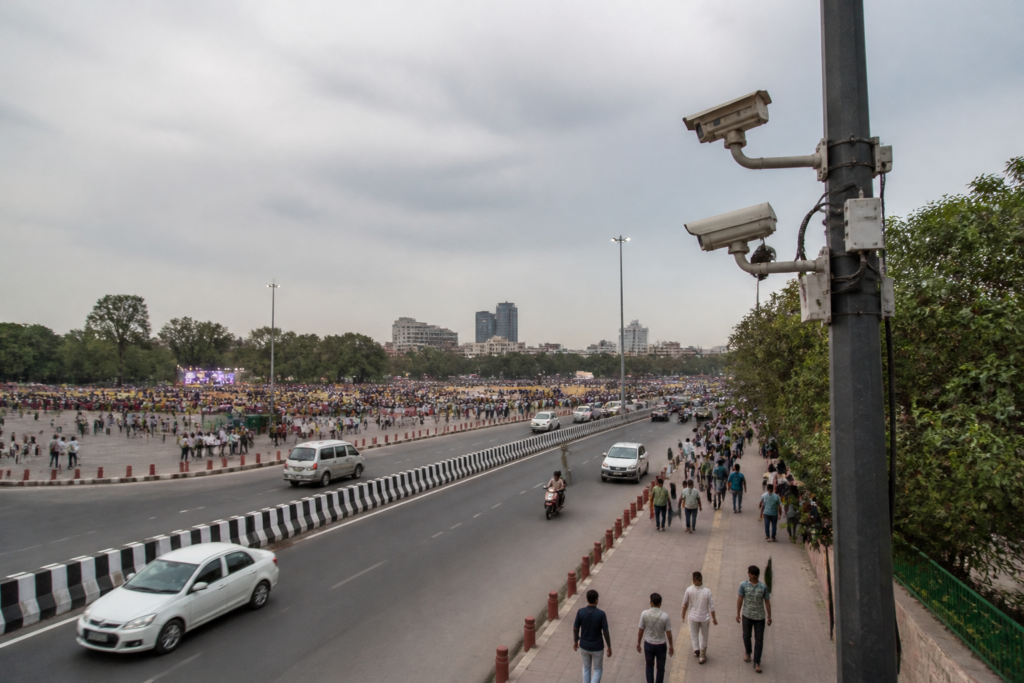
Delhi’s latest surveillance infrastructure tender places a question about public-space governance alongside a major technology procurement. A ₹15.66-crore Delhi Police tender issued in July covers 338 cameras across central and New Delhi districts, including facial recognition capability, while Ramlila Maidan was later designated as one of three new protest venues after Jantar Mantar was denotified. The available evidence does not establish that the two decisions were connected. It does, however, show how security infrastructure and civic spaces are being planned within the same urban geography.
The tender, posted on the Government e Marketplace on July 30, was issued nearly two and a half months before Delhi Police denotified Jantar Mantar as a protest site and designated Ramlila Maidan, Burari Ground in north Delhi and CBD Ground in east Delhi as new protest venues. The document covers locations that include the VVIP gate of Ramlila Maidan, Turkman Gate, Delhi Gate, Raj Ghat, the India Gate C-Hexagon, Mandi House and Patiala House.
The Internet Freedom Foundation, a digital rights organisation, flagged the issue in a report. The Hindu said it independently verified the details. The organisation also said it could not establish whether the tender and the subsequent designation of Ramlila Maidan as a protest venue were connected. That limitation is central to understanding the story: the documents establish the scope and technical requirements of the proposed surveillance system, but they do not establish the institutional reasoning behind the selection of the protest sites.
The procurement illustrates the scale and variety of the planned system. The 76-page request for proposal specifies 248 fixed cameras, 43 pan-tilt-zoom cameras and 47 automatic number plate recognition cameras. Of the total, 188 cameras are to be installed in central Delhi and 150 in New Delhi district. The tender says the cameras will cover VIP and VVIP routes and locations used for Republic Day and Independence Day celebrations.
The system is also intended to connect with existing Delhi Police CCTV networks, including the Safe City Project. The successful bidder must provide a minimum of 30 days of CCTV footage storage. This means the tender is not simply for isolated cameras at individual junctions or gates. It describes an expansion that is designed to operate alongside an existing police surveillance network, although the supplied material does not specify how data from the different systems will be governed, accessed or audited.
The facial recognition requirement adds another layer to the procurement. The tender requires facial recognition system features on 10% of the CCTV cameras, excluding the automatic number plate recognition cameras. Yet it does not specify the exact number of cameras that will receive the facial recognition capability. On the tender’s stated numbers, 10% of the 291 fixed and pan-tilt-zoom cameras would amount to roughly 29 cameras, but the document, as described in the report, does not identify the final deployment count or the sites where the technology would operate. The exact number therefore remains unclear from the supplied material.
This distinction matters because fixed cameras, pan-tilt-zoom cameras, number plate recognition and facial recognition perform different surveillance functions. A fixed camera provides a continuous view of a defined area. A pan-tilt-zoom camera can be directed across a wider field. Automatic number plate recognition focuses on vehicles, while facial recognition introduces the possibility of identifying people through images captured in public spaces. The tender groups these capabilities within one integrated procurement, but the material available here does not explain the operating protocols for each system.
The locations listed in the tender also show that the planned network is closely associated with Delhi’s ceremonial, administrative and high-security landscape. Republic Day and Independence Day routes, Raj Ghat, India Gate, Mandi House, Patiala House and the gates of a major public ground represent different kinds of urban spaces. Some are used for national events, some connect major roads and institutions, and others host public gatherings. Treating them within a single surveillance plan may improve coordination for police operations, but it also brings very different public uses within the reach of a common technical system.
Ramlila Maidan is particularly significant because it is both a large public gathering space and one of the venues designated for protests after the change at Jantar Mantar. The tender’s inclusion of its VVIP gate predates that designation, according to the timeline reported by The Hindu. That chronology does not prove that surveillance planning shaped the decision about protest venues. It does show that a location later identified for public assembly was already part of a security-oriented camera procurement covering central Delhi and New Delhi.
The institutional issue is therefore not only whether cameras are installed. It is also how urban authorities define the purpose of a surveillance network when the same spaces serve security, ceremonial, civic and democratic functions. The tender specifies equipment quantities, camera types, integration requirements and storage duration. The supplied report does not provide comparable detail about public notice, access controls, retention beyond the minimum 30-day requirement, independent oversight, safeguards for facial recognition or procedures for challenging an identification.
Those omissions cannot be treated as evidence that safeguards do not exist. They do indicate that the procurement document, as described in the report, primarily communicates an operational and technical brief. It is less clear from the available material how the system’s effect on people using these spaces will be assessed. That gap becomes more consequential when surveillance infrastructure covers protest venues, routes used for public events and locations that attract large gatherings.
The tender also demonstrates how Delhi’s surveillance capacity is being developed through network integration rather than only through new equipment. By requiring compatibility with other Delhi Police CCTV networks, including the Safe City Project, the procurement links new cameras to an existing institutional system. The result is potentially a more connected security architecture, although the article does not establish how many cameras are currently operational in the connected networks or how the combined system is administered.
The available numbers establish a substantial deployment: 338 cameras, divided between 188 installations in central Delhi and 150 in New Delhi district. They also establish a minimum storage period of 30 days and a facial recognition requirement for 10% of eligible cameras. What they do not establish is the final installation date, the identity of the successful bidder, the precise locations of every camera, the final number equipped with facial recognition or whether the tender has since been executed.
That distinction between planned capacity and operational capacity is important in public infrastructure reporting. A tender records what a department seeks to procure, not necessarily what has been installed or how it is being used. Until implementation details are available, the document can show the direction and scale of Delhi Police’s surveillance planning but cannot by itself establish the system’s actual reach on the ground.
The broader urban question is how public authorities will account for technologies that operate across spaces with different civic purposes. A camera placed on a VVIP route may be justified through event security; the same network may also observe commuters, visitors, vendors or protesters using nearby public areas. Facial recognition and number plate recognition create additional forms of data capture, but the supplied material does not clarify the conditions under which those tools will be activated or the circumstances in which information will be retained or shared.
The record currently supports three conclusions. Delhi Police planned a ₹15.66-crore, 338-camera procurement across central and New Delhi districts; the tender included integration with existing CCTV networks, at least 30 days of storage and facial recognition features on 10% of eligible cameras; and Ramlila Maidan was among the locations covered before it was later designated as a protest venue. The record does not establish a connection between the tender and the protest-site decision. Further scrutiny will depend on the tender’s implementation status, the final camera locations, the operation of the facial recognition system and the governance rules applied to the resulting data.


