

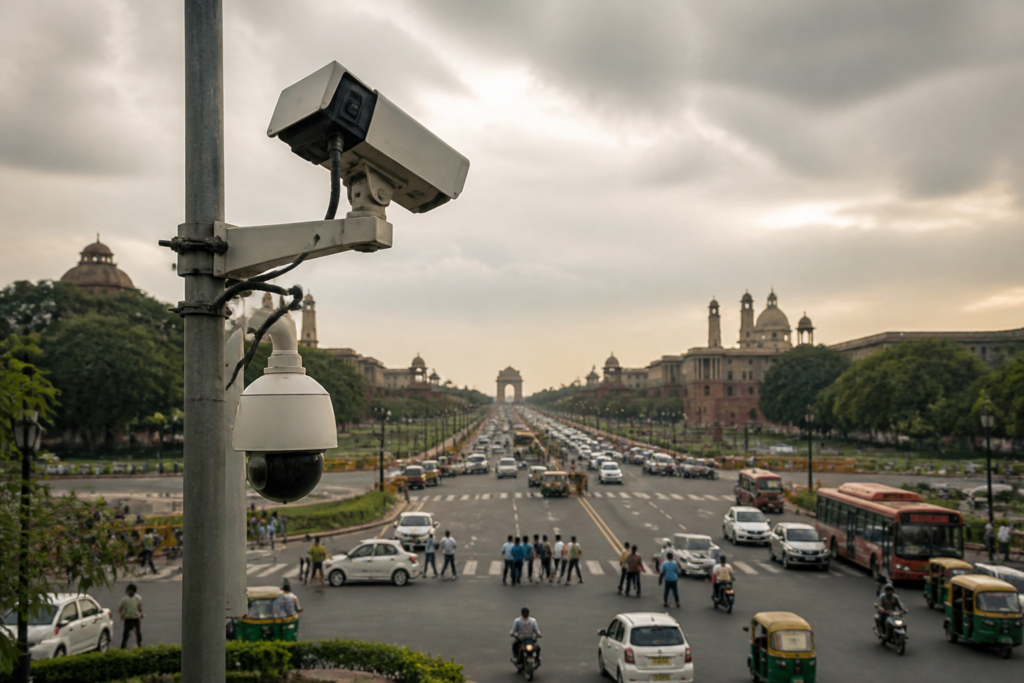
Delhi facial recognition cameras planned for Central and New Delhi have brought a larger governance problem into view: the city is expanding permanent surveillance infrastructure while key rules for privacy, accuracy, data retention and accountability remain unclear. The Rs 15.7-crore Delhi Police tender covers 338 CCTV cameras, including facial recognition-enabled equipment, automatic number plate recognition systems and a five-year technology and maintenance contract.
The tender has attracted attention because several proposed sites are associated with public gatherings, high-security movement and civic landmarks. They include Ramlila Maidan’s VVIP gate, Turkman Gate, Delhi Gate, Rajghat, India Gate’s C-Hexagon, Mandi House and Patiala House courts. The police have said the project was part of a modernisation plan conceived about two years ago and was not connected to protests held in July. The Internet Freedom Foundation, however, has used the timing and location of the tender to raise questions about how public surveillance is planned and governed.
The central issue is not simply whether Delhi should use cameras. Police forces already deploy CCTV systems for security and traffic management, and the report says Delhi Police previously hired cameras on rent for security arrangements along VVIP routes. The institutional shift in this proposal is from temporary or rented equipment to a permanent network with facial recognition, number plate tracking, video management software and long-term storage. That shift increases the importance of rules governing who can be monitored, what counts as a match, how errors are handled and when data must be deleted.
According to the report, Delhi Police sources said the proposal was first conceptualised two years ago. A detailed project report was prepared after approval was sought from the ministry concerned, while the proposal to install permanent cameras under the ASUMP modernisation scheme was considered in March 2025 and approved in September 2025. The police source said the tender process was underway and that a work order had been issued. A senior officer separately said both tender processes remained underway, creating an apparent difference in the description of the procurement’s status.
The current plan consists of two related bids. An e-bid for 194 cameras was invited on May 22 for VVIP routes in North district. The tender provided for facial recognition in 10% of fixed and pan-tilt-zoom cameras. A second bid for 338 cameras in New Delhi and Central districts was issued on July 30. The officer cited in the report said installation was expected to begin in December 2026 or January 2027.
The 338-camera tender reportedly includes 248 fixed cameras, 43 PTZ cameras and 47 ANPR cameras. The five-year contract also covers video management software, storage and associated systems. This makes the procurement more than a purchase of individual cameras. It is a bundled surveillance system involving equipment, software, databases, monitoring processes and the continued retention and use of recorded information.
That system-wide character is where the IFF analysis finds its largest gaps. The report said the tender contains no facial recognition standard operating procedure, privacy impact assessment, details of the database against which faces would be matched, accuracy thresholds or safeguards against false matches. These are not minor technical omissions. They determine how the system operates in public places and what happens when the technology produces an incorrect identification.
The absence of an accuracy threshold is particularly important because facial recognition does not produce a self-explanatory fact. A camera captures an image, software compares it with a database and the system generates a possible match. The operational decision—whether to stop, question or investigate a person—belongs to police personnel. Without a stated threshold, review process or requirement for human confirmation, the tender does not establish how a possible match should be treated before it becomes an enforcement action.
The data-retention provisions also appear incomplete. The report said the tender specifies 30-day storage for video but does not set out retention rules for facial templates, match logs or number plate data. These categories of information are different from ordinary video. A face template or match record can remain useful for future identification even after the original footage is deleted, while ANPR records can create a movement trail tied to vehicles and locations. The absence of separate retention rules leaves the life cycle of this information unclear in the supplied tender analysis.
The procurement’s location choices have added a public-space dimension to the debate. The IFF report noted that the proposed surveillance sites include Ramlila Maidan, a designated location for public events, as well as roads and landmarks around central Delhi. The report said the bid was uploaded on the Government e-Marketplace five days after protests at Jantar Mantar over the NEET paper leak ended. Delhi Police later de-notified Jantar Mantar as a designated protest site and named Ramlila Maidan, Burari Ground and CBD Ground in Shahdara as alternatives.
The IFF analysis stated that it found no evidence that the decisions on protest locations and the surveillance tender were coordinated. At the same time, it argued that the ground selected for protests was also among the places the police had already chosen to monitor with facial recognition. That distinction matters. It does not establish a coordinated policy, but it does show why surveillance deployments in civic spaces require transparent explanations about purpose, scope and safeguards.
The police position, as reported, is that the tender predates the July protests and forms part of a broader modernisation initiative also being implemented in other states. The police source said the project followed a planning process involving approval and a detailed project report. The report therefore presents two separate questions: when the project began, and whether its design provides adequate protections for people who are recorded or flagged by the system.
The procurement analysis also identified 28 alleged tender defects. These included mismatched counts for PTZ and ANPR cameras, specifications apparently copied from an earlier tender, outdated details concerning independent monitors and incorrect coordinates that placed one camera about 40 kilometres east of Delhi. Such discrepancies do not by themselves prove that the surveillance system would fail, but they raise questions about the quality-control process behind a complex public technology contract.
For municipal and policing institutions, the camera count is only the visible part of the infrastructure. The 338 cameras must be connected to a video management platform, storage architecture and operating procedures. The system will also rely on decisions about database access, software configuration, vendor responsibilities and police oversight. A tender that specifies hardware but leaves operational safeguards undefined can make accountability difficult to trace once the network becomes active.
The report also mentions vehicle-mounted jammers used by the Delhi Police security unit during VIP movements. That detail places the camera project within a larger security architecture that already includes specialised equipment for protecting routes and public figures. The proposed permanent network would add a fixed layer of observation across central districts, potentially changing how public spaces are monitored even when no VIP movement or specific security event is taking place.
The timing of implementation gives authorities an opportunity to clarify these questions before cameras are installed. The reported installation window is December 2026 or January 2027, while the tender process is described as ongoing. The relevant documents, as summarised in the report, do not establish a facial recognition SOP, a privacy impact assessment, database specifications, accuracy thresholds or retention periods for facial templates, match logs and number plate data.
The larger urban question is how Delhi’s security infrastructure can expand without leaving governance to be written after deployment. Public cameras are installed in streets, markets, protest venues, transport corridors and civic landmarks, where people cannot realistically opt out of being recorded. Facial recognition and ANPR systems add an identification and tracking capability that ordinary video surveillance does not necessarily have. That difference requires the public authority to define purpose, limits and review mechanisms in advance.
The supplied report confirms that Delhi Police is pursuing a substantial, multi-year surveillance procurement and that the tender has been criticised for both documentation defects and missing safeguards. It also confirms that police officials attribute the project to a pre-existing modernisation plan rather than the July protests. What remains unclear is how the proposed system would regulate facial matches, protect against false identification, manage databases and delete derived data. Those details, along with the final procurement status and implementation documents, are the next milestones to watch before the network becomes operational.


