

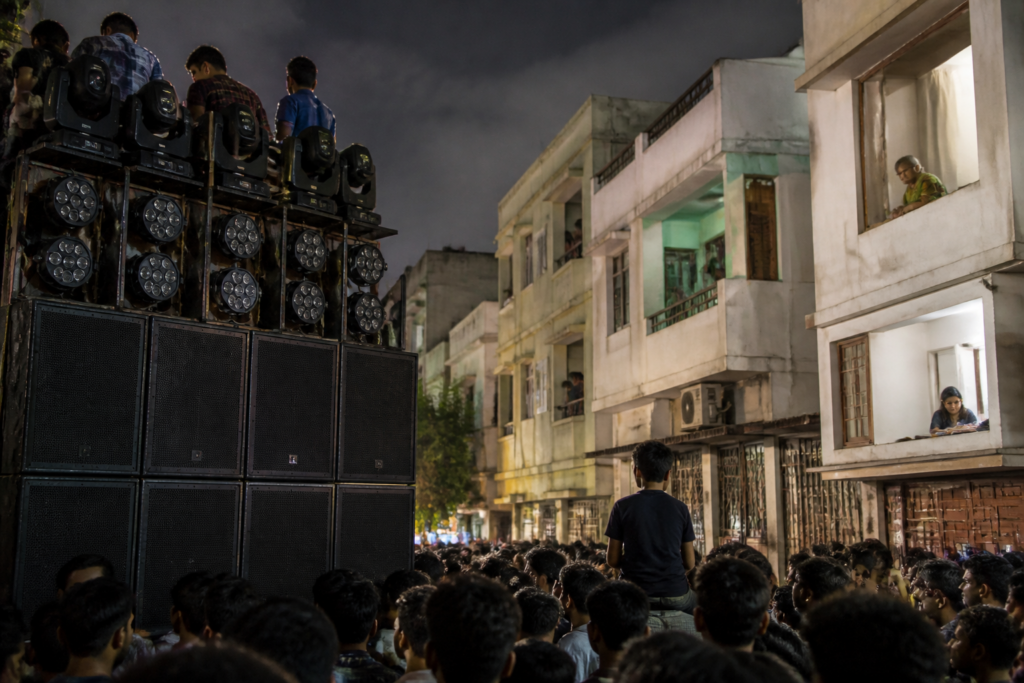
The debate over loud DJ systems and amplified loudspeakers in Bhopal is usually framed as a question of public nuisance. Doctors quoted in a recent report, however, describe a wider urban health problem: excessive noise can disrupt sleep, worsen anxiety and existing mental health conditions, damage hearing and place repeated stress on the cardiovascular system. The issue is not only how loud a celebration is, but how the city recognises, measures and responds to noise that enters homes, hospitals, classrooms and public spaces.
A 2025 study on environmental noise pollution in Bhopal, published in the Journal of the Metrology Society of India, assessed noise levels in different parts of the city. The study did not specifically examine amplified DJ music, but it found that noise levels at the surveyed sites exceeded permissible limits. That distinction is important. The available evidence does not establish that every health effect reported by doctors was caused by DJ systems in Bhopal, nor does it provide a city-wide measurement of amplified music. It does, however, show that excessive noise is already a documented environmental condition in the city and that amplified sound operates within that wider problem.
The institutional gap begins with the way noise is classified. A loudspeaker used at an odd hour may be treated as a temporary disturbance requiring a local response. The health consequences described by doctors suggest that the same event should also be understood through the public-health system. District civil surgeon Dr Sanjay Jain said excessive noise poses a risk of hearing loss and that noise played at odd hours disrupts sleep and adversely affects overall health. His comments connect the immediate experience of disturbance with longer-term effects that are less visible and harder to report.
Sleep is a key part of that connection. When noise interrupts rest, the impact is not limited to the period during which a loudspeaker is operating. Repeated disruption can affect daily functioning, concentration and emotional well-being. The supplied report does not quantify the number of residents affected or measure the duration of sleep loss in Bhopal. But it identifies the basic administrative problem: an event may end within hours while its effects are experienced by residents who must work, study, care for others or manage existing health conditions the following day.
The burden is also unevenly distributed. Dr Samiksha Sahu, assistant professor in the psychiatry department at Gandhi Medical College, said excessive noise affects people across age groups, particularly children, people with autism and elderly residents. She associated prolonged exposure with irritability and anxiety and said it could aggravate existing mental health conditions, including depression. For people with post-traumatic stress disorder, she said loud music and firecrackers can trigger flashbacks and heightened startle responses.
This makes noise governance a question of urban vulnerability. Residents do not experience the city with the same capacity to absorb disturbance. A healthy adult may be able to tolerate a short period of loud music more easily than a child, an elderly person, a student preparing for examinations or someone living with autism or PTSD. Dr Sahu also identified noise-triggered migraines and difficulty concentrating as concerns. These effects are difficult to capture through conventional enforcement because they are often private, intermittent and not immediately visible to authorities.
The built environment can intensify the problem. Sound travels through dense neighbourhoods, reaches adjoining buildings and can enter homes even when the source is some distance away. The report does not provide acoustic maps or identify particular Bhopal neighbourhoods where exposure is highest. It also does not establish whether noise levels differ systematically between residential, commercial or event areas. Those gaps matter because enforcement without location-specific measurement can become reactive: officials may respond to individual complaints without building a picture of recurring exposure.
The cardiovascular explanation supplied by cardiologist Dr GC Gautam adds another layer. He said prolonged noise exposure can activate the body’s stress response, releasing hormones that raise heart rate and blood pressure. Repeated exposure, he added, can keep the body under stress and increase strain on the heart and blood vessels, potentially raising the risk of cardiovascular problems over time. The wording is appropriately cautious: it describes a potential risk associated with prolonged exposure, not a direct diagnosis for every person exposed to loud music.
That distinction is essential for responsible urban health reporting. The Bhopal study cited in the report establishes that surveyed sites exceeded permissible noise limits, while the doctors explain possible health pathways associated with excessive or prolonged exposure. The available material does not establish a direct causal study linking Bhopal’s DJ events to a measured increase in heart disease, hypertension or psychiatric illness. It also does not state the exact sound levels, exposure durations or number of sites covered by the 2025 study. What it does show is a chain of concern that warrants better measurement: excessive environmental noise, identifiable vulnerable groups and plausible health effects documented by medical professionals.
Hearing damage is the most direct physical risk discussed in the report. ENT specialist Dr SP Dubey said high-volume amplified music can cause tinnitus, a persistent ringing or buzzing in the ears, as well as temporary or permanent hearing damage. He said the risk depends on the sound level reaching the ears and on the duration and frequency of exposure. This shifts attention from the presence of a DJ system to the conditions under which it is used. A short event at a controlled level and a repeated high-volume event at close range do not represent the same exposure.
For city authorities, that means enforcement cannot depend only on whether a loudspeaker exists or whether a complaint has been received. It must also consider timing, measured sound levels, duration, location and the sensitivity of the surrounding area. The supplied report does not specify which agency is responsible for individual enforcement actions in Bhopal, how complaints are recorded or how often violations are prosecuted. Those institutional details remain important gaps in understanding the city’s response.
The legal framework gives the issue a wider constitutional dimension. The report notes that the Supreme Court has recognised excessive noise as a threat to the right to life under Article 21, while Article 48A directs the State to protect the environment. In that framework, noise is not simply a private disagreement between event organisers and residents. It is an environmental condition with implications for health, dignity and the ability to use one’s home and neighbourhood without avoidable harm.
Yet recognition in law does not automatically produce effective implementation. The report identifies a risk-recognition gap in which authorities may fail to treat excessive noise as a public-health issue despite evidence of harm. That gap can lead to fragmented responses. Police or local officials may handle complaints as law-and-order matters, health departments may see the consequences only after symptoms appear, and environmental authorities may focus on measurement rather than the lived experience of repeated disturbance. Without coordination, responsibility can move between institutions while the source of noise continues operating.
The Bhopal evidence also highlights the limits of one-time assessments. The 2025 study found exceedances at surveyed sites, but the supplied report does not indicate whether monitoring was continuous, seasonal or tied to particular events. It does not reveal whether readings were taken during daytime or night-time periods, or whether the city has a public database of noise complaints and enforcement actions. These are not minor technicalities. Noise is variable, and an isolated reading may fail to capture repeated exposure during festivals, processions, weddings or late-night events.
A stronger urban response would therefore depend on making the problem legible. Authorities would need reliable measurements, consistent records of complaints, clarity about enforcement responsibilities and a way to identify locations where vulnerable populations are exposed. The source material does not confirm that such a system currently exists in Bhopal, so its absence should not be assumed. But the lack of these details in the available evidence makes it difficult to assess whether the city is managing noise as a recurring environmental risk or responding only to individual incidents.
The central question is consequently not whether celebrations or public events should use music. It is whether the city can balance those activities with the right of residents to sleep, study, recover and live without excessive exposure. The medical concerns described by Bhopal specialists make that balance more than a matter of personal preference. They point to a governance challenge involving environmental monitoring, public health, vulnerable residents and the practical enforcement of existing protections.
What the available evidence confirms is limited but significant: noise levels at sites surveyed in Bhopal in 2025 exceeded permissible limits; doctors in the city warn that excessive and prolonged noise can affect hearing, sleep, mental health and cardiovascular stress; and the legal framework treats excessive noise as an issue connected to life and environmental protection. What remains unclear is the scale of exposure from DJ systems specifically, the city’s enforcement record and whether vulnerable groups are being systematically protected. Those are the facts that future monitoring and public reporting will need to establish.


